


For millennia, transforming food was a matter of survival. Salting meat for the winter, fermenting milk to prevent it from spoiling, cooking to aid digestion. The logic was simple: starting from a raw ingredient and applying a few basic steps. In this way, the final product remained identifiable.
Today, walking through supermarket aisles, the contrast is striking. Artificial colors, standardized shapes, long ingredient lists… The simple gestures of the past have given way to complex industrial processes that are impossible to reproduce at home. As a result, ultra-processed foods now represent between 60% and 70% of the food supply in many countries. Some populations are exposed to them in a particularly concerning way, especially younger people. In the United States and the United Kingdom, ultra-processed foods account for more than 60% of the calories consumed by children and adolescents1-3. In France, Canada, or Australia, this figure is around 50%. Even in Italy or Brazil, where exposure is lower, it exceeds 25%4.
How did we get here? What are the health consequences? How can we learn to identify ultra-processed foods in order to limit their presence in our diet?
The birth of industrial food
In 1810, Napoleon was looking for a way to preserve food to feed his troops. A Frenchman, Nicolas Appert, invented a simple process: heating food in sealed containers. This is how modern canning was born! For the first time, food processing became standardized. Fruits and vegetables, fish, and meat could be transported over long distances and stored for long periods5-7.
With the second industrial revolution, working days became longer. Food then had to adapt to these new rhythms: produce more, faster, and be able to store longer. It was in this context that, at the end of the 19th century, these food processing and preservation techniques gradually spread among the civilian population.
It was during this period that brands still omnipresent today were born. Nestlé was founded in 1866 with a milk and wheat formula intended for infants who could not be breastfed8. Maggi was founded in 1885 with the first instant soup designed to quickly and cheaply feed a working-class population with little time and limited means9. The following year, Coca-Cola appeared, initially as a syrup sold as a tonic to help endure work10. Campbell became famous in 1897 with its ready-made canned soups, ideal for urban life and factory work11. Processing was no longer only about preserving: it made it possible to feed increasingly large urban populations, with foods that were easy to distribute and cheaper to produce.
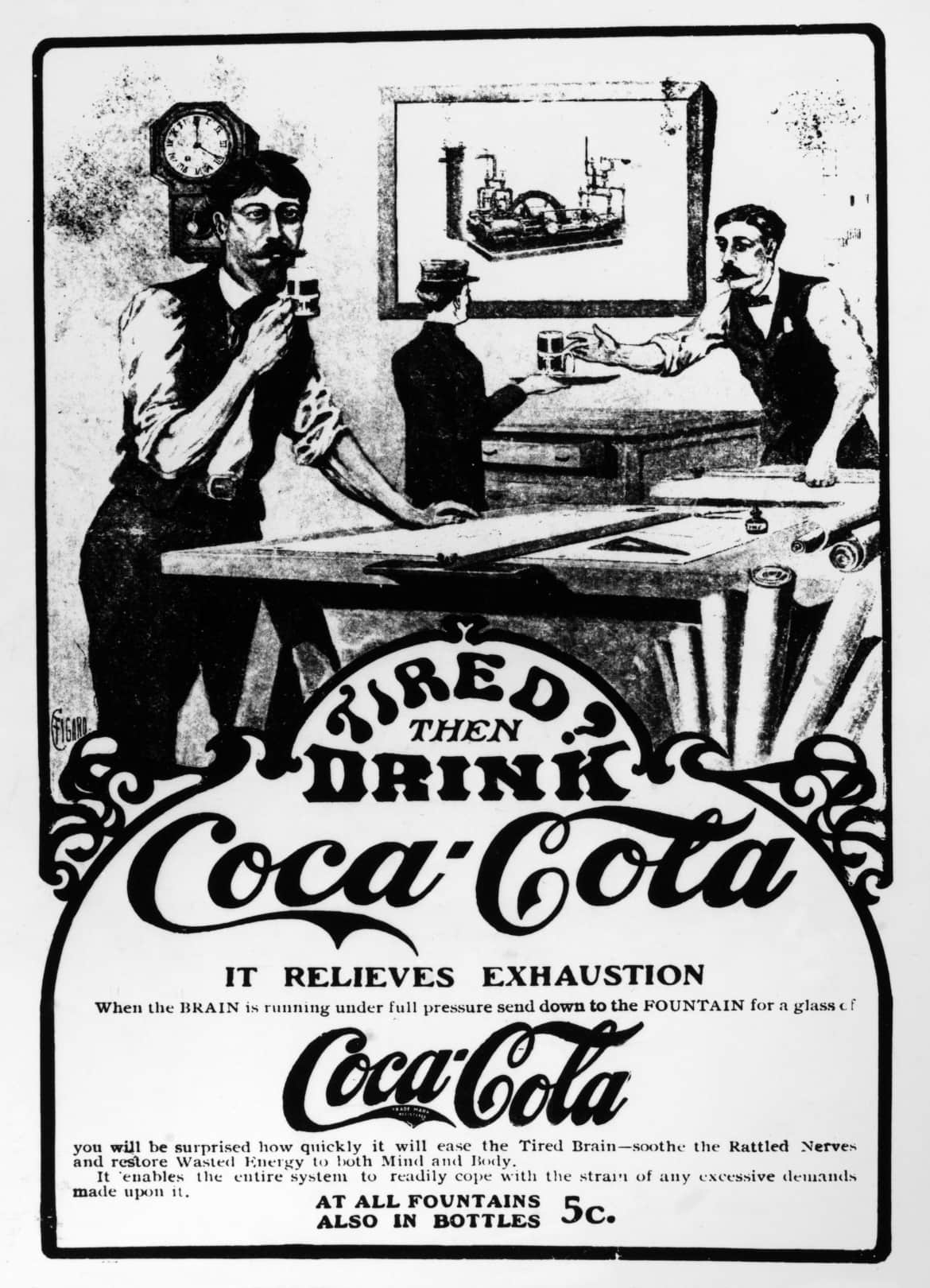
© GRANGER Historical Picture Archive / Alamy Stock Photo
It was also during this period that the industry began to use synthetic substances. Certain dyes, notably derived from coal and sometimes highly toxic, were used to improve the appearance of products and mask their poor quality. These practices quickly led to widespread misuse, to the point that the United States adopted the Food and Drugs Act in 1906, one of the first laws regulating the use of food additives, in order to control the use of these dyes12.
The two world wars further accelerated this movement. Millions of soldiers had to be fed with products that were easy to transport, stable, and ready to consume. Powdered milk, dehydrated soups, canned goods, and packaged rations became widespread13,14.
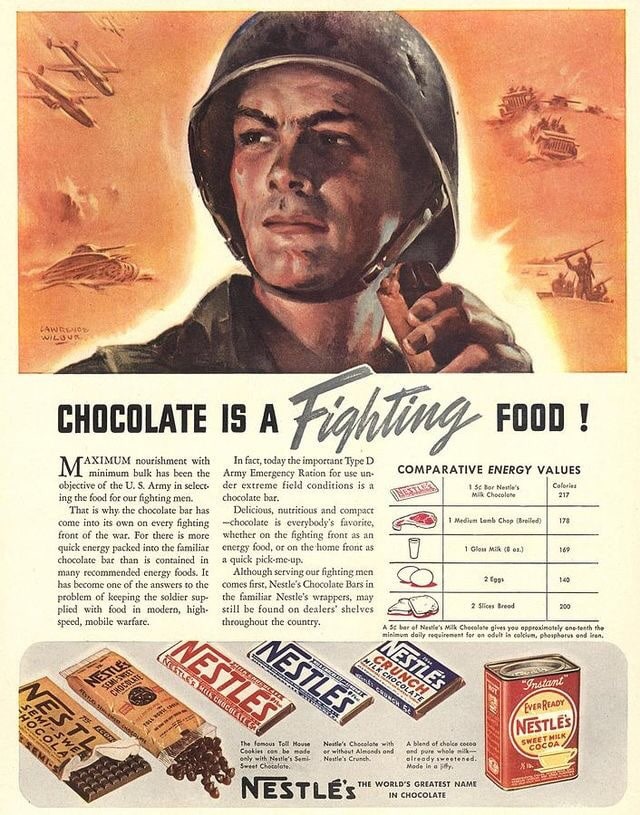
© Lawrence Wilbur, 1942 / Life magazine
At the end of the conflicts, these innovations did not disappear. The factories and processes were already in place. So, in order to find new outlets for these products, the industry turned toward the civilian market. Products designed for the military then entered households and gradually transformed everyday eating habits15.
The rise of ready-to-eat foods
After the Second World War, a period of rapid economic growth began. Reconstruction stimulated activity, and living standards rose rapidly. Households became widely equipped: refrigerators, freezers, and then microwaves entered kitchens.
At the same time, the organization of work evolved. More and more women entered the labor market. Thus, in the United States, the share of women working outside the home rose from around 20% at the beginning of the 1950s to more than 40% in 197016. The time spent in the kitchen decreased, and the food industry saw an opportunity: to offer prepared products, ready to eat or to reheat17. Advertising campaigns then massively targeted women, promising them a double benefit: time savings and improved nutritional quality18. Kellogg’s, for example, promoted cereals said to contain “much more vitamins than whole grains themselves,” while Kraft cheddar was presented as providing “11 times more calcium than cream and more protein than meat.”
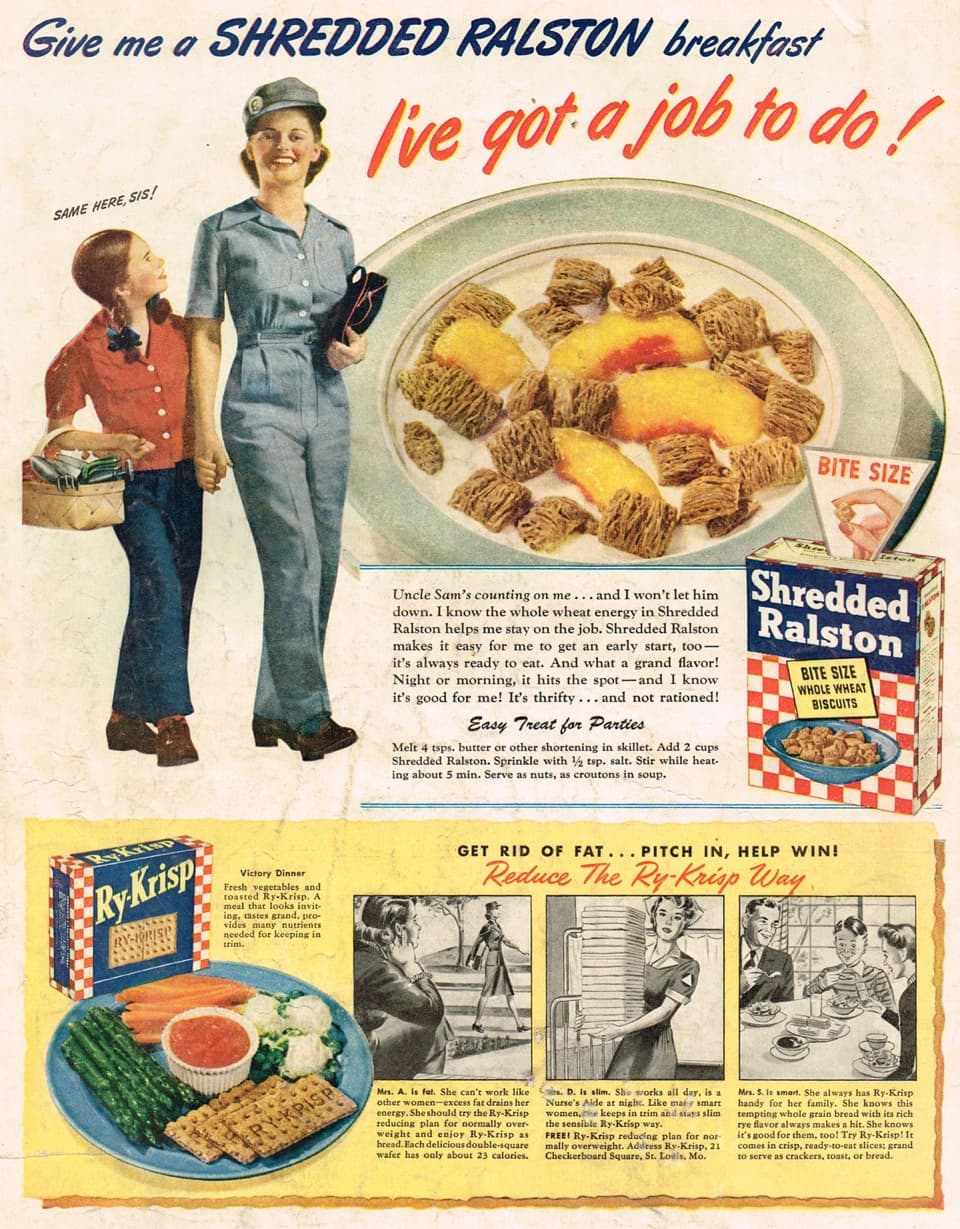
© jbcurio / Flickr, CC BY-NC 2.0
Frozen meals and portioned dishes multiplied. They were presented as modern, easy to use, and compatible with an increasingly constrained daily life. At this stage, these products were not yet all ultra-processed, but they established a lasting idea: it became possible to eat without cooking.
The boom of ultra-processed foods
From the 1970s onward, a new transformation accelerated. It no longer affected just how meals were prepared, but the very nature of food itself.
Agriculture became highly industrialized. Thanks to the massive use of chemical fertilizers and pesticides, the production of certain crops exploded. Corn, wheat, and soy became the pillars of an intensive agricultural system, capable of producing in very large quantities, at low cost.
This overproduction pushed the industry to change its logic: rather than transforming agricultural products as a whole, it began to “break them down” to extract inexpensive components that are easy to store and combine: sugars, oils, starches, proteins. Thus, wheat is no longer only ground into flour: it is also fractionated into industrial ingredients such as starch or maltodextrin, used to give texture to products. At the same time, corn becomes a central raw material for producing industrial sugars, notably glucose syrup, which gradually replaces sugar in many products from the 1980s onward19.
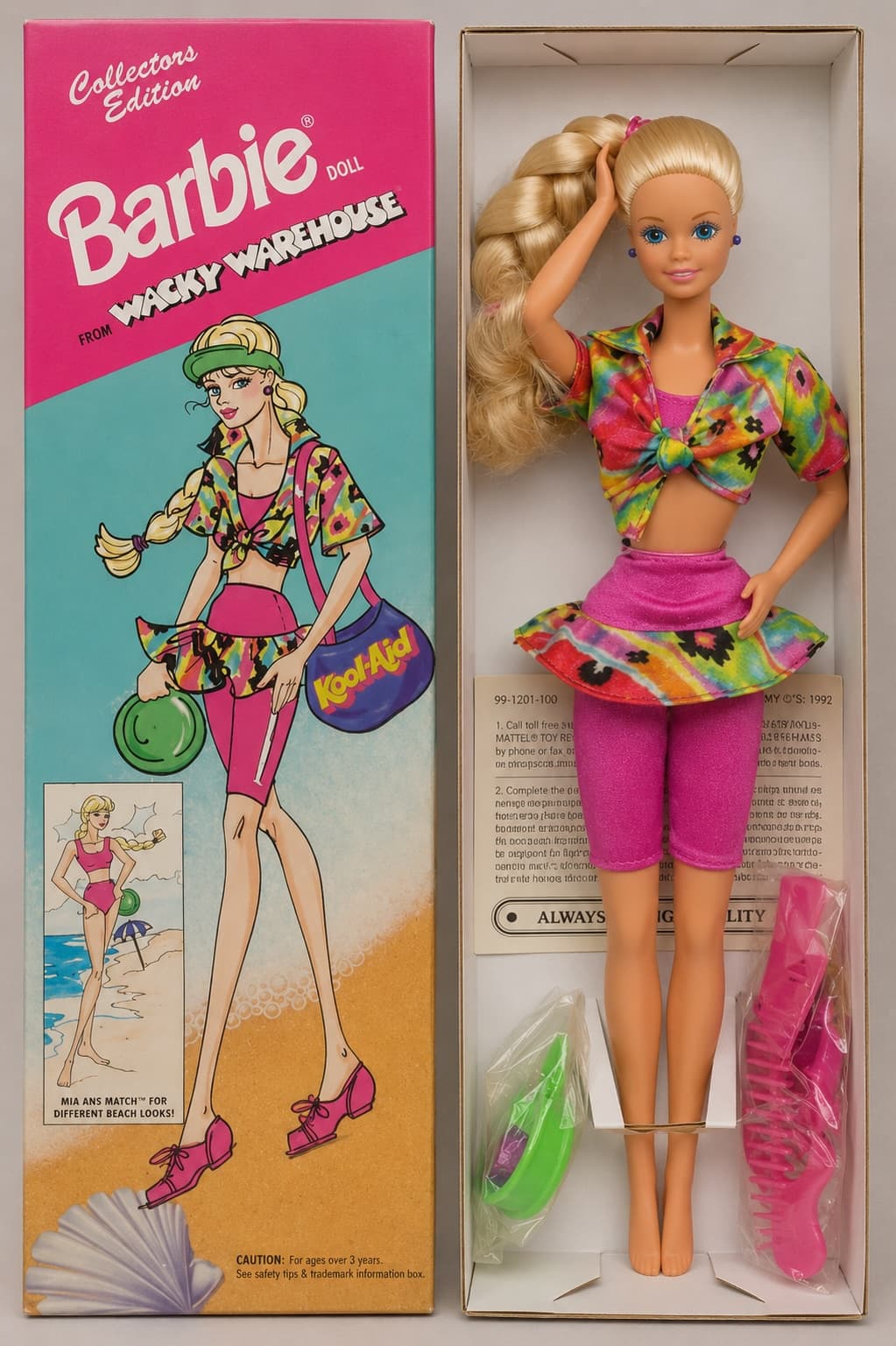
At the same time, the two tobacco giants, Philip Morris and R.J. Reynolds, invest heavily in the food industry. They seek to diversify their activities in the face of growing criticism of tobacco and the threats to their core business. They acquire major food companies such as Kraft, General Foods, or Nabisco, and apply a logic already proven in tobacco: use of flavorings, aggressive marketing, and targeting of children20-23. The example of Kool-Aid is revealing: when Philip Morris acquires General Foods in 1985, and with it the sugary drink brand Kool-Aid, the company decides to rely on the existing Kool-Aid Man character to launch a massive marketing campaign targeting children. It notably creates a loyalty program in which children collect points that can be exchanged for branded gifts. This mechanism is directly inspired by the Marlboro program, which allowed smokers to accumulate points to obtain clothing or accessories featuring the brand. A company executive states the following year: “We decided to focus our marketing on children, where we know our strength is greatest”24.
The objective is no longer simply to feed or save time, but to design products that are highly attractive, low-cost, and frequently consumed. Television becomes a central lever, particularly among children. As more than 95% of American households are now equipped with it, food advertisements flood children’s programming. Cereals, sugary drinks, and snacks are staged using endearing mascots and catchy jingles, in order to capture the attention of younger audiences and anchor consumption habits from a very early age26.

Faced with these practices, the Federal Trade Commission (FTC) in the United States attempts in 1978 to restrict television advertising aimed at young children. But under pressure from industry, Congress threatens to reduce the FTC’s budget, forcing it to abandon this initiative27.
Advertising is not their only lever to impose these new products. From this period onward, the industry also seeks to act directly on what triggers desire. Specialists in sensory perception and neuroscience are mobilized to understand what makes a food desirable, and to adjust recipes and textures with unprecedented precision. Ultra-processed foods are no longer only practical and inexpensive: they become products scientifically optimized to maximize consumption… and therefore sales28.
Joe Camel: the mascot that made children like cigarettes
This marketing strategy using mascots aimed at children was also used by the tobacco industry for years, which may initially seem surprising for a product intended for adults. The character Joe Camel, mascot of Camel cigarettes launched at the end of the 1980s, is an emblematic example. This cartoon-style camel was designed to attract the attention of younger audiences.
The objective was clear: to familiarize children with the brand very early on, and to create a lasting attachment, so that, once adults, they would naturally turn to these cigarettes. A study published in 1991 showed that six-year-old children recognized Joe Camel as easily as Mickey Mouse, illustrating the power of this type of marketing strategy29.

- ¹ Williams, Anne M., Couch, Catharine A., Emmerich, Samuel D., and Ogburn, Damon F., 2024. Ultra-processed Food Consumption in Youth and Adults: United States, August 2021–August 2023.
- ² Conway, R.E., Heuchan, G.N., Heggie, L. et al., 2024. Ultra-processed food intake in toddlerhood and mid-childhood in the UK: cross sectional and longitudinal perspectives. European Journal of Nutrition, 63, pp. 3149–3160. https://doi.org/10.1007/s00394-024-03496-7
- ³ Mertens, E., Colizzi, C., and Peñalvo, J.L., 2022. Ultra-processed food consumption in adults across Europe. European Journal of Nutrition, 61(3), pp. 1521–1539. https://doi.org/10.1007/s00394-021-02733-7
- ⁴ United Nations Children’s Fund (UNICEF), 2025. Feeding Profit. How food environments are failing children. Child Nutrition Report 2025. New York: UNICEF.
- ⁵ Can Manufacturers Institute, 2023. The History of the Can: The Impact of the Can on Culture and Economics for More Than 200 Years. Accessed May 2026. https://www.cancentral.com/wp-content/uploads/2023/01/HISTORY-OF-THE-CAN.pdf
- ⁶ Le Monde, 1994. Perspectives histoire d’une invention: La boîte de conserve a deux cents ans. 28 June 1994. https://www.lemonde.fr/archives/article/1994/06/28/perspectives-histoire-d-une-invention-la-boite-de-conserve-a-deux-cents-ans_3816270_1819218.html
- ⁷ France Archives, 1810. Découverte de l'appertisation par Nicolas Appert. https://francearchives.gouv.fr/pages_histoire/39492
- ⁸ Nestlé, n.d. The Nestlé story from 1866. Accessed May 2026. https://www.nestle.com.mt/aboutus/nestle-history
- ⁹ Maggi, n.d. Learn More About Maggi. Accessed May 2026. https://www.maggi.co.uk/about-us/
- ¹⁰ Coca-Cola Company, n.d. History. Accessed May 2026. https://www.coca-colacompany.com/about-us/history
- ¹¹ The Campbell’s Company, n.d. Campbell’s History. Accessed May 2026. https://www.thecampbellscompany.com/about-us/our-story/campbell-history/
- ¹² U.S. Food and Drug Administration (FDA), 2003. Color Additives History. Food Safety Magazine, October/November 2003. https://www.fda.gov/industry/color-additives/color-additives-history
- ¹³ Rothfeld, Anne, 2022. Coffee Rationing During World War II. Circulating Now, National Library of Medicine. https://circulatingnow.nlm.nih.gov/2022/11/23/coffee-rationing-during-world-war-ii/
- ¹⁴ Huber, Jennifer, 2019. A look back at the military's influence on nutrition in the U.S. Stanford Medicine. https://med.stanford.edu/news/insights/2019/01/a-look-back-at-the-militarys-influence-on-nutrition-in-the-u-s.html
- ¹⁵ The New York Times, 2025. Ultraprocessed food junk history. 16 October 2025. https://www.nytimes.com/interactive/2025/10/16/well/eat/ultraprocessed-food-junk-history.html
- ¹⁶ Fernandez, Raquel, 2010. Culture as Learning: The Evolution of Female Labor Force Participation over a Century. New York University. https://www.eief.it/files/2011/06/lecture-2.pdf
- ¹⁷ Biakolo, Kovie, 2020. A Brief History of the TV Dinner. Smithsonian Magazine. https://www.smithsonianmag.com/arts-culture/brief-history-tv-dinner-180976039/
- ¹⁸ Cowan, R.S., 2023. More Work for Mother: The Ironies of Household Technology from the Open Hearth to the Microwave. Plunkett Lake Press.
- ¹⁹ United States Department of Agriculture (USDA), 2015. High fructose corn syrup use in beverages: Composition, manufacturing, properties, consumption, and health effects.
- ²⁰ The New York Times, 1985. Philip Morris to Buy General Foods for $5.8 Billion. 28 September 1985. https://www.nytimes.com/1985/09/28/business/philip-morris-to-buy-general-foods-for-5.8-billion.html
- ²¹ Fazzino, T.L., Jun, D., Chollet-Hinton, L., and Bjorlie, K., 2024. US tobacco companies selectively disseminated hyper-palatable foods into the US food system: empirical evidence and current implications. Addiction, 119, pp. 62–71.
- ²² The Washington Post, 2023. Many of today’s unhealthy foods were brought to you by Big Tobacco. https://www.washingtonpost.com/wellness/2023/09/19/addiction-foods-hyperpalatable-tobacco/
- ²³ Brownell, K.D. and Warner, K.E., 2009. The Perils of Ignoring History: Big Tobacco Played Dirty and Millions Died. How Similar Is Big Food? The Milbank Quarterly, 87, pp. 259–294. https://doi.org/10.1111/j.1468-0009.2009.00555.x
- ²⁴ Nguyen, K.H., Glantz, S.A., Palmer, C.N., and Schmidt, L.A., 2019. Tobacco industry involvement in children's sugary drinks market. BMJ, 364:l736. https://doi.org/10.1136/bmj.l736
- ²⁵ The Nielsen Company, n.d. National Television Penetration Trends: TOTAL & TV HOUSEHOLDS. Accessed May 2026. https://www.tvb.org/wp-content/uploads/2022/10/National-TV-Household-Penetration-Trends.pdf
- ²⁶ Henry J. Kaiser Family Foundation, 2004. The Role of Media in Childhood Obesity. https://www.kff.org/wp-content/uploads/2013/01/the-role-of-media-in-childhood-obesity.pdf
- ²⁷ American Psychological Association (APA), 2004. Report of the APA Task Force on Advertising and Children. https://www.apa.org/pi/families/resources/advertising-children.pdf
- ²⁸ van Tulleken, Chris, n.d. Ultraprocessed Food: Function, Mechanisms, Policy. Lecture available at: https://www.youtube.com/watch?v=pIQq6vbwtGc
- ²⁹ Fischer, P., Schwartz, M., Richards, J., Goldstein, A., and Rojas, T., 1991. Brand Logo Recognition by Children Aged 3 to 6 Years: Mickey Mouse and Old Joe the Camel. JAMA, 266, pp. 3145–3148.
