



Over the past decade, a growing number of scientific studies have established a link between high consumption of ultra-processed foods and an increased risk of numerous chronic diseases. Studies also suggest a link with certain mental health disorders, such as depressive symptoms or cognitive impairments.
For a long time, these effects were attributed solely to their poor nutritional composition: too much sugar, salt, or fat. However, recent research suggests a more complex reality. Several studies show that the negative effects of ultra-processed foods persist even when calorie intake and nutritional content are comparable, suggesting that the issue is not limited to nutrients alone, but also relates to the very nature of these products and the processes used to manufacture them.
Strong evidence now exists for several major risk factors
Today, more than a hundred studies converge on the same conclusion: high consumption of ultra-processed foods is associated with an increased risk of numerous chronic diseases, including obesity, type 2 diabetes, cardiovascular and cerebrovascular diseases, hypertension, dyslipidemia (an imbalance in cholesterol and/or triglycerides), as well as certain cancers1-9. Research also points to associations with depressive symptoms, cognitive disorders, sleep disturbances, and higher overall mortality10-12.
These findings are now supported by a body of converging evidence using complementary scientific methodologies: meta-analyses, umbrella reviews, large cohorts followed over several years, cross-sectional studies, and, more recently, randomized controlled trials. Furthermore, these results have been observed across many countries, at different stages of life, and in large and diverse populations, which strengthens the robustness of the associations identified.
Cardiovascular risk is among the most well-documented effects. An analysis published in 2024 involving more than 200,000 U.S. adults followed over several decades showed that high consumption of ultra-processed foods was associated with a significant increase in the risk of cardiovascular diseases, particularly heart attacks and strokes. In this study, participants consuming the most ultra-processed foods had an 11% higher risk of cardiovascular disease and a 16% higher risk of coronary disease compared with those consuming the least, even after adjusting for numerous factors such as smoking, physical activity, and overall diet quality12.
Robust associations have also been observed for other chronic diseases, particularly type 2 diabetes, obesity, and certain cancers. This is notably the case for findings from the French NutriNet-Santé cohort, one of the largest nutrition cohorts in the world. Its results are striking: an increase of just 10% in the proportion of ultra-processed foods in the diet is associated with13-15:
- +12% risk of overall cancer
- +11% risk of breast cancer
- +15% risk of type 2 diabetes
- +11% risk of overweight
- +9% risk of obesity
These associations follow a dose-response pattern: the greater the proportion of ultra-processed foods in the diet, the higher the risk tends to be. In other words, these effects do not concern only individuals who consume them excessively. Even at moderate levels, a gradual increase may already be associated with a progressive rise in risk. Conversely, reducing their share in the diet could help lower this risk.
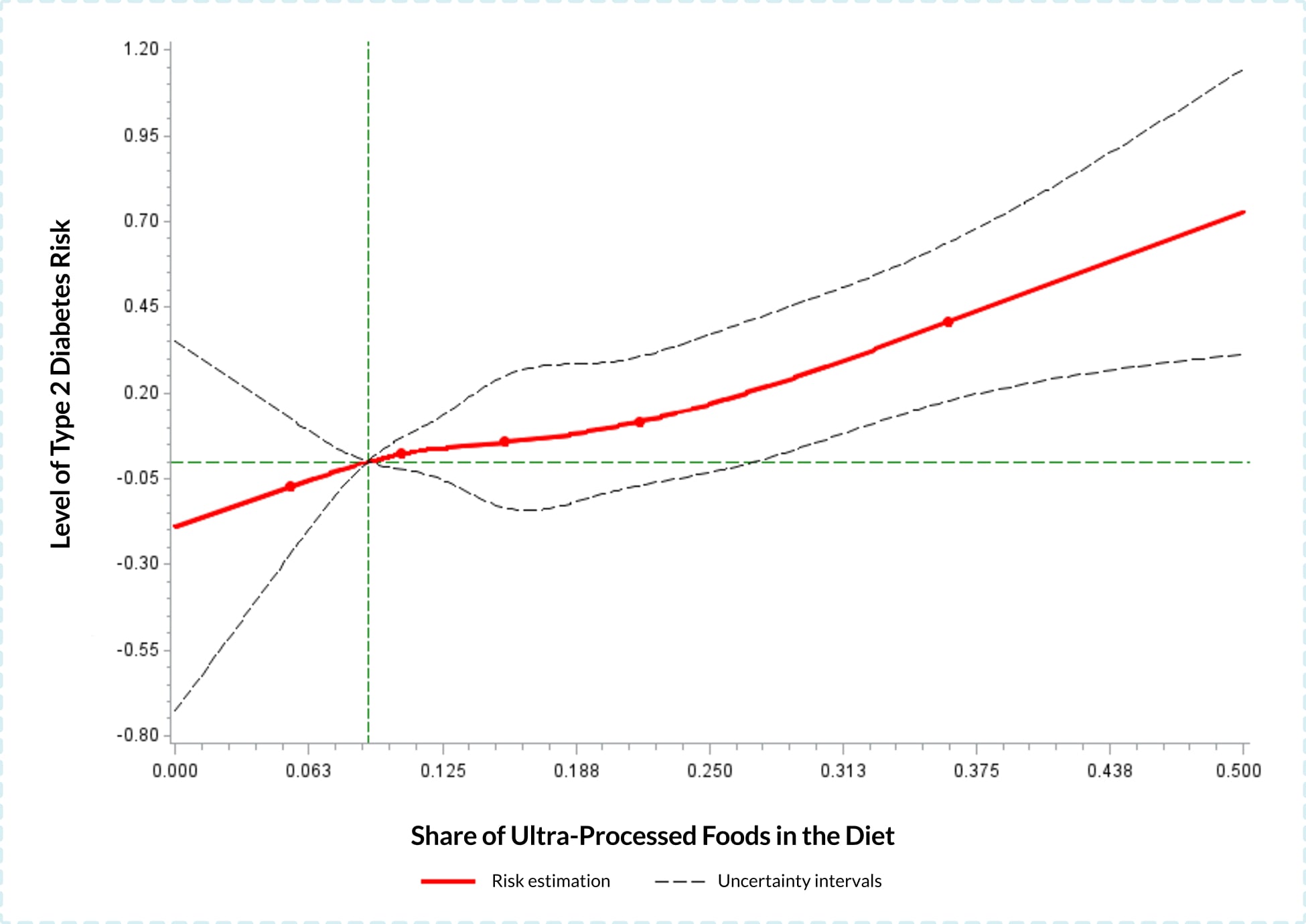
the higher the risk of type 2 diabetes Source: adapted from Srour et al., JAMA Internal Medicine, 2019., 2019.
Recent syntheses go even further by ranking these associations according to their level of evidence. Umbrella reviews and meta-analyses published in 2024 and 2025 – meaning studies that aggregate and assess the best available evidence according to strict quality criteria – confirm that the link between high consumption of ultra-processed foods and certain diseases is supported by strong evidence.
The 2024 umbrella review analyzed data from 9.9 million individuals across 14 independent, high-quality studies. It identified direct associations between the consumption of ultra-processed foods and an increased risk of 32 health outcomes. The researchers then identified the associations supported by the highest levels of evidence:
These findings are supported by a large meta-analysis published in 2025 in The Lancet, one of the most prestigious and widely cited medical journals, conducted with the participation of 20 experts from around the world. Of the 104 studies analyzed, covering large populations across several continents and different life stages, 92 showed a significant increase in risk for more than a dozen health problems.
This meta-analysis found, in particular, an approximately 18% increase in all-cause mortality risk among individuals consuming the highest amounts of ultra-processed foods. It also identified strong associations with several other conditions, including a 90% increased risk of Crohn’s disease, a 33% increased risk of abdominal obesity, and a 26% increased risk of dyslipidemia.
Overall, the observed effects involve nearly all major systems of the body, suggesting that ultra-processed foods may impair health through multiple distinct mechanisms.
Other concerning effects under investigation
For some conditions, the evidence is still being consolidated, but the available findings are sufficiently concerning to warrant attention. This is notably the case for gut health, reproduction, and liver health.
Gut health
Ultra-processed foods are particularly harmful to the gut microbiota, the community of billions of microorganisms that play a central role in health (see our article on the microbiota). This is due both to their unfavorable nutritional profile and to the presence of numerous additives that can disrupt the composition and balance of this fragile ecosystem17,18.
This unfavorable nutritional profile, characterized by low levels of fiber and bioactive compounds, and a high content of rapidly absorbable nutrients, hinders the growth of beneficial gut bacteria while promoting less favorable species. Gradually, an imbalance in the microbiota develops: this is what is known as dysbiosis19.
There can be multiple consequences. Metabolically, dysbiosis can disrupt insulin regulation, promote fat storage, increase cravings for sugar and fat, and lead to persistent fatigue. Studies also highlight its role in the development of certain mental health disorders, such as anxiety and depression. An imbalanced microbiota can disrupt the synthesis of certain neurotransmitters, such as serotonin and dopamine, which may negatively affect motivation, mood, and overall mental health20,21.
In addition, some additives commonly found in ultra-processed foods – particularly emulsifiers and sweeteners – may impair the intestinal barrier and increase its permeability. Pro-inflammatory compounds can then enter the bloodstream and contribute to chronic low-grade inflammation, which is now considered a contributing factor in many chronic diseases, including type 2 diabetes, obesity, inflammatory bowel disease, certain cancers, and non-alcoholic fatty liver disease22-25.
Reproductive health
A clinical trial published in 2025 showed that in just three weeks, a diet high in ultra-processed foods was sufficient to alter several markers of male reproductive health: reduced sperm motility, decreased sperm quality, and disruption of certain hormones involved in fertility, including testosterone. This finding is particularly striking because it was observed under equal caloric conditions, suggesting that the issue lies not in the quantity consumed, but rather the nature of the foods consumed26.
Effects on the liver
Recent literature suggests an association between high consumption of ultra-processed foods and an increased risk of non-alcoholic fatty liver disease, commonly referred to as “fatty liver disease.” This condition appears to be promoted in particular by the high levels of industrial sugars found in these products, especially high-fructose syrups.
Excess fructose stimulates fat production in the liver. Moreover, when the absorptive capacity of the small intestine is exceeded, some of the unabsorbed fructose becomes an easily accessible food source for certain bacteria that are less favorable to the balance of the gut microbiota, which may further exacerbate dysbiosis27,28.
The liver plays a central role in overall health, contributing to many metabolic functions, including the regulation of sugars and fats and the elimination of certain substances. According to findings from three large cohort studies conducted in the United States and the United Kingdom, involving more than 250,000 individuals, part of the negative effects associated with ultra-processed foods may be explained by their impact on the liver and on inflammatory mechanisms. Researchers estimate that these disruptions may account for approximately 20–30% of the observed associations between ultra-processed food consumption and certain health risks29.
A problem that goes beyond calories
For a long time, ultra-processed foods were primarily considered problematic because they are too high in fat, sugar, or salt. However, recent research suggests that their effects cannot be explained solely by their nutritional composition.
Several studies have therefore sought to determine whether the observed effects could simply be explained by the fact that ultra-processed foods are often higher in calories, sugar, salt, or fat. However, in many cohorts, associations with obesity and other health outcomes persist even after adjusting for these nutritional factors. A review published in 2022 concluded that the observed effects do not appear to be fully explained by nutritional composition alone30.
Clinical trials support this conclusion. The most notable study on this topic was published in 2019 by a team from the U.S. National Institutes of Health (NIH)31. In this controlled trial, twenty adults were successively assigned to two diets: one composed mainly of ultra-processed foods, the other of minimally processed foods. The meals were designed to be comparable in terms of calories offered, sugar, salt, fat, protein, carbohydrates, and fiber. Participants were free to eat as much as they wanted. The result: when consuming the ultra-processed diet, participants ate about 500 more calories per day and gained an average of 0.9 kg in just two weeks. Conversely, when following the minimally processed diet, they lost an average of 0.9 kg over the same period. This study marked an important turning point, as it was one of the first to experimentally demonstrate that foods with similar nutritional profiles can produce very different effects depending on their level of processing.
Similar findings were observed in a randomized trial published in 2025 in Nature Medicine32. Researchers compared two diets that both met UK nutritional recommendations, but one was composed mainly of ultra-processed foods and the other of minimally processed foods. Despite broadly comparable nutritional profiles, participants lost about twice as much weight on the minimally processed diet. Once again, these findings suggest that the effects of ultra-processed foods cannot be explained solely by their content of calories, sugar, salt, or fat.
One explanation proposed by researchers relates to the physical characteristics of ultra-processed foods. Their textures, often soft or crunchy, require little chewing and promote rapid consumption. Eating quickly disrupts satiety mechanisms and may lead to increased calorie intake. This hypothesis is supported by a study published in 2025. Researchers observed that foods eaten more slowly spontaneously led to a consumption of about 369 fewer calories per day than foods consumed quickly, despite comparable nutritional profiles. These findings suggest that food texture and eating rate may play an important role in the effects associated with ultra-processed foods.

- ¹ Monteiro, C.A., Louzada, M.L., Steele-Martinez, E., Cannon, G., Andrade, G.C., Baker, P., Bes-Rastrollo, M., Bonaccio, M., Gearhardt, A.N., Khandpur, N., Kolby, M., Levy, R.B., Machado, P.P., Moubarac, J.C., Rezende, L.F.M., Rivera, J.A., Scrinis, G., Srour, B., Swinburn, B., and Touvier, M., 2025. Ultra-processed foods and human health: the main thesis and the evidence. The Lancet, 406(10520), pp. 2667–2684. https://doi.org/10.1016/S0140-6736(25)01565-X
- ² Neri, D., Steele, E.M., Khandpur, N., Cediel, G., Zapata, M.E., Rauber, F., Marrón-Ponce, J.A., Machado, P., da Costa Louzada, M.L., Andrade, G.C., Batis, C., Babio, N., Salas-Salvadó, J., Millett, C., Monteiro, C.A., and Levy, R.B., 2022. Ultraprocessed food consumption and dietary nutrient profiles associated with obesity: A multicountry study of children and adolescents. Obesity Reviews, 23(Suppl 1), e13387. https://doi.org/10.1111/obr.13387
- ³ Srour, B., Fezeu, L.K., Kesse-Guyot, E., Allès, B., Méjean, C., Andrianasolo, R.M., Chazelas, E., Deschasaux, M., Hercberg, S., Galan, P., Monteiro, C.A., Julia, C., and Touvier, M., 2019. Ultra-processed food intake and risk of cardiovascular disease: prospective cohort study (NutriNet-Santé). BMJ, 365:l1451. https://doi.org/10.1136/bmj.l1451
- ⁴ Mendonça, R.D., Lopes, A.C., Pimenta, A.M., Gea, A., Martinez-Gonzalez, M.A., and Bes-Rastrollo, M., 2017. Ultra-Processed Food Consumption and the Incidence of Hypertension in a Mediterranean Cohort: The Seguimiento Universidad de Navarra Project. American Journal of Hypertension, 30(4), pp. 358–366. https://doi.org/10.1093/ajh/hpw137
- ⁵ Dai, S., Wellens, J., Yang, N., Li, D., Wang, J., Wang, L., Yuan, S., He, Y., Song, P., Munger, R., Kent, M.P., MacFarlane, A.J., Mullie, P., Duthie, S., Little, J., Theodoratou, E., and Li, X., 2024. Ultra-processed foods and human health: An umbrella review and updated meta-analyses of observational evidence. Clinical Nutrition, 43(6), pp. 1386–1394. https://doi.org/10.1016/j.clnu.2024.04.016
- ⁶ Wang, C., Du, M., Kim, H., Nguyen, L.H., Wang, Q.L., Drew, D.A., Leeming, E.R., Khandpur, N., Sun, Q., Zong, X., Gweon, T.G., Ogino, S., Ng, K., Berry, S., Giovannucci, E.L., Song, M., Cao, Y., and Chan, A.T., 2026. Ultraprocessed Food Consumption and Risk of Early-Onset Colorectal Cancer Precursors Among Women. JAMA Oncology, 12(1), pp. 49–57. https://doi.org/10.1001/jamaoncol.2025.4777
- ⁷ Kliemann, N., Rauber, F., Bertazzi Levy, R. et al., 2023. Food processing and cancer risk in Europe: results from the prospective EPIC cohort study. The Lancet Planetary Health, 7, pp. e219–e232.
- ⁸ Beslay, M., Srour, B., Méjean, C., Allès, B., Fiolet, T., Debras, C., Chazelas, E., Deschasaux, M., Wendeu-Foyet, M.G., Hercberg, S., Galan, P., Monteiro, C.A., Deschamps, V., Calixto Andrade, G., Kesse-Guyot, E., Julia, C., and Touvier, M., 2020. Ultra-processed food intake in association with BMI change and risk of overweight and obesity: A prospective analysis of the French NutriNet-Santé cohort. PLOS Medicine, 17(8), e1003256. https://doi.org/10.1371/journal.pmed.1003256
- ⁹ Bhave, V.M., Oladele, C.R., Ament, Z., Kijpaisalratana, N., Jones, A.C., Couch, C.A., Patki, A., Garcia Guarniz, A.L., Bennett, A., Crowe, M., Irvin, M.R., and Kimberly, W.T., 2024. Associations Between Ultra-Processed Food Consumption and Adverse Brain Health Outcomes. Neurology, 102(11), e209432. https://doi.org/10.1212/WNL.0000000000209432
- ¹⁰ Adjibade, M., Julia, C., Allès, B., Touvier, M., Lemogne, C., Srour, B., Hercberg, S., Galan, P., Assmann, K.E., and Kesse-Guyot, E., 2019. Prospective association between ultra-processed food consumption and incident depressive symptoms in the French NutriNet-Santé cohort. BMC Medicine, 17(1), 78. https://doi.org/10.1186/s12916-019-1312-y
- ¹¹ World Health Organization (WHO), 2024. Commercial determinants of noncommunicable diseases in the WHO European Region. https://www.who.int/europe/publications/i/item/9789289061162
- ¹² Mendoza, K., Smith-Warner, S.A., Rossato, S.L., Khandpur, N., Manson, J.E., Qi, L., Rimm, E.B., Mukamal, K.J., Willett, W.C., Wang, M., Hu, F.B., Mattei, J., and Sun, Q., 2024. Ultra-processed foods and cardiovascular disease: analysis of three large US prospective cohorts and a systematic review and meta-analysis of prospective cohort studies. The Lancet Regional Health – Americas, 37, 100859. https://doi.org/10.1016/j.lana.2024.100859
- ¹³ Fiolet, T., Srour, B., Sellem, L., Kesse-Guyot, E., Allès, B., Méjean, C., Deschasaux, M., Fassier, P., Latino-Martel, P., Beslay, M., Hercberg, S., Lavalette, C., Monteiro, C.A., Julia, C., and Touvier, M., 2018. Consumption of ultra-processed foods and cancer risk: results from NutriNet-Santé prospective cohort. BMJ, 360:k322. https://doi.org/10.1136/bmj.k322
- ¹⁴ Schnabel, L., Kesse-Guyot, E., Allès, B., Touvier, M., Srour, B., Hercberg, S., Buscail, C., and Julia, C., 2019. Association Between Ultraprocessed Food Consumption and Risk of Mortality Among Middle-aged Adults in France. JAMA Internal Medicine, 179(4), pp. 490–498. https://doi.org/10.1001/jamainternmed.2018.7289
- ¹⁵ Srour, B., Fezeu, L.K., Kesse-Guyot, E. et al., 2019. Ultraprocessed Food Consumption and Risk of Type 2 Diabetes Among Participants of the NutriNet-Santé Prospective Cohort. JAMA Internal Medicine. https://doi.org/10.1001/jamainternmed.2019.5942
- ¹⁶ Lane, M.M., Gamage, E., Du, S., Ashtree, D.N., McGuinness, A.J., Gauci, S. et al., 2024. Ultra-processed food exposure and adverse health outcomes: umbrella review of epidemiological meta-analyses. BMJ, 384:e077310. https://doi.org/10.1136/bmj-2023-077310
- ¹⁷ Seto, T., Grondin, J.A., and Khan, W.I., 2025. Food Additives: Emerging Detrimental Roles on Gut Health. The FASEB Journal, 39(13), e70810. https://doi.org/10.1096/fj.202500737R
- ¹⁸ Food and Agriculture Organization of the United Nations (FAO), 2025. State of research on the interactions between food additives, the gut microbiome and the host – A food safety perspective. Food Safety and Quality Series, No. 22. Rome: FAO.
- ¹⁹ Anastasiou, I.A., Kounatidis, D., Vallianou, N.G., Skourtis, A., Dimitriou, K., Tzivaki, I., Tsioulos, G., Rigatou, A., Karampela, I., and Dalamaga, M., 2025. Beneath the Surface: The Emerging Role of Ultra-Processed Foods in Obesity-Related Cancer. Current Oncology Reports, 27(4), pp. 390–414. https://doi.org/10.1007/s11912-025-01654-6
- ²⁰ Lutz, M., Arancibia, M., Moran-Kneer, J., and Manterola, M., 2025. Ultraprocessed Foods and Neuropsychiatric Outcomes: Putative Mechanisms. Nutrients, 17(7), 1215. https://doi.org/10.3390/nu17071215
- ²¹ Zinöcker, M.K. and Lindseth, I.A., 2018. The Western Diet-Microbiome-Host Interaction and Its Role in Metabolic Disease. Nutrients, 10(3), 365. https://doi.org/10.3390/nu10030365
- ²² Levy, R.B., Barata, M.F., Leite, M.A., and Andrade, G.C., 2024. How and why ultra-processed foods harm human health. Proceedings of the Nutrition Society, 83(1), pp. 1–8. https://doi.org/10.1017/S0029665123003567
- ²³ Chassaing, B., Compher, C., Bonhomme, B., Liu, Q., Tian, Y., Walters, W., Nessel, L., Delaroque, C., Hao, F., Gershuni, V., Chau, L., Ni, J., Bewtra, M., Albenberg, L., Bretin, A., McKeever, L., Ley, R.E., Patterson, A.D., Wu, G.D., Gewirtz, A.T., and Lewis, J.D., 2022. Randomized Controlled-Feeding Study of Dietary Emulsifier Carboxymethylcellulose Reveals Detrimental Impacts on the Gut Microbiota and Metabolome. Gastroenterology, 162(3), pp. 743–756. https://doi.org/10.1053/j.gastro.2021.11.006
- ²⁴ Daniel, N., Wu, G.D., Walters, W., Compher, C., Ni, J., Delaroque, C., Albenberg, L., Ley, R.E., Patterson, A.D., Lewis, J.D., Gewirtz, A.T., and Chassaing, B., 2024. Human Intestinal Microbiome Determines Individualized Inflammatory Response to Dietary Emulsifier Carboxymethylcellulose Consumption. Cellular and Molecular Gastroenterology and Hepatology, 17(2), pp. 315–318. https://doi.org/10.1016/j.jcmgh.2023.11.001
- ²⁵ INSERM, 2023. Syndrome métabolique : un lien entre atteinte inflammatoire vasculaire et microbiote intestinal. https://www.inserm.fr/actualite/syndrome-metabolique-lien-entre-atteinte-inflammatoire-vasculaire-et-microbiote-intestinal/
- ²⁶ Preston, J., Iversen, J., and Hufnagel, A., 2025. Effect of ultra-processed food consumption on male reproductive and metabolic health. Cell Metabolism, 37, pp. 1950–1960.e2.
- ²⁷ Srour, B., Kordahi, M.C., Bonazzi, E., Deschasaux-Tanguy, M., Touvier, M., and Chassaing, B., 2022. Ultra-processed foods and human health: from epidemiological evidence to mechanistic insights. The Lancet Gastroenterology & Hepatology, 7(12), pp. 1128–1140. https://doi.org/10.1016/S2468-1253(22)00169-8
- ²⁸ Song, J., Chen, S., Qian, K., and Ye, W., 2025. Association of ultra-processed foods consumption with increased liver steatosis in U.S. adults. Frontiers in Nutrition, 12, 1536989. https://doi.org/10.3389/fnut.2025.1536989
- ²⁹ Zhao, Y., Chen, W., Li, J., Yi, J., Song, X., Ni, Y., Zhu, S., Zhang, Z., Xia, L., Zhang, J., Yang, S., Ni, J., Lu, H., Wang, Z., Nie, S., and Liu, L., 2024. Ultra-Processed Food Consumption and Mortality: Three Cohort Studies in the United States and United Kingdom. American Journal of Preventive Medicine, 66(2), pp. 315–323. https://doi.org/10.1016/j.amepre.2023.09.005
- ³⁰ Dicken, S.J. and Batterham, R.L., 2022. The Role of Diet Quality in Mediating the Association between Ultra-Processed Food Intake, Obesity and Health-Related Outcomes: A Review of Prospective Cohort Studies. Nutrients, 14(1), 23. https://doi.org/10.3390/nu14010023
- ³¹ Hall, K.D., Ayuketah, A., Brychta, R., Cai, H., Cassimatis, T., Chen, K.Y., Chung, S.T., Costa, E., Courville, A., Darcey, V., Fletcher, L.A., Forde, C.G., Gharib, A.M., Guo, J., Howard, R., Joseph, P.V., McGehee, S., Ouwerkerk, R., Raisinger, K., Rozga, I., Stagliano, M., Walter, M., Walter, P.J., Yang, S., and Zhou, M., 2019. Ultra-Processed Diets Cause Excess Calorie Intake and Weight Gain: An Inpatient Randomized Controlled Trial of Ad Libitum Food Intake. Cell Metabolism, 30(1), pp. 67–77.e3. https://doi.org/10.1016/j.cmet.2019.05.008
- ³² Poppitt, S.D. et al., 2025. Ultra-processed and minimally processed diets containing matched nutrients cause different effects on energy intake and body weight. Nature Medicine. https://doi.org/10.1038/s41591-025-03842-0
- ³³ Forde, C.G., Heuven, L.A.J., van Bruinessen, M., Liu, Z., Stieger, M., de Graaf, K., and Lasschuijt, M.P., 2025. Eating rate has sustained effects on energy intake from ultraprocessed diets: a 2-week ad libitum dietary randomized controlled crossover trial. American Journal of Clinical Nutrition. https://doi.org/10.1016/j.ajcnut.2025.11.012
