


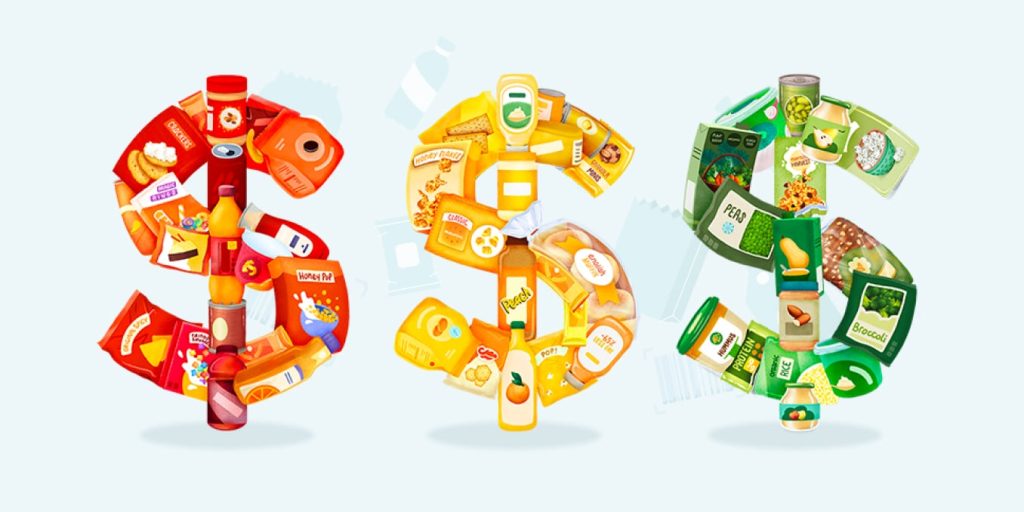
In a report, Yuka and Harvard Law School’s Food Law and Policy Clinic reveal a striking reality about how price shapes food composition in the United States, to the detriment of consumers. Drawing on an analysis of more than 800 food products sold nationwide across 12 of the most common processed food categories, including cereals, bread, and other everyday staples, the study examines how additives, sugar, and sodium vary across price ranges.
The findings are clear: lower-priced products contain significantly more additives, sugar, and salt, exposing a two-tier food system where access to healthier products is largely reserved for those who can afford them. This report combines robust data with policy recommendations to show how food policies shape what ends up on Americans’ plates and what must change to make healthy food the standard, not a privilege.
A joint study by Yuka and Harvard Law School’s Food Law and Policy Clinic.
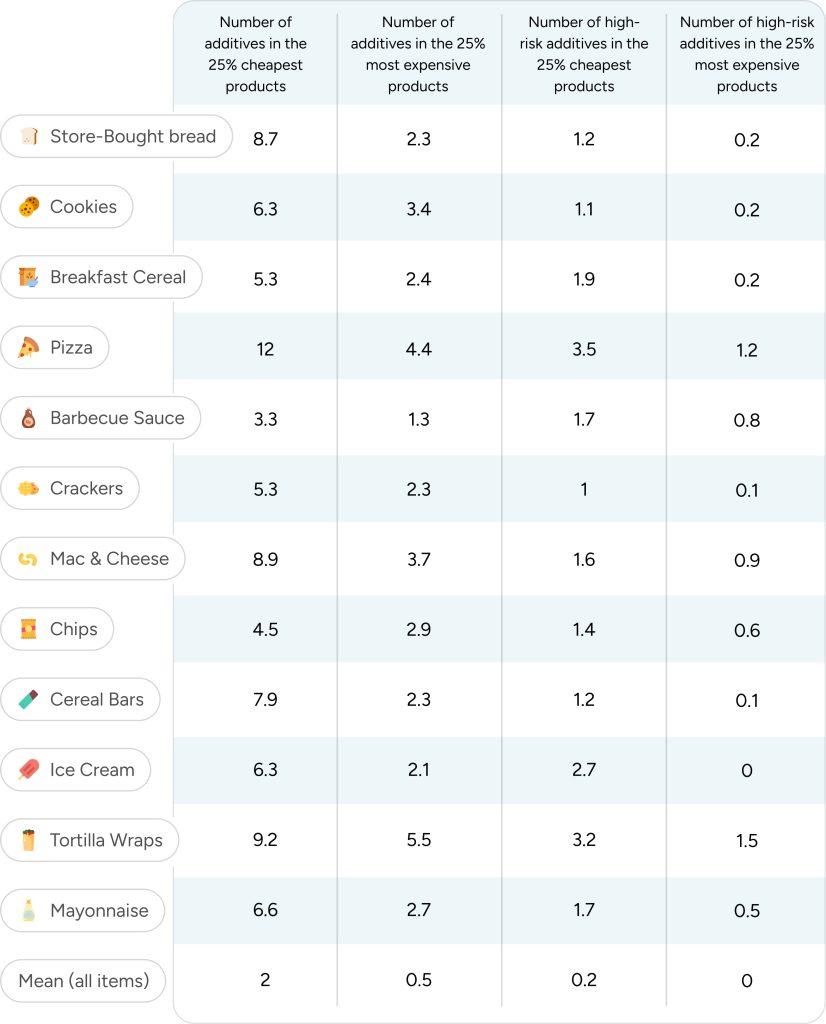
Cheaper Products Contain More Additives
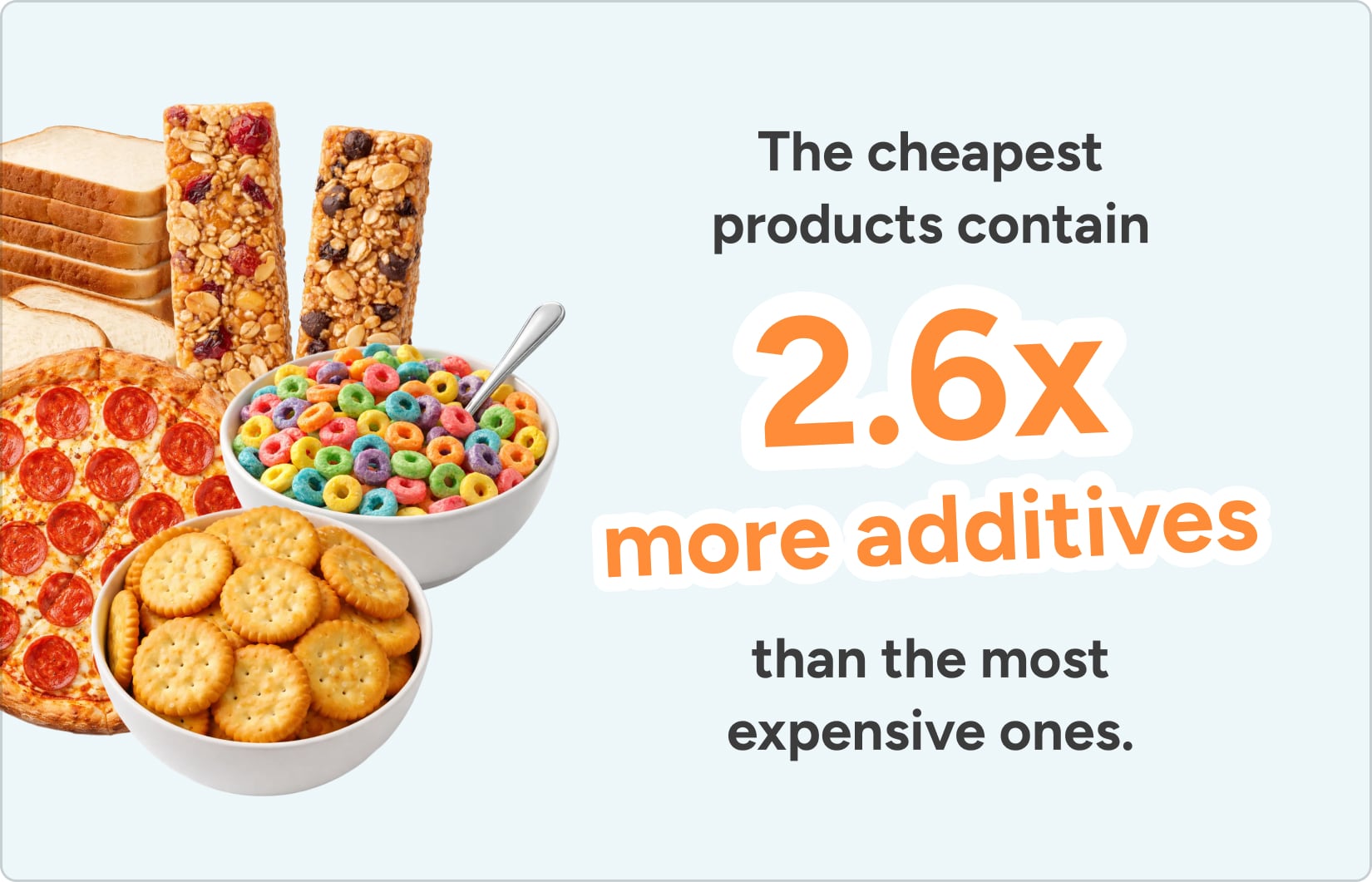
Across the 12 categories analyzed, the cheapest products contain, on average, 2.6 times more additives than the most expensive ones. Products in the lowest price quartile (25%) contain an average of 6.6 additives per item, whereas those in the highest price quartile (25%) contain an average of 2.7 additives.
The gap is even larger for the most concerning additives, assessed as high-risk on Yuka. The lowest-priced products contain, on average, over 3 times more high-risk additives than the highest-priced ones.
Overall, the results point to the same conclusion: avoiding additives—and especially high-risk additives— isn’t equally affordable. Products without high-risk additives are, on average, 63% more expensive than those with high-risk additives.
Store-bought bread
Store-bought bread is a staple in the U.S., appearing in everyday meals—from breakfast toast and children’s sandwiches to burger buns and quick dinner sides. Supermarkets devote entire aisles to it, offering a wide range of options—white, whole wheat, multigrain, sourdough, brioche, seeded, or “healthy” varieties—making it a typical product where prices vary widely while choice appears abundant.
For this category, we analyzed 61 store-bought bread products from 43 different brands, selected among the most scanned on Yuka. The results show a clear and significant association between price and the number of additives: the cheapest products contain nearly 4 times more additives than the most expensive. Products in the lowest-priced quartile contain an average of 8.7 additives, whereas those in the highest-priced quartile contain an average of 2.3 additives.
When focusing specifically on high-risk additives, the contrast is even more striking: in the lowest-priced quartile, 75% of breads contain at least one high-risk additive, compared with only 12% in the highest-priced quartile. And this gap shows up directly in what consumers pay: store-bought breads without high-risk additives are, on average, 28% more expensive than those with high-risk additives.
Breakfast cereal
Breakfast cereals have recently become the subject of significant U.S.-specific scrutiny, as major brands face criticism for using artificial colors and other additives in products heavily marketed to children, despite cleaner formulations existing abroad. This context makes cereals an illustrative category for examining how price influences families’ purchasing decisions.
We analyzed 83 breakfast cereals from 61 different brands, and the quality gap is evident. The cheapest cereals contain about 2 times more additives than the most expensive quartile, with an average of 5.3 additives per product. The contrast is even stronger for high-risk additives: in the lowest-priced quartile, 61% of breakfast cereals contain at least one high-risk additive, compared with 19% in the highest-priced quartile.
In other words, avoiding high-risk additives costs more: breakfast cereals without high-risk additives are, on average, 65% more expensive than those with high-risk additives.
Pizza
Pizza is deeply embedded in U.S. food culture: one of the most widely eaten comfort foods, shared at family nights, birthday parties, school events, and major sporting events. It has become a default meal choice—one broadly accepted across households—and is consumed regularly, making it a meaningful part of weekly diets.
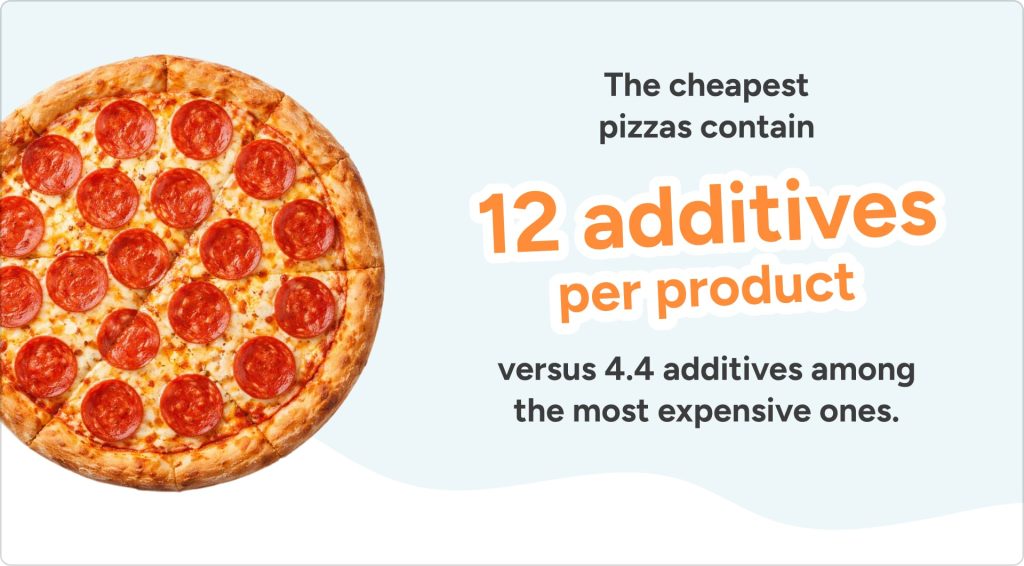
In this category, our analysis of 70 pizzas shows the same price–quality trend observed in other food staples. The additive load in low-priced pizzas is extremely high: the cheapest products contain 12 additives per product on average (including 3.5 rated high-risk on Yuka), versus only 4.4 additives per product among the most expensive pizzas (including 1.2 rated high-risk). Pizzas without high-risk additives are, on average, 35% more expensive than those with high-risk additives.
Wraps
Wraps capture two core American habits at once: eating on-the-go and the desire to “make it healthier.” They are often marketed as a better-for-you alternative to bread—but that health halo can conceal highly processed formulations designed for softness, flexibility, and long shelf life.
For this category, we analyzed 53 store-bought wraps from 31 different brands. The association between price and the presence of additives is clear: the cheapest wraps contain, on average, 69% more additives than the most expensive ones. The gap is even more pronounced for high-risk additives: the lowest-priced quartile contains more than twice as many high-risk additives as the highest-priced quartile (3.2 versus 1.5 high-risk additives per product).
Recap
Cheaper Products Contain More Sugar
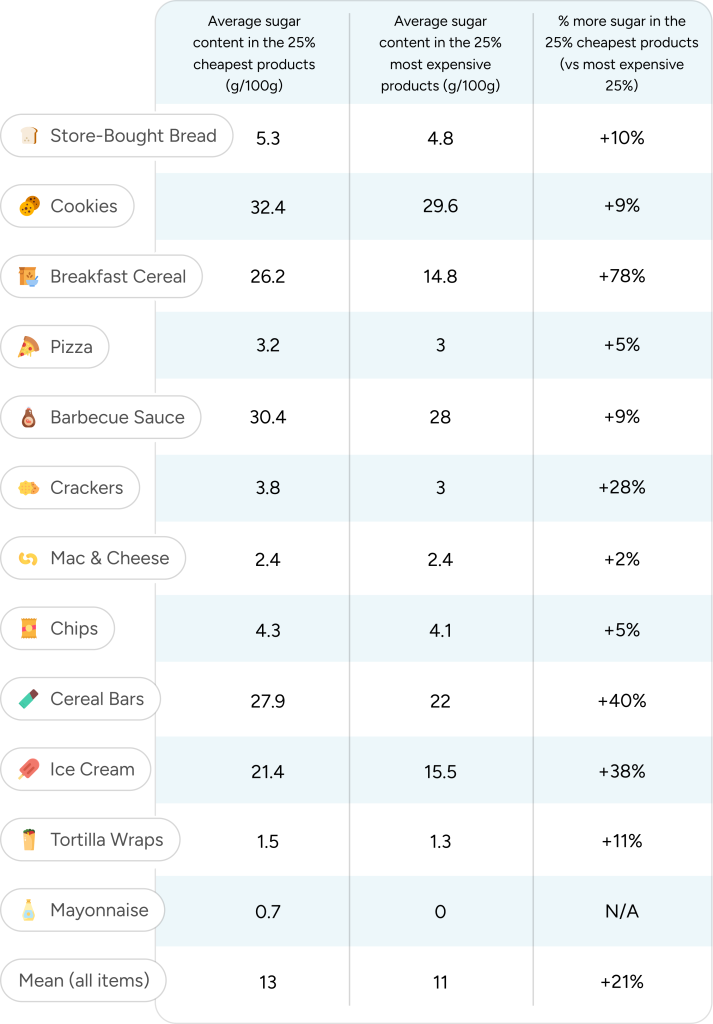
The price–composition gap doesn’t end with additives. Sugar follows the same pattern: lower-priced products are both more additive-heavy and significantly sweeter. This is especially concerning in the U.S., where on average, Americans consume up to three times the sugar intake recommended by the WHO¹. Added sugars are consistently linked to major chronic conditions, including obesity, type 2 diabetes, hypertension and cardiovascular disease mortality.²
Across the 12 categories studied, the cheapest products contain, on average, 21% more sugar than the most expensive. Conversely, the least sugary products cost, on average, 23% more than the most sugary.
Breakfast cereal
Breakfast cereals have become a focal point in the U.S. debate on additives, particularly due to the widespread marketing of best-selling products to children; however, sugar constitutes an equally structural concern in this category. In fact, the price gap mirrors what is observed for additives: cereals in the lowest-priced quartile contain, on average, 73% more sugar than those in the highest-priced quartile—26g of sugar per 100g of product, compared with 15g in the most expensive ones.
For families seeking less sweet options, the trade-off is clear: cereals in the lowest-sugar quartile are, on average, twice as expensive as those in the highest-sugar quartile.
Ice cream
Ice cream is a U.S. supermarket institution that became mass-market with the advent of industrial refrigeration, and Americans continue to consume it at exceptionally high levels—about five gallons per person per year.³ The category has also shaped global ice-cream culture through iconic U.S. brands such as Häagen-Dazs and Ben & Jerry’s.
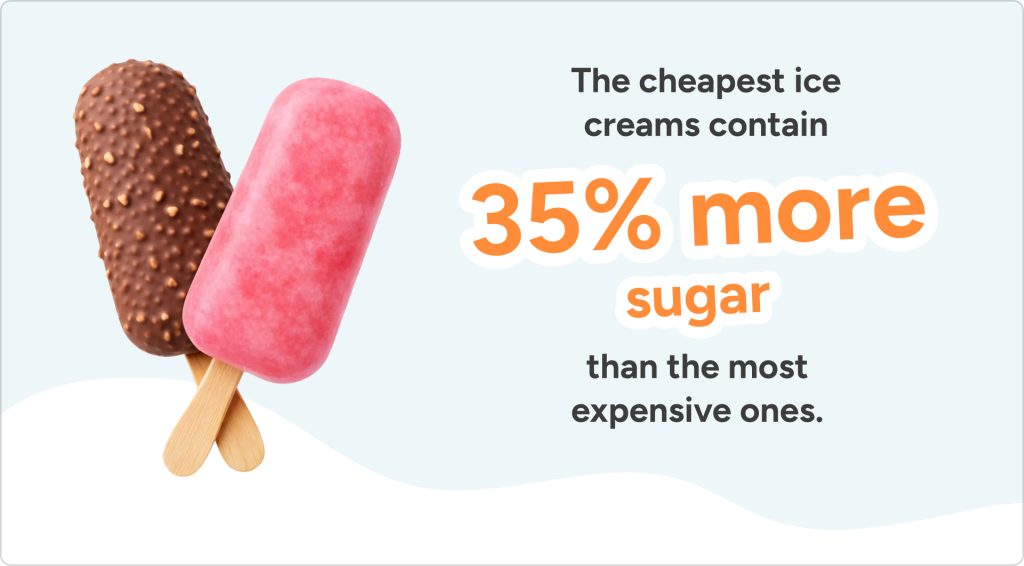
Here too, based on our analysis of 47 products from 28 different brands, price tracks sugar content: ice creams in the lowest-priced quartile contain, on average, 31% more sugar than those in the highest-priced quartile—21g of sugar per 100g, compared with 16g of sugar. Products in the lowest-sugar quartile are, on average, 47% more expensive than those in the highest-sugar quartile.
Crackers
Crackers are typically seen as a savory snack—something to pair with cheese, soups, or eat straight from the box. Yet many supermarket crackers also contain added sugar, which enhances palatability and makes them harder to stop eating.
This category follows the same pattern: across the 95 products from 57 brands we analyzed: the lowest-priced quartile of crackers contains, on average, 28% more sugar than the highest-priced quartile.
Cereal bars
Cereal bars are breakfast cereals repackaged for the U.S. snacking culture—portable, ever-present, and marketed as a convenient default when something quick is needed.
In reality, this everyday format also reveals stark price-based differences in sugar content across the 82 products from 50 brands we analyzed: the cheapest bars contain 40% more sugar than the most expensive, while the least sugary bars are, on average, 44% more expensive than the most sugary ones.
Lower Budgets and Exceedance of Health Recommendations
Using FDA RACCs4 (Reference Amounts Customarily Consumed), we observe a clear affordability-driven nutrition inequity: cheaper products can bring consumers much closer to— or beyond—WHO daily sugar intake recommendations under normal consumption patterns. This is particularly evident for breakfast cereals, cereal bars, and ice creams: one serving of cheaper breakfast cereals can reach 52% of the WHO limit versus 29% for pricier cereals, and cheaper ice creams can reach 80% vs 58% per serving.
Recap
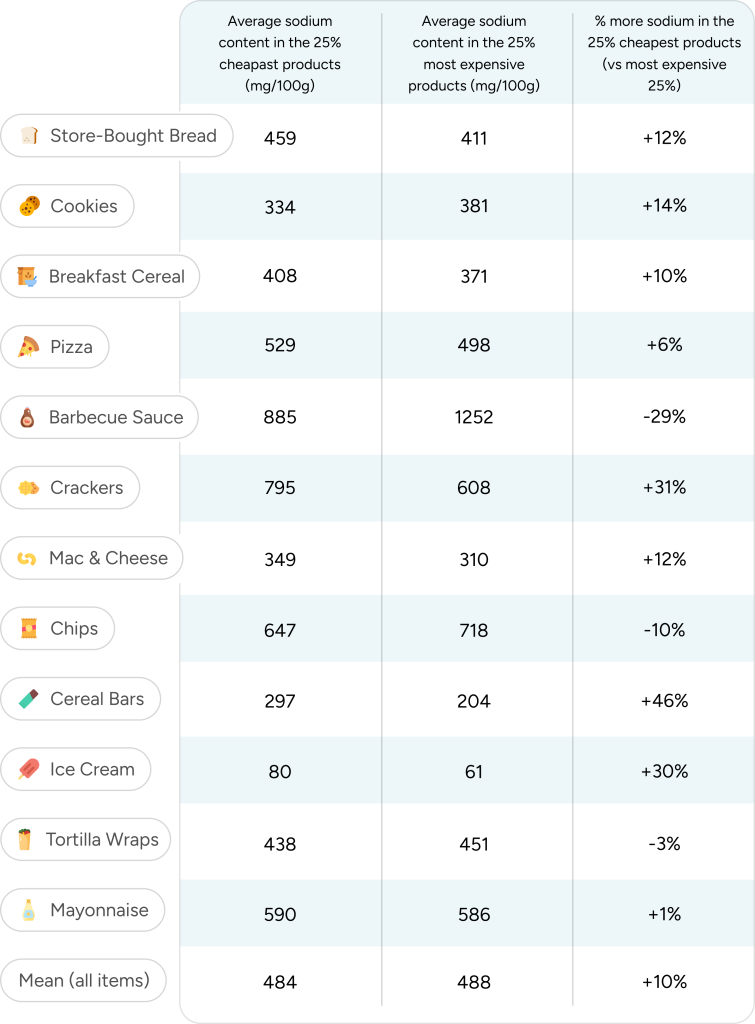
Cheaper Products Contain More Sodium
Of the 12 categories analyzed, 11 had WHO-recommended sodium targets⁵—and all exceeded them. In 7 of these 11 categories, lower-priced products showed greater exceedance of the recommended sodium levels.This has significant public health implications. Excess sodium intake is a well-established contributor to high blood pressure and increases the risk of cardiovascular disease, including heart attacks and stroke. The WHO estimates that excessive sodium consumption is linked to approximately 1.9 million deaths worldwide each year, while most populations exceed the recommended daily limit of 2 grams of sodium. In the U.S., average intake far surpasses these thresholds—about 1.4 times the federal guideline (2,3 g/day)⁶ and 1.75 times the WHO recommendation⁷.
Mac and Cheese
Mac & cheese is a defining presence in U.S. grocery aisles: bright boxed classics, instant cups, and family-size ready meals designed to be cheap, fast, and shelf-stable. Here, price often reflects how far formulations are pushed—not just with additives and sugar, but with sodium as well.
An analysis of 72 mac & cheese products shows that the cheapest mac & cheese options contain, on average, 348 mg of sodium/100g, versus 310 mg for the most expensive ones. For consumers seeking lower-sodium options, the trade-off is clear: the lowest-sodium products are, on average, 40% more expensive than the highest-sodium ones.
An analysis of 72 mac & cheese products shows that the cheapest mac & cheese options contain, on average, 348 mg of sodium/100g, versus 310 mg for the most expensive ones. For consumers seeking lower-sodium options, the trade-off is clear: the lowest-sodium products are, on average, 40% more expensive than the highest-sodium ones.
Crackers
Crackers illustrate the broader picture: as prices drop, overall quality declines. Cheaper options tend to stack the same compromises — more additives, more sugar, and also more sodium. The cheapest 25% of products contain, on average, 31% more sodium than the most expensive 25%.
Breakfast cereal
While breakfast cereals are most often discussed in terms of sugar, sodium also plays a role—and lower-sodium options tend to be more expensive.
On average, the cheapest products contain 408 mg of sodium/100g, compared with 371 mg/100g in the most expensive ones. Consequently, the 25% lowest-sodium products are, on average, 59% more expensive than the 25% highest-sodium ones.
Recap
Policy Recommendations
The policy recommendations that follow respond to structural weaknesses in the U.S. regulatory system that allow many chemical substances, including potentially harmful substances, to remain widespread in the food supply, particularly in lower-cost and ultra-processed foods. These recommendations pursue two complementary approaches: modernizing food additive oversight through regulatory reform, and reducing exposure to additives and ultra-processed foods through schools, public institutions, and fiscal policy. Together, these recommendations aim to reduce harmful exposures, strengthen accountability across the food system, and better align U.S. food policy with public health goals.
A. Reforming Substances Added to Food Oversight & Safety
The first set of recommendations focus on opportunities to reform the system of oversight for additives and ingredients added to food, in order to improve the general safety standards and transparency for those substances.
1. Reform the Generally Recognized as Safe (GRAS) Loophole
A regulatory loophole known as “generally recognized as safe” (GRAS) allows most ingredients to enter the U.S. market without FDA review. As a result, 99 percent of new food chemicals introduced since 2000 have bypassed federal oversight. Closing this gap requires federal action, which could be taken by either Congress or the FDA.

Congress should amend the Food, Drug, and Cosmetic Act (FD&C Act) to eliminate the GRAS exemption and require FDA review for all substances added to food, with a limited carve-out for common household ingredients such as sugar, salt, vinegar and baking soda. New substances should require explicit FDA approval prior to use, and no substance should enter the food supply unless the FDA has reviewed it and affirmatively listed it as permitted.
Congress should require all substances used under the GRAS pathway to undergo renewed review, with continued interim use permitted only for substances already known to FDA, while self-determined (non-notified) GRAS substances would be prohibited unless and until FDA approval is granted.
The FDA could alternatively strengthen its oversight by making GRAS notifications mandatory, thus prohibiting self-certified GRAS determinations and preventing manufacturers that withdraw GRAS notifications from still using the substance. The agency should also re-evaluate all GRAS substances within five years using transparent, publicly available safety data that account for cumulative and long-term exposure, and publish these data in a searchable database.
2. Strengthen FDA Post-Market Review of Food Additives
The FDA currently lacks a systematic post-market safety review process for food additives and GRAS substances. Because GRAS substances may be marketed without prior FDA notification at all, and even substances approved via the additive pathway have often gone decades without re-review, safety concerns are often addressed only after widespread exposure has occurred. Strengthening post-market oversight therefore requires the FDA to implement a robust and predictable review framework.
The FDA should start by reassessing all GRAS substances, and adopting a precautionary approach similar to that employed by the European Food Safety Authority: when credible safety concerns of a substance exist, it should be prohibited in the food supply
In addition, the agency should establish a formal, periodic reassessment cycle for all food additives and GRAS substances, with reviews conducted at least every fifteen years. Substances should be prioritized for a full safety assessment based on clear, risk-based criteria, including public health concerns, regulatory actions taken by peer countries, hazard classifications issued by recognized authorities, emerging scientific evidence of harm, or excessive exposure relative to safety thresholds such as Acceptable Daily Intake (ADI) levels. In parallel, the FDA should implement an annual, risk-based priority review list—independent of the fifteen-year cycle—to ensure timely action when new concerns arise.
Finally, the FDA should set or update limits on individual substances and establish group-level limits for related substances to address cumulative exposure. This approach would better reflect real-world consumption patterns and align U.S. oversight with international best practices.
3. Redefine Food Additives and Use Limits
U.S. law defines a “food additive” so broadly that, combined with the GRAS loophole, it allows substances to be added to food for virtually any purpose, including cosmetic or marketing reasons rather than essential functions. Establishing functional and category-specific limits would reduce exposure to additives.
Congress should amend the definition of “food additive” under the FD&C Act to require that additives serve a legitimate, non-cosmetic function. Limiting additives to defined functional purposes would reduce unnecessary use and prevent inclusion driven solely by marketing or appearance.
Congress should also require manufacturers to disclose all additives and GRAS substances used in their products and justify the function of each. Amending the Food Safety Modernization Act to mandate full disclosure of such substances to FDA would increase transparency, give FDA a clearer view of cumulative additive exposure across the food supply, and support stronger, more targeted regulation.
4. Improve Transparency in Flavoring Ingredients
Another barrier for consumers seeking to avoid risky additives is the lack of transparency around flavorings. Current labeling rules allow merely the use of the terms “natural” or “artificial” flavors, even though they often contain dozens or even hundreds of individual substances. This loophole allows potentially risky substances, including self-GRAS substances, to be hidden from both consumers and regulators.

To address this gap, the FDA should require greater disclosure for flavorings. Manufacturers should list the top three substances by weight in each flavoring directly on ingredient labels and include a QR code linking to a complete list of flavoring ingredients. This approach would improve consumer transparency, enable faster identification of harmful substances, and help public health experts assess cumulative exposure across the food supply, without requiring disclosure of proprietary formulas or ingredient quantities.
5. Require Disclosure of Ingredient Processing and Sources
U.S. food labels allow ingredients to be listed using generic terms without disclosing how they were processed or derived, even though certain production methods can introduce contaminants, including heavy metals. By contrast, the European Union regulates additives as distinct substances based on their method of production, even when derived from the same starting material, in line with Codex Alimentarius principles. Each process-defined additive is assigned a specific name and E-number, along with purity criteria, specifications, and conditions of use.
The FDA should adopt a similar approach and require additives to be identified by production method, using existing Codex E-codes or equivalent names, and by establishing corresponding purity standards and use conditions. Including this information on ingredient labels would increase transparency, empower consumers to make informed choices, and allow regulators to better assess and manage contamination risks in the food supply.
B. Reducing Exposure to High-Risk Additives and Ultra-Processed Foods
Outside of policy changes to improve the oversight of additives and ingredients in food both pre- and post-market, there are a range of policy approaches that the federal government, as well as state or local governments, could take to reduce exposure to UPF or to foods containing high risk additives. The recommendations below present some of the key opportunities.
1. Ban High-Risk Additives in School Foods
Children are uniquely vulnerable to food additives due to their lower body weight, developing metabolism and brains, and disproportionate exposure to processed foods, yet U.S. regulations do not adequately account for these risks.
To address this gap, the FDA should establish and maintain a federal list of additives and additive classes that pose heightened risks to children. This would include, among others, synthetic food dyes associated with behavioral effects and endocrine-disrupting substances such as nitrates, nitrites, and BHA/BHT, with risk assessments accounting for both individual toxicity and cumulative exposure.
This list should be regularly updated as new scientific evidence emerges and serve as the scientific basis for restricting additives in foods consumed by children. Using this list, the USDA should revise the Nutrition Standards for Schools and the Smart Snacks in School rule to prohibit, or at minimum sharply limit, foods containing additives of concern from being eligible for federal reimbursement or sale in schools.
In parallel, state and local governments should use their existing authority to further restrict high-risk additives and ultra-processed foods in schools. While federal agencies can set national standards and guidance, states and localities may adopt stronger nutrition policies tailored to their school systems. Several cities and states have already banned foods containing certain artificial colors, preservatives, or other additives of concern in school meals, and California has enacted legislation to prohibit “ultra-processed foods of concern” in schools based on clear health-risk criteria. These policies demonstrate that stricter school nutrition standards are both feasible and effective, and provide a model for broader adoption nationwide.
2. Improve Public Food Procurement Standards
Beyond school meals, governments can reduce exposure to high-risk additives by reforming food procurement across other institutional settings. The federal government spends billions each year on food for public programs, including military service members, veterans’ hospitals, and senior nutrition programs, yet procurement policies prioritize cost over food quality, favoring products more likely to contain high-risk additives. State and local governments follow similar practices. Updating procurement standards to account for additive risk and food quality would reduce harmful exposures and help shift the market toward healthier food options.
Federal agencies should adopt procurement standards or incentives that limit the purchase of foods containing high-risk additives or that are ultra-processed, and explicitly incorporate additive safety into purchasing decisions. These standards could be implemented through updates to the Federal Acquisition Regulation and via strengthened CDC Food Service Guidelines, which should be adopted more broadly across federal facilities.
State and local governments should likewise update their procurement policies to restrict foods containing high-risk additives or ultra-processed foods when public funds are used. Existing value-based procurement frameworks offer a practical model for prioritizing public health alongside cost and can be adapted to reduce harmful additive exposure in state and local institutions.
3. Implement Tax Incentives for Foods with Fewer Risky Additives
Tax policies, including incentives and excise taxes, can encourage both manufacturers and consumers to shift toward foods with fewer harmful additives. Evidence from tobacco, alcohol, and sugar-sweetened beverage taxes shows that food demand is highly price-responsive, and fiscal measures can also drive product reformulation.
Governments could use tax credits to lower the cost of foods made without high-risk additives, particularly in widely consumed product categories. Offering targeted tax credits to manufacturers that reformulate products to eliminate harmful additives would help make healthier options more price-competitive and incentivize industry-wide change, while keeping public costs manageable by focusing on high-consumption food categories.
Excise taxes on foods containing high-risk additives or certain ultra-processed foods are another option, though more politically sensitive due to potential price impacts. These taxes can be structured upstream, at the manufacturer or distributor level, to target industry practices rather than consumers directly. However, because excise taxes are often passed on to consumers and may disproportionately affect low-income households, any such policy should be paired with equity safeguards, including directing tax revenues toward programs that improve access to healthy foods and offset cost burdens for marginalized communities.
The detailed Policy Recommendations and supporting references are available in the full report.

- ¹ OMS, 2023. Reducing free sugars intake in adults to reduce the risk of noncommunicable diseases. e-Library of Evidence for Nutrition Actions (eLENA). https://www.who.int/tools/elena/interventions/free-sugars-adults-ncds
- ² Lee, S.H.; Park, S.; Blanck, H.M. Consumption of Added Sugars by States and Factors Associated with Added Sugars Intake among US Adults in 50 States and the District of Columbia—2010 and 2015. Nutrients 2023, 15, 357. https://doi.org/10.3390/nu15020357
- ³ Terán, A., 2023. Ice cream consumption melts from 2000 to 2021. USDA Economic Research Service, Charts of Note. https://ers.usda.gov/data-products/charts-of-note/chart-detail?chartId=106814 
- ⁴ FDA, 2018. Guidance for Industry: Reference Amounts Customarily Consumed (List of Products for Each Product Category) https://www.fda.gov/regulatory-information/search-fda-guidance-documents/guidance-industry-reference-amounts-customarily-consumed-list-products-each-product-category
- ⁵ WHO, 2024. WHO global sodium benchmarks for different food categories, 2nd ed https://www.who.int/publications/i/item/9789240092013
- ⁶ USDA, 2025. Dietary Guidelines for Americans: Make Every Bite Count With the Dietary Guidelines - Ninth Edition https://www.dietaryguidelines.gov/sites/default/files/2021-03/Dietary_Guidelines_for_Americans-2020-2025.pdf
- ⁷ WHO, 2023. World Health Organization Global Report on Sodium Intake Reduction https://iris.who.int/server/api/core/bitstreams/296605a9-820a-41bc-8f28-bf4b1367d530/content


Thank you! Love the app! I use it all the time and even shared with other family members.
Thank you for sharing. I often share the Yuka app with people when they are out grocery shopping and enjoy having all this information at my fingertips. You and your team are doing a great job~
Excellent report thank you very much
Thank you, Julie, for this wonderful, healthful information!! I wonder if you could team up with Health Secretary (Bobby Kennedy, Jr.) if you haven’t already done so? I, for one, don’t ever purchase food items any longer without using my Yuka app 🙂 I’m horrified to find sooo many foods that contain high-risk ingredients, and I’m certain these are contributing to our children/grandchildren’s health issues 🙁
Thank you Yuka Team for all the work you do to show which foods are healthiest and what is wrong with the food we eat today and make changes for the better I have always believed food should be left as close to completely natural as possible in modern life.
Thank you for all the hard work all of you & team Yuka put into all this research, it baffles me how little we know considering, the fact that mostly I’ve always resorted to cook at home, healthy food for my daughter but on the occasional time we got takeout or something, this report is an eye-opener on what we are feeding ourselves and our families! Thank you team Yuka!
What can we do personally as citizens to make these recommendations come to fruition?
My dad was on me for about a year to try this app. I finally did, and it was shocking to me as a health-conscious person how wrong I was about the products I thought were healthy! It has changed much of what I buy that is packaged. I also find it surprising in some ways. The generic version of frosted mini-wheats from Aldi scores better than the ones from Trader Joe’s. The pita chips at Aldi also score better. I do believe education is helpful, and cost can be part of the equation. I thought 100% whole wheat bread was healthy, but sprouted grain bread is much healthier. Thank you so much for all your hard work and for creating such an easy-to-use tool for so many people. We have five kids and two with disabilities. Although the teens are not appreciating some of my changed shopping habits, I believe they will someday.
I think some FDA officials need to be indicted. Maybe that would motivate them not to approve toxins in our food. Or whomever is responsible for approving those levels. Or put a damper in their plans to go to work for the same manufacturers they’re supposed to oversee. Or maybe restructure the funding! So that manufactures do not pay for almost half of the FDA funding. In my opinion
The FDA receives funding from two main sources: federal budget appropriations (taxpayer money) and industry user fees paid by manufacturers for product approvals. As of recent figures, the budget is roughly split, with about 55% from federal funding and 45% from industry user fees, which are reauthorized by Congress every five years.
I always suspected this correlation, thank you for this in-depth report!
Very impressive report. I’d like to personally thank everyone of you, who worked so hard, to obtain all of this information and share it with us. I trust all of the information, that I find on Yuka! In today’s times, that’s a rarity. Yuca’s website has made it easier for me to make decisions on eating healthy, by educating me on what’s in the food. I highly recommend Yuka to everyone Sincerely Rebecca Burchell.
Thank you, Yuka! I use your app every time I shop! I’ve completely changed our eating habits and it does take longer to grocery shop, but we are much healthier for it.
It would have been nice if you had showed the brand names of the good ones and bad ones.
Yes exactly. Great work YUKA!!
Just add to it what items pass the standards.
I use your app every time I shop and tell other people about it!
I agree with everything you said. I agree with person who said John F. Kennedy needs this information.
You’re about 63 years too late to get that to him.
You should send all this helpful information to Robert F. Kennedy, Jr., the 26th United States secretary of Health and Human Services since 2025!
Thanks so very much for your conscientious professionalism and enlightenment
Thanks YUKA !
I’m 70 years young. Growing up my friends had Wonder bread , soda , , Oreo cookies , Spam.
I was Blessed to have parents that owned a juicer, my father gardened.
Never a vaccine
So it was relatively easy for me to carry on nutrition w my children and the Grands.
But I still need YUKA
Every b shopping day I need YUkA
Because the Clusterfucks are still playing games .
Greed Sucks !
Big Pharma and corporate greed runs the USA. I love how u write, “The FDA ‘should’ set guidelines…” Yes, they should, but it will never happen! People are too lazy and our politicians are too bought out by big name lobbyists so the change will not happen. Its the sad truth. We really need to kick out the entirety of our political establishments and start fresh but that will never happen while the majority of the population sits happily accepting lies that the system enforces. Covid, govt ‘standards,’ war, hiding the truth, and jew-run bank shekels are all examples way too important for the change of ethics in US govt. to occur.
The only way to stop big pharma is to try and live healthy and stop taking their pharma pills….. There is no other way …
Thank you for information 👍
How can we get this information to the people that have the power to make changes?
Sad to know, Christine they already have all of the information. This is where, we as the consumer have the responsibility of taking care of ourselves along with family and loved ones. Great to know that we have Yuka to help us make better choices in what we eat. Have a great day! ✌️♥️
Thank you for your information.
Thank you YUKA, you have changed how I eat and what I purchase. I am so thankful. I have lost 45lbs. and feel so much better all around. No more headaches, no more cravings, I can’t tell you the difference you have made. I wish everyone would use it. Takes me longer to shop but it is so worth it.
Great job Yuka, keep up the good work. The Yuka app is always open while I’m shopping and many foods are being left behind. I love the listed alternatives at the bottom, though at times I can’t find the listed alternatives in our area. Regardless, the app is great!
Thank you. I love being able to compare and see what I am getting in the food that I buy.
Thank you for compiling and sharing this information. Your app has helped me make better choices. Please keep up the work
Thank you very much for the helpful information. I really appreciate Yuka for the healthy concern. Good job Yuka.
Thank you for your diligent and persistent pursuit of healthy foods for consumers. We appreciate your hard work and ask if possible for you to continue to help us increase our knowledge and ability to obtain healthy food.
Appreciate all your efforts in putting this together, This is really helpful information. Would think twice before I grab anything as common as pizza or a cracker for cravings, imagining what additives and preservatives goes with it, would have to check the ingredients and spend more on purchasing quality products for what it is worth.
Loving all the information that you provide! It’s interesting that what I notice is that the big name brands are giving us all the additives that are the worst for the people. ( and that’s who I use to trust most ) .
I love your app and rely on it so much! How does the average citizen bring about the changes needed to push our FDA to be more health conscious?
Thanks for all the work you do!! I love the yuka app.
U.S. food needs to change!!!
Thank you very much for this enlightening information.
I elect Yuka to be in charge of the FDA
This information on nutrition is very helpful, and so appreciated. Thank you for all the help you give to all your readers in providing information on this very important issue.
If only the policy makers would read this report and act! The work you are doing is so important. Don’t ever give up. Some people are listening.
Hopefully Senator Kennedy is aware of all of this. He is banning harmful additives in United Stares.
Push for these changes.
This needs to be addressed, gone on to long.
Hey Yuka! I love this app! I have bipolar and other mental illness such as adhd and in 2020 I did a deep research of foods I should stay away from and foods I should increase on concerning the bipolar. Well I found out that all the additives and preservatives and other junk was contributing to me being aggressive, or angry and I didn’t know why at the time. I ommited the foods that had these chemicals and I am no longer aggressive thanks to the YUKA APP! Now of course I still have bipolar but I am not triggering my brain with the chemicals that induce aggressiveness. That is a major game changer!! With this app I am able to stay away from those foods and make better decisions for my health and mental wellness. And this article is the facts!!! Healthy food is way more expensive but I HAVE to get it to be healthy. But its just ridiculous that good food is more. It should be the other way around, you want to poison your body and be sick then pay more! Let us people who want to eat more nutritionally enjoy mother earth’s food the way its supposed to be! Thanks for this eye opening article!
Thank you for sharing 😊
Thank you so much for this information. It’s eye opening. For years I thought I was making healthy choices for my kids with snack foods and clearly, I was not. Aside from fruits and vegetables, I have no idea what to eat anymore. My young adult daughter now lives in Europe and every time she comes home to America, she gets sick with digestive issues. I can see why.
While our fruits and veggies, Even our air and water is being sprayed with pesticides continuously as Monsanto owns and buys out our politicians. There is NO safe ‘healthy’ foods unless u grow it yourself or import everything.
I think that’s true
Thank you very much 👍👍 for sharing!
Thank you very much for all of the information you provide all of us via you Yuka app!
Thank you so much for all this information. Your App, YUKA is a Big Blessing, I use it all the time, every store.
Many people on low income cannot afford organic products. How do we have Congress to address this BIG food supply issue in our country. I spread the word on your YUKA App, many people are not familiar with this app. Please KEEP this APP as it is, easy to use, excellent information.
Many Many thanks.
Thank you for your information 😊
It is great to see that Yuka has teamed up with Havard to do this study. I think this information is already out there. If not, as conscienscious consumers have already come to this conclusion. So what comes next, now that this has been published?
Very good information, but it would have been more informative if you gave examples of better brands.
That study is nothing new in America and all over the world diet is always based on how much money you have to be able to afford organic items that is why Yuka should not recommend products that contain GMO ingredients.
I have had Yuka since 2019 and they dont recommend hmo products. They recommend healthier alternatives BUT iys up to you to look on the package and see if it says no gmo or make sure it says organic. OH and dont make the mistake that something is organic so it MUST mean its non gmo. Because that’s not true. Make sure it says BOTH. Also I think you can set up your Yuka to look for non gmo and organic not sure tho dont quote me on that one. Lol. Its just disgusting how food with notjing in it is MORE expensive that food with crap in it. Unbelievable merrikka sucks foodwise
How do we get this information to the president??
it is cute you think the child rapist that lives on MacDonalds would care!
He cares more than the previous head sniffer! He didn’t do anything for the American people! Stop spreading lies.
I guess u hate RFK also and the slogan “Make America Healthier Again?” Pressure on the FDA, CDC, FBI, CIA all have something in common: finding the truth for the source of GOVT DEPTS that we fund with our taxes and lobbists pay off. At least there is a little unveiling of the truth vrs ALL prior admin that just brushed this info under the rug. Trump is gross, but we need our communities to do the work and not blame sides. Ur comment just proves that u r part of the problem and have not woken up to the mass lies we live within.
This is not the place rude incorrect comments!
This is not the place for rude incorrect comments!
We love the Yuka advantage. We use it whenever shopping and we tell anyone who will listen. Thanks for the report! Now if we could just get FDA and congress to move. We’re currently often choosing Canadian and European products. So discouraged with additives and fertilizers!
Your app has been so helpful when going to food shop. I think this report is amazing, but does it get to the right people to make the changes necessary to improve the health of the American people. Doctors don’t even learn about nutrition in schools. I have been on this healthy path since 1950. I’m 83 now and consider myself in very good condition.
Thanks for sharing I love your app, if I have a question about a product I just use the Yuka to help with my decision.
Thank you for the information. People need to pay attention and tell companies they need to stop hurting us.
Finally Kennedy is trying to stop some of these additives in our food!! We need to be aware of this.. especially since companies don’t need to put on their products.
Your app is amazing! Iv been using it every time i go to the store! The garbage my family and i have been eating is unbelievable! Thank you
I love America because I was born here, but I hate America because the companies keep putting the toxins in our food. They don’t want to tell the stockholders they’re losing money. they rely on the stupidity of mothers and fathers making a quick cheap meal that they feel is nutritious, but it is not far from it. I see it in their children they’re lethargic our they’re hyper. Obese. They’re on drugs, cause mom and dad don’t know what to do with them if they ever did get a little education, Wall Street would have to report to the stockholders, etc. etc. it’s a quick trickle down in short we are killing ourselves.
I try to enlighten some friends, it’s difficult.
l’ll keep trying.
Thanks yuka !!!
Has anyone else noticed the increase in food recalls due to processing issues and spoiled diseased food stuffs? Chemicals are just another way to kill the American people faster.
Finally someone acting to get chemicals out of our food. Thank you all for your hard work and continued dedication. Somehow our society has turned a blind eye to the content of our food. Meanwhile, cancer is taking hold of our loved ones.
Wow—the hidden cost of low priced food! And here I thought the dangerous additives made food MORE expensive.
Thank you Yuka
This is a well written article that explains the sad reality of the food we consume in this country. It also sheds light on how the medical issues faced by so many are related to the food marketed and sold to low income households. Thanks for sharing this and for the Yuka app. It’s been an eye opening experience for me and I continue to share it with friends, family and even strangers who see me using it in the grocery aisle!
Oh and one more thing…..GMO produced foods are banned from most european countries but approved in the US…..interesting, eh!!!!!
Lucky for me I don’t fall into this scam of food producers making crappy unhealthy food just to sell them….
I make my own pizza using high quality King Arthur Flour and Healthy cheese and sauce…..I make my own read with only a few natural ingredients as I refuse to buy overpriced over processed store bought bread….I also catch and fillet my own fish fresh and saltwaters……I refuse to pay for overpriced fish at the market that is old, farm raised or supposedly wildcaught…..my fish is filleted right away and wrapped and frozen if I’m not going to eat it the same day……
I eat natural oatmeal in the morning and sometimes as raisens and cinnamon…..
I rarely if ever eat ice cream or cake, cookies or any sweets…..I read label ingredients and if there are too many ingredients too much sodium or sugar I do not buy it….
It’s best and much more fun and rewarding to make your own food…. And you know exactly what’s going in it.
😁😁
So there you have it….
Food manufacturers are only interested in one thing….$$$$$$
Health is something they do not care about….. So I will not support them….
Most people are too lazy to do the research on food and then make wise decisions…… And that’s how the government wants then to stay….
Thank you for your invaluable service to humanity! Thank you for saving lives with this exposè.
Thank you! Thank god for Yuka app. Is beyond my comprehension the actions of the food industry in USA
Nice work! Very good information about what we eat
Thank you
I’m grateful for your work reported here. I use your scanning app on most purchases of processed foods
Impressive research. So revealing! Thank you!
Thank you for sharing the results of this report. It’s shocking! And, I also love Yuka. I don’t buy ANYTHING with a bar code without “Yuking” it first. Thank you for keeping Yuka updated!
Thank you for doing this study and keeping us aware. Knowledge is Golden! Thank you for the Yuka app… it’s amazing how the packaging deceives you into thinking you are buying something healthy, clean and organic and then you scan it and find out how bad for you it is, such an awful surprise. FDA should be doing more to ensure transparency in our food and they should also hold the food suppliers accountable and transparent and just plain honest in their advertising and packaging.
I’m sure food manufacturers pay off the FDA to look the other way and approve items that shouldn’t be sold….. You can’t trust any government department.
Thank you! I love the Yuka app. It’s helped me become much more aware of what’s actually in the food I buy. AWhat’s frustrating is that Americans shouldn’t have to rely on an app to figure out whether food is healthy. The FDA should be doing more to ensure transparency in the food supply.
I’ve also noticed some stores put their own labels over the manufacturer’s barcode, making products unscannable. You literally have to peel the label off just to scan it. That reduces transparency for consumers and shouldn’t be allowed.
I’m so thankful for this app it has helped open my eyes to just how poisonous our food is, I am always recommending this app to other I use it when I’m grocery shopping to help me choice the better products.
I love this app and I’m impressed by this study. I’m glad you’re using this study to call out the FDA and make it more transparent that our food supply is poisoned!
Great information. How completely unacceptable that the FDA is not focused on the food chain. There should be high standards for the food industry. Americans should not be segregated on the affordability of being able to afford healthy foods. The FDA is focused on prescription medication. There needs to be stringent guidelines and testing on the United States food products. This is crucial because food is what nourishes the body.
This report confirms a long held suspicion of mine. Spend more for quality foods.
Hopefully, this report will make a difference. I love the Yuka app! It has changed the way I shop.
Poison, chemicals, sugars and high fructos chemicals. What is natural flavor? Please help.
I have been relying on the Yuca app for all my shopping needs for about 5 months. It was recommended to me to help with my search for healthier options when shopping. It’s GREAT! Thank you Yuca for making my shopping experience a healthy one!
I personally appreciate this information. Two years ago my allergies were out of control. It took a year to figure out what was causing symptoms. Palm oil is one thing my body can’t handle. It’s in 60-70% of food. Thanks to your app I am much more aware of unhealthy additives, chemicals, and values.
U.S.A. standards need a lot of improvement, and regulation.
Love this app eating healthier. Lost weight so very thankful to Yuka
Thanks so much or this report. It makes me wonder if all these additives are causing health issues.
I use your app every time I shop. The better quality items may cost more, but you eat/need less
Love using the app – find it does take me are longer to shop, but am astounded at the results of scanning labels. Have recommended Yuka to so many friends.
Since starting with Yuka I have been reading labels more and more. I find myself taking longer to shop but it’s okay. Thank you for continuing to share information
Agree!
Thank you for the report and your app. It has been a real eye opener.
Cheaper Products Contain More Additives. That doesn’t make any sense unless they are actually trying to kill us.
Merci, Yuka, ceci confirme ce que nous supposions depuis longtemps. Dépenser un peu plus en vaut toujours la peine pour une meilleure santé! La qualité a un prix. Bonne continuation!
Thank you for this information,
Can you give us the list of the good products and bad products. So we know what to buy?
Use the Yuka app on your phone; it’s free and saves a bundle on health risk when buying stuff off the shelf. I have told numerous people about this app and it works. My health check up this year was great thanks to Yuka finding what I bought at the store and brought home was toxic. The app is a MUST.
Thank you for pointing this out. I have known this for year when attempting to purchase healthier foods for my children and still while trying to eat as healthy as we can afford.
Thank you for publicizing this report. It really makes Secretary Kennedy’s concerns/issues that much more valid. I particularly liked learning about the loopholes- wow!!
Very enlightening article. More reason for using the Yuka app.
And the app gives you alternative choices which are very helpful. I was at local coffee place and asked to scan the whip cream they put on drinks. Once I showed them the toxic cancer causing additives on Yuka; their eyes could not believe what they read.
Send this report to your congress person:) Very sad for the US…
So pleased this is coming out in the open.
Thank you for your involvement and notifying me. I use Yuka more and more and depend on your ratings and research!
Thank you for such science based information and explanation for what needs to be known by consumers.