


In a report, Yuka and Harvard Law School’s Food Law and Policy Clinic reveal a striking reality about how price shapes food composition in the United States, to the detriment of consumers. Drawing on an analysis of more than 800 food products sold nationwide across 12 of the most common processed food categories, including cereals, bread, and other everyday staples, the study examines how additives, sugar, and sodium vary across price ranges.
The findings are clear: lower-priced products contain significantly more additives, sugar, and salt, exposing a two-tier food system where access to healthier products is largely reserved for those who can afford them. This report combines robust data with policy recommendations to show how food policies shape what ends up on Americans’ plates and what must change to make healthy food the standard, not a privilege.
A joint study by Yuka and Harvard Law School’s Food Law and Policy Clinic.
Cheaper Products Contain More Additives
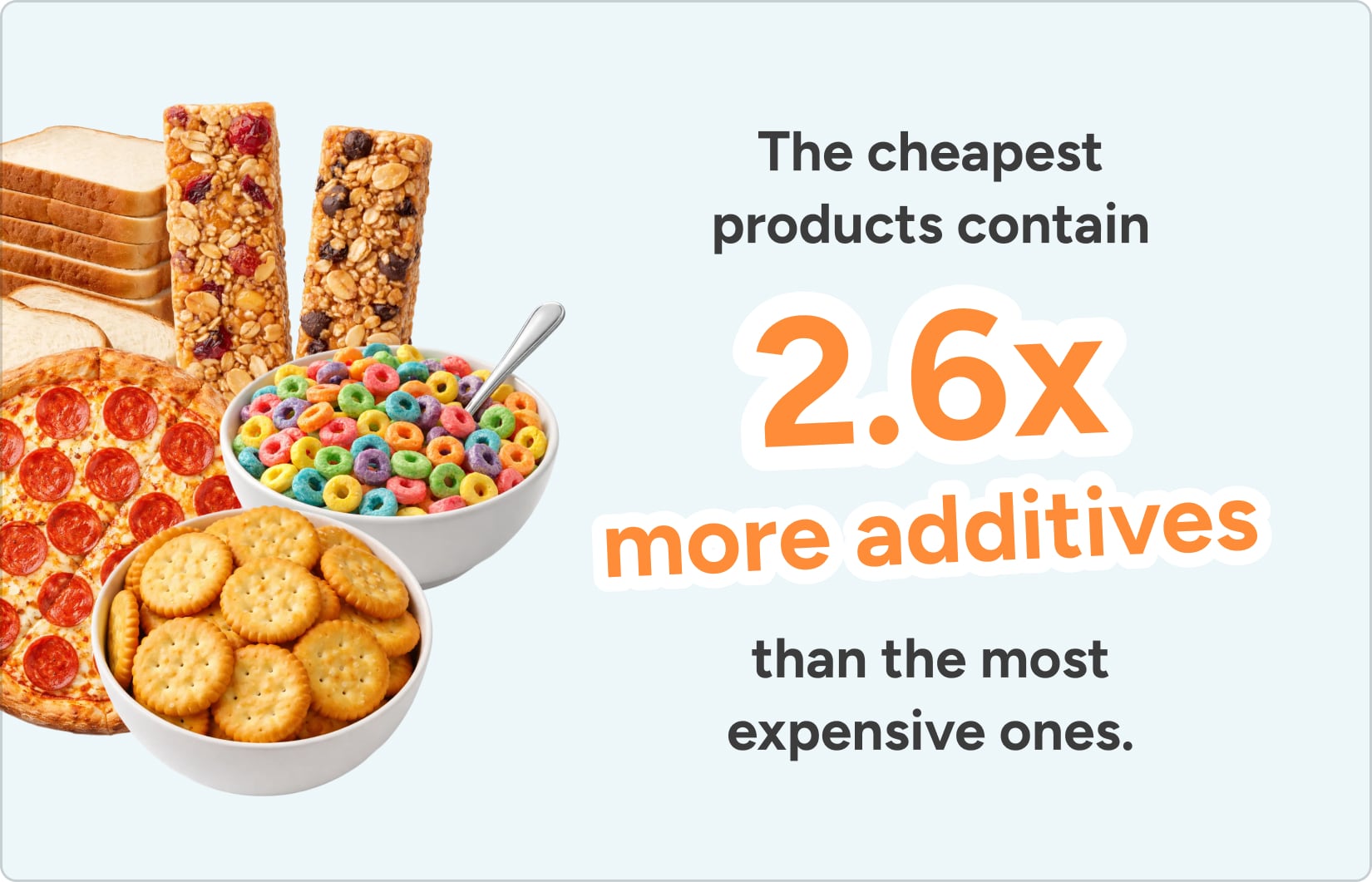
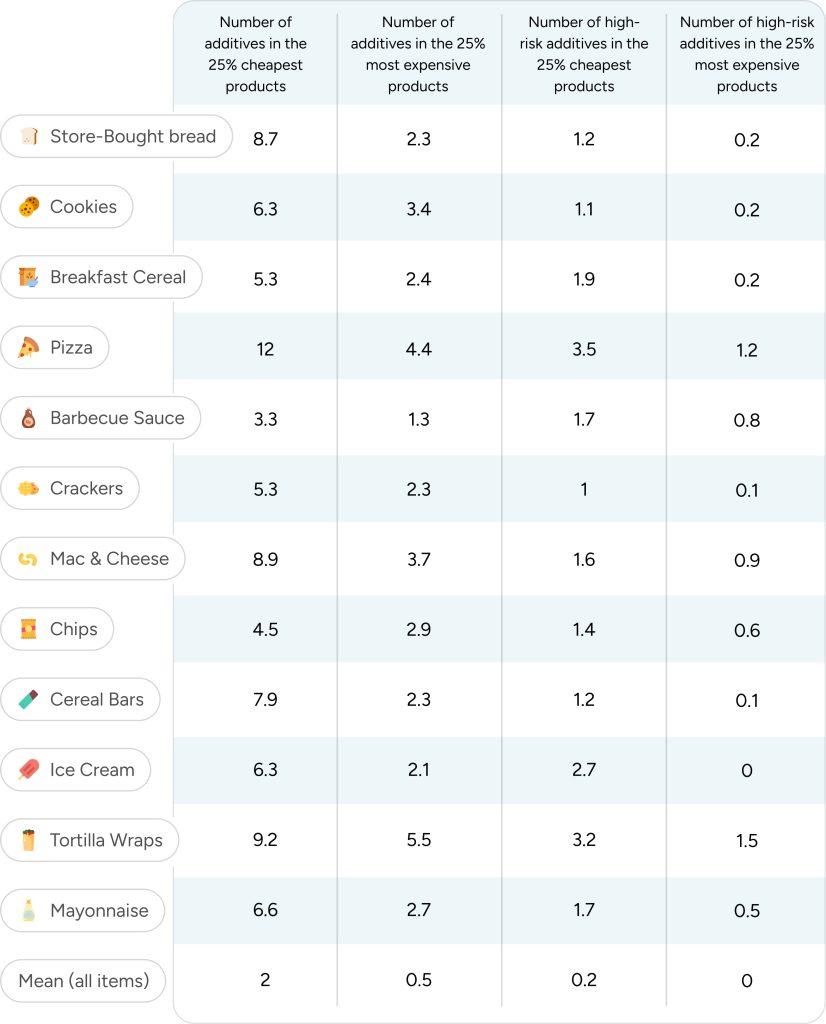
Across the 12 categories analyzed, the cheapest products contain, on average, 2.6 times more additives than the most expensive ones. Products in the lowest price quartile (25%) contain an average of 6.6 additives per item, whereas those in the highest price quartile (25%) contain an average of 2.7 additives.
The gap is even larger for the most concerning additives, assessed as high-risk on Yuka. The lowest-priced products contain, on average, over 3 times more high-risk additives than the highest-priced ones.
Overall, the results point to the same conclusion: avoiding additives—and especially high-risk additives— isn’t equally affordable. Products without high-risk additives are, on average, 63% more expensive than those with high-risk additives.
Store-bought bread
Store-bought bread is a staple in the U.S., appearing in everyday meals—from breakfast toast and children’s sandwiches to burger buns and quick dinner sides. Supermarkets devote entire aisles to it, offering a wide range of options—white, whole wheat, multigrain, sourdough, brioche, seeded, or “healthy” varieties—making it a typical product where prices vary widely while choice appears abundant.
For this category, we analyzed 61 store-bought bread products from 43 different brands, selected among the most scanned on Yuka. The results show a clear and significant association between price and the number of additives: the cheapest products contain nearly 4 times more additives than the most expensive. Products in the lowest-priced quartile contain an average of 8.7 additives, whereas those in the highest-priced quartile contain an average of 2.3 additives.
When focusing specifically on high-risk additives, the contrast is even more striking: in the lowest-priced quartile, 75% of breads contain at least one high-risk additive, compared with only 12% in the highest-priced quartile. And this gap shows up directly in what consumers pay: store-bought breads without high-risk additives are, on average, 28% more expensive than those with high-risk additives.
Breakfast cereal
Breakfast cereals have recently become the subject of significant U.S.-specific scrutiny, as major brands face criticism for using artificial colors and other additives in products heavily marketed to children, despite cleaner formulations existing abroad. This context makes cereals an illustrative category for examining how price influences families’ purchasing decisions.
We analyzed 83 breakfast cereals from 61 different brands, and the quality gap is evident. The cheapest cereals contain about 2 times more additives than the most expensive quartile, with an average of 5.3 additives per product. The contrast is even stronger for high-risk additives: in the lowest-priced quartile, 61% of breakfast cereals contain at least one high-risk additive, compared with 19% in the highest-priced quartile.
In other words, avoiding high-risk additives costs more: breakfast cereals without high-risk additives are, on average, 65% more expensive than those with high-risk additives.
Pizza
Pizza is deeply embedded in U.S. food culture: one of the most widely eaten comfort foods, shared at family nights, birthday parties, school events, and major sporting events. It has become a default meal choice—one broadly accepted across households—and is consumed regularly, making it a meaningful part of weekly diets.
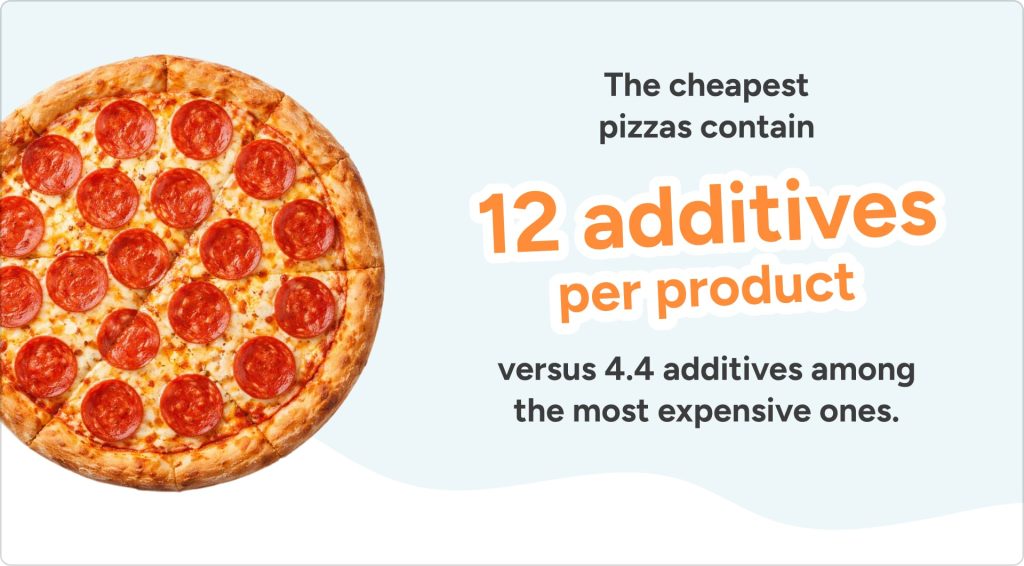
In this category, our analysis of 70 pizzas shows the same price–quality trend observed in other food staples. The additive load in low-priced pizzas is extremely high: the cheapest products contain 12 additives per product on average (including 3.5 rated high-risk on Yuka), versus only 4.4 additives per product among the most expensive pizzas (including 1.2 rated high-risk). Pizzas without high-risk additives are, on average, 35% more expensive than those with high-risk additives.
Wraps
Wraps capture two core American habits at once: eating on-the-go and the desire to “make it healthier.” They are often marketed as a better-for-you alternative to bread—but that health halo can conceal highly processed formulations designed for softness, flexibility, and long shelf life.
For this category, we analyzed 53 store-bought wraps from 31 different brands. The association between price and the presence of additives is clear: the cheapest wraps contain, on average, 69% more additives than the most expensive ones. The gap is even more pronounced for high-risk additives: the lowest-priced quartile contains more than twice as many high-risk additives as the highest-priced quartile (3.2 versus 1.5 high-risk additives per product).
Recap
Cheaper Products Contain More Sugar
The price–composition gap doesn’t end with additives. Sugar follows the same pattern: lower-priced products are both more additive-heavy and significantly sweeter. This is especially concerning in the U.S., where on average, Americans consume up to three times the sugar intake recommended by the WHO¹. Added sugars are consistently linked to major chronic conditions, including obesity, type 2 diabetes, hypertension and cardiovascular disease mortality.²
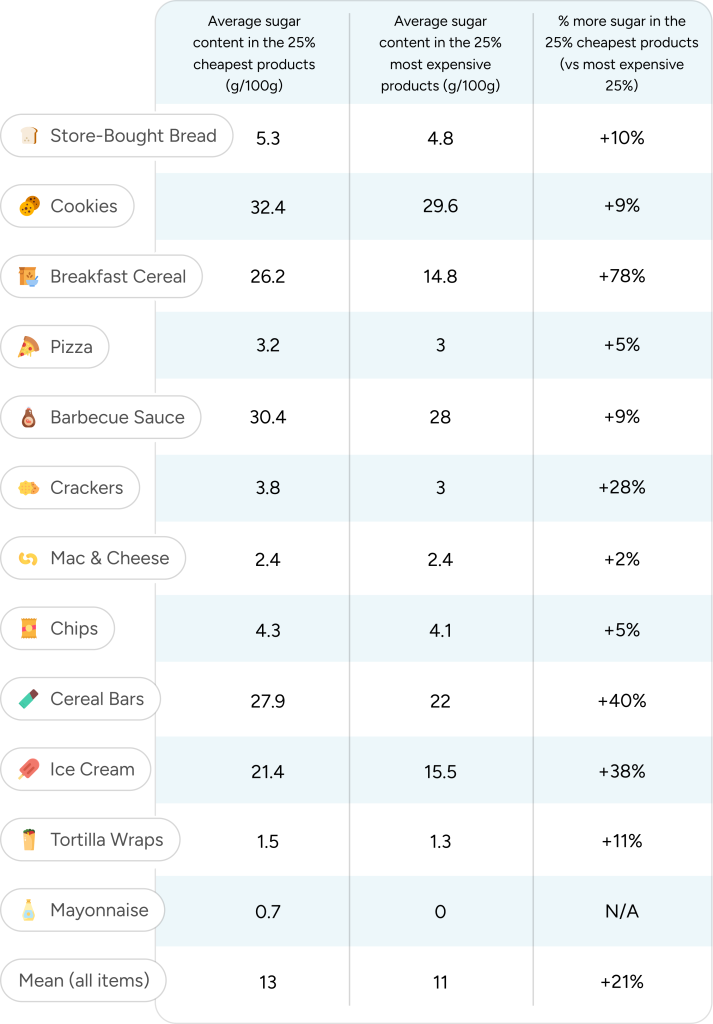
Across the 12 categories studied, the cheapest products contain, on average, 21% more sugar than the most expensive. Conversely, the least sugary products cost, on average, 23% more than the most sugary.
Breakfast cereal
Breakfast cereals have become a focal point in the U.S. debate on additives, particularly due to the widespread marketing of best-selling products to children; however, sugar constitutes an equally structural concern in this category. In fact, the price gap mirrors what is observed for additives: cereals in the lowest-priced quartile contain, on average, 73% more sugar than those in the highest-priced quartile—26g of sugar per 100g of product, compared with 15g in the most expensive ones.
For families seeking less sweet options, the trade-off is clear: cereals in the lowest-sugar quartile are, on average, twice as expensive as those in the highest-sugar quartile.
Ice cream
Ice cream is a U.S. supermarket institution that became mass-market with the advent of industrial refrigeration, and Americans continue to consume it at exceptionally high levels—about five gallons per person per year.³ The category has also shaped global ice-cream culture through iconic U.S. brands such as Häagen-Dazs and Ben & Jerry’s.
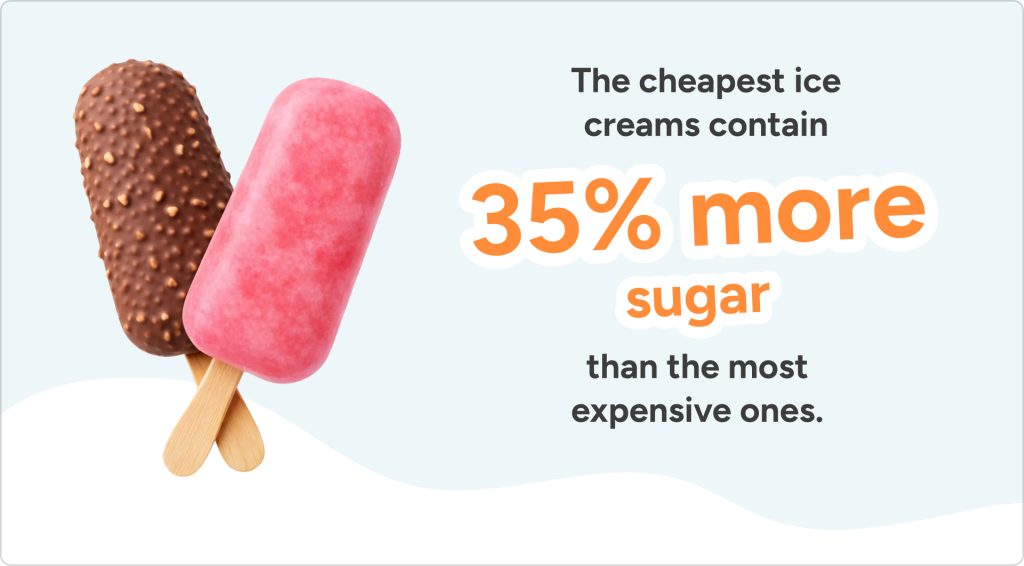
Here too, based on our analysis of 47 products from 28 different brands, price tracks sugar content: ice creams in the lowest-priced quartile contain, on average, 31% more sugar than those in the highest-priced quartile—21g of sugar per 100g, compared with 16g of sugar. Products in the lowest-sugar quartile are, on average, 47% more expensive than those in the highest-sugar quartile.
Crackers
Crackers are typically seen as a savory snack—something to pair with cheese, soups, or eat straight from the box. Yet many supermarket crackers also contain added sugar, which enhances palatability and makes them harder to stop eating.
This category follows the same pattern: across the 95 products from 57 brands we analyzed: the lowest-priced quartile of crackers contains, on average, 28% more sugar than the highest-priced quartile.
Cereal bars
Cereal bars are breakfast cereals repackaged for the U.S. snacking culture—portable, ever-present, and marketed as a convenient default when something quick is needed.
In reality, this everyday format also reveals stark price-based differences in sugar content across the 82 products from 50 brands we analyzed: the cheapest bars contain 40% more sugar than the most expensive, while the least sugary bars are, on average, 44% more expensive than the most sugary ones.
Lower Budgets and Exceedance of Health Recommendations
Using FDA RACCs4 (Reference Amounts Customarily Consumed), we observe a clear affordability-driven nutrition inequity: cheaper products can bring consumers much closer to— or beyond—WHO daily sugar intake recommendations under normal consumption patterns. This is particularly evident for breakfast cereals, cereal bars, and ice creams: one serving of cheaper breakfast cereals can reach 52% of the WHO limit versus 29% for pricier cereals, and cheaper ice creams can reach 80% vs 58% per serving.
Recap
Cheaper Products Contain More Sodium
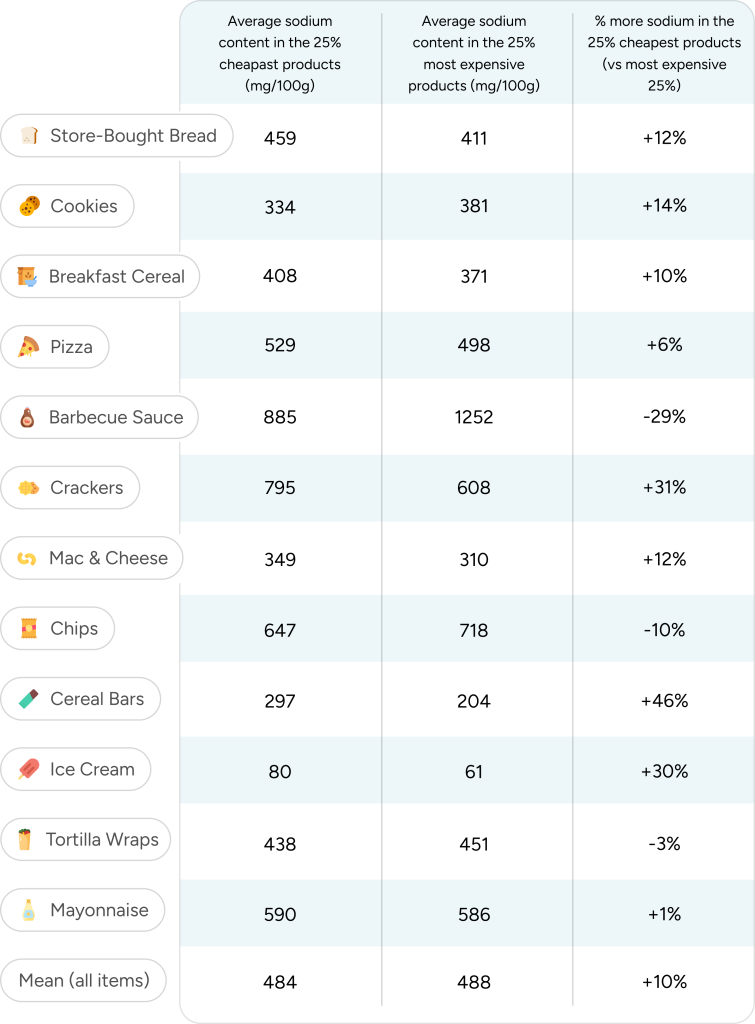
Of the 12 categories analyzed, 11 had WHO-recommended sodium targets⁵—and all exceeded them. In 7 of these 11 categories, lower-priced products showed greater exceedance of the recommended sodium levels.This has significant public health implications. Excess sodium intake is a well-established contributor to high blood pressure and increases the risk of cardiovascular disease, including heart attacks and stroke. The WHO estimates that excessive sodium consumption is linked to approximately 1.9 million deaths worldwide each year, while most populations exceed the recommended daily limit of 2 grams of sodium. In the U.S., average intake far surpasses these thresholds—about 1.4 times the federal guideline (2,3 g/day)⁶ and 1.75 times the WHO recommendation⁷.
Mac and Cheese
Mac & cheese is a defining presence in U.S. grocery aisles: bright boxed classics, instant cups, and family-size ready meals designed to be cheap, fast, and shelf-stable. Here, price often reflects how far formulations are pushed—not just with additives and sugar, but with sodium as well.
An analysis of 72 mac & cheese products shows that the cheapest mac & cheese options contain, on average, 348 mg of sodium/100g, versus 310 mg for the most expensive ones. For consumers seeking lower-sodium options, the trade-off is clear: the lowest-sodium products are, on average, 40% more expensive than the highest-sodium ones.
An analysis of 72 mac & cheese products shows that the cheapest mac & cheese options contain, on average, 348 mg of sodium/100g, versus 310 mg for the most expensive ones. For consumers seeking lower-sodium options, the trade-off is clear: the lowest-sodium products are, on average, 40% more expensive than the highest-sodium ones.
Crackers
Crackers illustrate the broader picture: as prices drop, overall quality declines. Cheaper options tend to stack the same compromises — more additives, more sugar, and also more sodium. The cheapest 25% of products contain, on average, 31% more sodium than the most expensive 25%.
Breakfast cereal
While breakfast cereals are most often discussed in terms of sugar, sodium also plays a role—and lower-sodium options tend to be more expensive.
On average, the cheapest products contain 408 mg of sodium/100g, compared with 371 mg/100g in the most expensive ones. Consequently, the 25% lowest-sodium products are, on average, 59% more expensive than the 25% highest-sodium ones.
Recap
Policy Recommendations
The policy recommendations that follow respond to structural weaknesses in the U.S. regulatory system that allow many chemical substances, including potentially harmful substances, to remain widespread in the food supply, particularly in lower-cost and ultra-processed foods. These recommendations pursue two complementary approaches: modernizing food additive oversight through regulatory reform, and reducing exposure to additives and ultra-processed foods through schools, public institutions, and fiscal policy. Together, these recommendations aim to reduce harmful exposures, strengthen accountability across the food system, and better align U.S. food policy with public health goals.
A. Reforming Substances Added to Food Oversight & Safety
The first set of recommendations focus on opportunities to reform the system of oversight for additives and ingredients added to food, in order to improve the general safety standards and transparency for those substances.
1. Reform the Generally Recognized as Safe (GRAS) Loophole
A regulatory loophole known as “generally recognized as safe” (GRAS) allows most ingredients to enter the U.S. market without FDA review. As a result, 99 percent of new food chemicals introduced since 2000 have bypassed federal oversight. Closing this gap requires federal action, which could be taken by either Congress or the FDA.

Congress should amend the Food, Drug, and Cosmetic Act (FD&C Act) to eliminate the GRAS exemption and require FDA review for all substances added to food, with a limited carve-out for common household ingredients such as sugar, salt, vinegar and baking soda. New substances should require explicit FDA approval prior to use, and no substance should enter the food supply unless the FDA has reviewed it and affirmatively listed it as permitted.
Congress should require all substances used under the GRAS pathway to undergo renewed review, with continued interim use permitted only for substances already known to FDA, while self-determined (non-notified) GRAS substances would be prohibited unless and until FDA approval is granted.
The FDA could alternatively strengthen its oversight by making GRAS notifications mandatory, thus prohibiting self-certified GRAS determinations and preventing manufacturers that withdraw GRAS notifications from still using the substance. The agency should also re-evaluate all GRAS substances within five years using transparent, publicly available safety data that account for cumulative and long-term exposure, and publish these data in a searchable database.
2. Strengthen FDA Post-Market Review of Food Additives
The FDA currently lacks a systematic post-market safety review process for food additives and GRAS substances. Because GRAS substances may be marketed without prior FDA notification at all, and even substances approved via the additive pathway have often gone decades without re-review, safety concerns are often addressed only after widespread exposure has occurred. Strengthening post-market oversight therefore requires the FDA to implement a robust and predictable review framework.
The FDA should start by reassessing all GRAS substances, and adopting a precautionary approach similar to that employed by the European Food Safety Authority: when credible safety concerns of a substance exist, it should be prohibited in the food supply
In addition, the agency should establish a formal, periodic reassessment cycle for all food additives and GRAS substances, with reviews conducted at least every fifteen years. Substances should be prioritized for a full safety assessment based on clear, risk-based criteria, including public health concerns, regulatory actions taken by peer countries, hazard classifications issued by recognized authorities, emerging scientific evidence of harm, or excessive exposure relative to safety thresholds such as Acceptable Daily Intake (ADI) levels. In parallel, the FDA should implement an annual, risk-based priority review list—independent of the fifteen-year cycle—to ensure timely action when new concerns arise.
Finally, the FDA should set or update limits on individual substances and establish group-level limits for related substances to address cumulative exposure. This approach would better reflect real-world consumption patterns and align U.S. oversight with international best practices.
3. Redefine Food Additives and Use Limits
U.S. law defines a “food additive” so broadly that, combined with the GRAS loophole, it allows substances to be added to food for virtually any purpose, including cosmetic or marketing reasons rather than essential functions. Establishing functional and category-specific limits would reduce exposure to additives.
Congress should amend the definition of “food additive” under the FD&C Act to require that additives serve a legitimate, non-cosmetic function. Limiting additives to defined functional purposes would reduce unnecessary use and prevent inclusion driven solely by marketing or appearance.
Congress should also require manufacturers to disclose all additives and GRAS substances used in their products and justify the function of each. Amending the Food Safety Modernization Act to mandate full disclosure of such substances to FDA would increase transparency, give FDA a clearer view of cumulative additive exposure across the food supply, and support stronger, more targeted regulation.
4. Improve Transparency in Flavoring Ingredients
Another barrier for consumers seeking to avoid risky additives is the lack of transparency around flavorings. Current labeling rules allow merely the use of the terms “natural” or “artificial” flavors, even though they often contain dozens or even hundreds of individual substances. This loophole allows potentially risky substances, including self-GRAS substances, to be hidden from both consumers and regulators.

To address this gap, the FDA should require greater disclosure for flavorings. Manufacturers should list the top three substances by weight in each flavoring directly on ingredient labels and include a QR code linking to a complete list of flavoring ingredients. This approach would improve consumer transparency, enable faster identification of harmful substances, and help public health experts assess cumulative exposure across the food supply, without requiring disclosure of proprietary formulas or ingredient quantities.
5. Require Disclosure of Ingredient Processing and Sources
U.S. food labels allow ingredients to be listed using generic terms without disclosing how they were processed or derived, even though certain production methods can introduce contaminants, including heavy metals. By contrast, the European Union regulates additives as distinct substances based on their method of production, even when derived from the same starting material, in line with Codex Alimentarius principles. Each process-defined additive is assigned a specific name and E-number, along with purity criteria, specifications, and conditions of use.
The FDA should adopt a similar approach and require additives to be identified by production method, using existing Codex E-codes or equivalent names, and by establishing corresponding purity standards and use conditions. Including this information on ingredient labels would increase transparency, empower consumers to make informed choices, and allow regulators to better assess and manage contamination risks in the food supply.
B. Reducing Exposure to High-Risk Additives and Ultra-Processed Foods
Outside of policy changes to improve the oversight of additives and ingredients in food both pre- and post-market, there are a range of policy approaches that the federal government, as well as state or local governments, could take to reduce exposure to UPF or to foods containing high risk additives. The recommendations below present some of the key opportunities.
1. Ban High-Risk Additives in School Foods
Children are uniquely vulnerable to food additives due to their lower body weight, developing metabolism and brains, and disproportionate exposure to processed foods, yet U.S. regulations do not adequately account for these risks.
To address this gap, the FDA should establish and maintain a federal list of additives and additive classes that pose heightened risks to children. This would include, among others, synthetic food dyes associated with behavioral effects and endocrine-disrupting substances such as nitrates, nitrites, and BHA/BHT, with risk assessments accounting for both individual toxicity and cumulative exposure.
This list should be regularly updated as new scientific evidence emerges and serve as the scientific basis for restricting additives in foods consumed by children. Using this list, the USDA should revise the Nutrition Standards for Schools and the Smart Snacks in School rule to prohibit, or at minimum sharply limit, foods containing additives of concern from being eligible for federal reimbursement or sale in schools.
In parallel, state and local governments should use their existing authority to further restrict high-risk additives and ultra-processed foods in schools. While federal agencies can set national standards and guidance, states and localities may adopt stronger nutrition policies tailored to their school systems. Several cities and states have already banned foods containing certain artificial colors, preservatives, or other additives of concern in school meals, and California has enacted legislation to prohibit “ultra-processed foods of concern” in schools based on clear health-risk criteria. These policies demonstrate that stricter school nutrition standards are both feasible and effective, and provide a model for broader adoption nationwide.
2. Improve Public Food Procurement Standards
Beyond school meals, governments can reduce exposure to high-risk additives by reforming food procurement across other institutional settings. The federal government spends billions each year on food for public programs, including military service members, veterans’ hospitals, and senior nutrition programs, yet procurement policies prioritize cost over food quality, favoring products more likely to contain high-risk additives. State and local governments follow similar practices. Updating procurement standards to account for additive risk and food quality would reduce harmful exposures and help shift the market toward healthier food options.
Federal agencies should adopt procurement standards or incentives that limit the purchase of foods containing high-risk additives or that are ultra-processed, and explicitly incorporate additive safety into purchasing decisions. These standards could be implemented through updates to the Federal Acquisition Regulation and via strengthened CDC Food Service Guidelines, which should be adopted more broadly across federal facilities.
State and local governments should likewise update their procurement policies to restrict foods containing high-risk additives or ultra-processed foods when public funds are used. Existing value-based procurement frameworks offer a practical model for prioritizing public health alongside cost and can be adapted to reduce harmful additive exposure in state and local institutions.
3. Implement Tax Incentives for Foods with Fewer Risky Additives
Tax policies, including incentives and excise taxes, can encourage both manufacturers and consumers to shift toward foods with fewer harmful additives. Evidence from tobacco, alcohol, and sugar-sweetened beverage taxes shows that food demand is highly price-responsive, and fiscal measures can also drive product reformulation.
Governments could use tax credits to lower the cost of foods made without high-risk additives, particularly in widely consumed product categories. Offering targeted tax credits to manufacturers that reformulate products to eliminate harmful additives would help make healthier options more price-competitive and incentivize industry-wide change, while keeping public costs manageable by focusing on high-consumption food categories.
Excise taxes on foods containing high-risk additives or certain ultra-processed foods are another option, though more politically sensitive due to potential price impacts. These taxes can be structured upstream, at the manufacturer or distributor level, to target industry practices rather than consumers directly. However, because excise taxes are often passed on to consumers and may disproportionately affect low-income households, any such policy should be paired with equity safeguards, including directing tax revenues toward programs that improve access to healthy foods and offset cost burdens for marginalized communities.
The detailed Policy Recommendations and supporting references are available in the full report.

- ¹ OMS, 2023. Reducing free sugars intake in adults to reduce the risk of noncommunicable diseases. e-Library of Evidence for Nutrition Actions (eLENA). https://www.who.int/tools/elena/interventions/free-sugars-adults-ncds
- ² Lee, S.H.; Park, S.; Blanck, H.M. Consumption of Added Sugars by States and Factors Associated with Added Sugars Intake among US Adults in 50 States and the District of Columbia—2010 and 2015. Nutrients 2023, 15, 357. https://doi.org/10.3390/nu15020357
- ³ Terán, A., 2023. Ice cream consumption melts from 2000 to 2021. USDA Economic Research Service, Charts of Note. https://ers.usda.gov/data-products/charts-of-note/chart-detail?chartId=106814 
- ⁴ FDA, 2018. Guidance for Industry: Reference Amounts Customarily Consumed (List of Products for Each Product Category) https://www.fda.gov/regulatory-information/search-fda-guidance-documents/guidance-industry-reference-amounts-customarily-consumed-list-products-each-product-category
- ⁵ WHO, 2024. WHO global sodium benchmarks for different food categories, 2nd ed https://www.who.int/publications/i/item/9789240092013
- ⁶ USDA, 2025. Dietary Guidelines for Americans: Make Every Bite Count With the Dietary Guidelines - Ninth Edition https://www.dietaryguidelines.gov/sites/default/files/2021-03/Dietary_Guidelines_for_Americans-2020-2025.pdf
- ⁷ WHO, 2023. World Health Organization Global Report on Sodium Intake Reduction https://iris.who.int/server/api/core/bitstreams/296605a9-820a-41bc-8f28-bf4b1367d530/content


Very Informative … And very Unfortunate! Thank you!! That’s why I try to use my app.
This is very interesting. Thank you YUKA for this and all your info. I love this app. It has really changed the way I have been eating. Please keep doing what you’re doing it is so helpful to many people.
This is a great article and thank you for sending.
Yuka has changed the way I eat by being able to compare products in real time what I am about to purchase. I love this app and it really shows how much the advertisement on healthy products are not really healthy at all once you dig a little deeper.
Let’s lower health care costs by eating more safely and healthier. The responsibility starts with us by applying YUKA app. to most everything we can.
Thank you so much for the information YUKA provides. I have learned so much and have much more to learn. While shopping and scanning a food code, I am often asked what I am looking for. It’s then that I can introduce someone to YUKA.
Im always sharing Yuka with people in the stores and with family and friends. Thank you for the app. I do use it a lot , but it’s sad that we have to pay so more for quality food. My husband and I are senior citizens so it is difficult.
Thank you for all this information, it’s not only helpful but indication on how we need to be aware of what we eat and what’s good or bad for us. Thank you. something I will pass on to family and friends.
What can we do to encourage your solution?
I’m great full for the app a very useful tool which I preach, change will happen when us the consumer avoid fast foods and drinks and demand changes in school cafeterias vending machines start with local government.
Keep up the good work.
Thank you for the information! I use Yuka on every shopping trip and try to use online but Walmart and other sites block the UPC codes on many items 🙁
Thank you for all that you do and for this apt we use every grocery trip
I am so glad my brother told me about Yuka. Shopping is much easier with Yuka and I don’t buy anything until I Yuka it! Thank You for the information.
Thank you for this thoughtful report! We use your app every time we shop for food—it’s an invaluable resource. I can’t tell you how many other shoppers I’ve shared it with while shopping, especially if I find someone reading labels. I know we were never keenly examining products that we were buying like we do now. We’ve also greatly increased our shopping hours. Thank you for the input and eye openings.
I love this app its very helpful
Thank you for this app and all the research you are doing. It has changed the way I shop. Plus, made me aware of Products that I thought were healthy are not. I have been sharing this app everywhere I can.
I viewed the report. WOW! So thorough! But the rating of the food was left off. What is a consumer to do? Another column in the report with a rating would have been so helpful.
Keep scanning bar codes, the reports are there.
Thank you for this insightful report! I use your app every time we shop for food—it’s an invaluable resource. I thought we were careful about what we purchase, but the app allowed us to really be even smarter about what we spend our money on and consume.
Thank u for sharing this.
Good food starts where and how it’s grown. Much of nutrient rich foods are being destroyed while still in the ground. The “Yuka” app is quite helpful when determining which “healthy” products to choose from. It’s interesting that not all healthy items produced by the same mfg., come up as healthy.
THANK YOU FOR THIS REPORT! America is waking up!
Having lived in both England and the US, I can vouch for the astounding difference each country’s food has on my own body. Eating a similar diet, my weight stayed 15 lbs lower in the UK than it had been in the US. Despite awareness and taking preventitive action, our relocation to the US caused an additional 15 lb increase on my frame within the first two years! Your suggestions for necessary changes to the FDA’s approval system are a necessary start, the biggest hurdle being how to overcome the devious tactics of the food manufacturing industry. Brilliant report!
Your app has transformed everything about the way we shop, prepare and eat. Even at restaurants, we are keenly aware of what to eat and what to avoid. Thank you for your extensive research. As shown, it is very expensive to pick the healthiest options, but worth it. Would love to see this become common sense and equalize the pricing structure.
This very concerning! Why is our government allowing this?
It is very evident that the nutritionally worst foods are “more affordable” which is very sad. Everyone should have access to great quality food and that will in turn improve the overall health of the entire population. We wish you luck in getting go ernment involved and changing policies!
Thank you for this! I have witnessed this trend. As we travel, we have been able to experience the effects of other cultures habits and foods. Less is way more!! Americans are being duped by the dopamine rush.
This is so sad to see these numbers. It is addiction hidden in cheaper foods with flashy labels. Regulation needs to make it mandatory to show impact on front label in larger distinguished type with these five numbers: # of additives, sodium, sugar and saturated-trans fats.
Ever since I’ve been using the app I’ve modified my groceries by so much. It keeps me and my daughter from shopping junk food. Sad that government doesn’t care about what goes into the food. Big pharma is making the money here when people get sick from all the chemicals and additives put into the food! Ughh – thank you for your app I share it with everyone I can.
Its really good for people to understand about what they are putting in their mouth however trying to make ALL the things you like is hardly reasonable so getting people to read labels and understand them is sn issue . Having worked for 17 years with people and their diet seemed as though i was wasting my breath. I have even approached ladies in the groceries store looking at a particular product and spoke to them about the product. Some were slightly interested and some were not. They want what they want.
In my opinion they are penalizing people who live pay check to paycheck using us as lab rats !! Medical is making a killing on health problems putting people that live paycheck to paycheck in debt with dr bills.
I love your app and I share it with anyone that will listen!
Thank you for this thorough report. It reinforces the data I’ve seen through your YUKA app that I use weekly when I shop for food. I’ve shared your app with many friends and family members, including my adult Son who has Down Syndrome and heart issues. He was surprised to learn about the extent of additives and sodium that are in our foods and finds your colored bar charts extremely helpful. Thank you for all the resources you provide us so we can make informed healthier choices AND for saving us time when searching for a healthy choice in our long bread, cereal, baking and beverage isles.
Our government needs to step up in properly regulating our food sources, so our society can be healthier! If we had healthier food, we would probably not rely on prescription medication in our everyday life.
Thank you for the report. The app is wonderful; extremely helpful. I would like the US Congress and FDA to be more involved.
Why does the Government allow this to our food? The European Government does not allow this for
Their people. I am shopping more European products if possible.
I’m 70 years old I follow your dietary advice, and it has helped me a lot, thank you very much.
thank you for all information you provide us.
This report is eye opening. Changes are needed for the health of the people
Thank you so much for this important information. Let’s hope the changes you recommend are implemented.
Thank you for what you do ! I am a recovering cancer patient and have a very limited diet. The $$ I have to spend on food is limited and find it hard to eat more than 2 meals daily of quality food on my budget!! You have been an enormous help as I spend a lot of time choosing what I buy. Your app has helped SO much ‘
Thank you Yuka, I scan everything, it brings about healthier choices and mindfulness practices regarding food. If it’s not known to Yuka, I make a choice that’s known. I have shared the app and encourage everyone to use it.
Many changes in school foods should be a priority
Grass fed milk should be in all schools
Thank you . The Informations are very helpful ! I use the Yuka app everytime on products i consider buying. I relay on it .
I also share the App to so many people.
Thank you for this report, it is excellent. I hope it makes an impact on everyone, that we have to watch what we are eating. I use your app all the time, it is so helpful when I do my grocery.
Great report. Clear information.
Hi Julie,
I use the Yuka app and share it with everyone I can. I only buy items rated Good or Excellent. Thank you for this tool to help us eat healthier.
It’s not getting better as long as the current Federal administration is in office.
The 2026 elections matter–vote, and think about who will support choices that enhance the content of food as opposed to choices that make more money for the company and endanger our health.
Very helpful. Use your app frequently
Thanks so much for this excellent report. As a retired Doctor you have distilled my beliefs into a very concise study. I will forward to my family and you should send it to Robert Kennedy the secretary of HHS
We need to ban high risk addictions not just in schools but everywhere!!!
Hi Julie, thanks for sharing the Yuka/Harvard report. I just finished it, and it’s a powerful look at the hidden costs of cheap food. Definitely highlights necessary changes in policy. Thanks for keeping me in the loop! I’m definitely sharing it!
Thank you – such simple suggestions for helping to make Americans healthier. It will be interesting to see if those in power actually take notice.
I use the Yuka app on every product I consider buying. If it is not good or excellent I leave it on the shelf. I have introduced many people to the Yuka app. THANK YOU
Thank you. Information very helpful. I’ve have given your app to so many people.
This by far one of the most useful and accurate tools available.
Thank you for your time and effort.
Thank you for all you do, if we are educated on what is out in the market place we can make better decisions on the food we eat. Great work!
Yuka provides such a great service. I rely on it. Thank you. This study also is an argument for eating whole foods and cooking simple meals from scratch whenever possible.
SO appreciative of your app and a tool to have some idea of whether what we’re eating is nourishing us or leading to health problems! An eye opener and has deleted many previously purchased products. Thank you!
Very interesting article.
Thank you for putting it together and sending.
The more information and chatter created on this subject will help transform to more healthy choices over time. Hopefully sooner than later
This app is very informative I ap
preciate the work you all are doing. Thanks
Why not make this article shareable?
Thank you for this informative article. It is obvious that the US does not care about the health of its citizens. Hopefully, using tax credits will give companies the incentive to change how food is produced in this country.
Love your app
I have done some research on the validity of yuka recommendations and with research like this, I am getting convinced that yuka has some credibility. I will continue to to follow up research articles and topics like this one.
GREAT
What can we as consumers do to help implement changes?
It seems quite disgusting to learn, learned the pathetic food practices that are implemented in the United States and around the world, they certainly do not care about anyone’s health. No wonder we have so much sickness and depression and issues with our complete human systems. I truly praise yuka for once again, letting us know the truth so that we can make much better choices👍❤️
Although ALOT of people find these studies and reports very helpful, I KNOW WHAT EVERYONE WHO ARE TAKING THE TIMEto read these would have 1 big question in they’re minds. Why don’t you list recommendations for ” WHAT KIND OF BREAD AND OTHERS PRODUCTS to add to my grocery list”. That would help IMMENSLY.
I love referring to your site daily but regarding this article I would like you to post a list the best products to purchase in each of these category.
“isn’t equally affordable. Products without high-risk additives are, on average, 63% more expensive than those without high-risk additives.”
We also have been finding the same results just by scanning products in the stores. We always abandon those items! Thanks for the app!
Thank you for your link that I can open and read lists in each category of food that can harm our bodies. I find that it is helpful to know about them that gives us red flags.
What an interesting through study. It is good news our government is working to make these improvements.
The problem is that the government ISN’T working to make these improvements. Instead, they are reducing regulation and oversight.
I love your app!! So helpful and informative.
Does this surprise anyone? We have a food industry that doesn’t take the consumer’s health into consideration, and we have a medical industry that doesn’t take into consideration what people eat. It’s a recipe for disaster.
I love the app and I think you’re doing a really good job informing and educating people. Sometimes marketing is just fooling people.
Been using for at least a year, I love this app. I’m using the yuka app in any grocery store that I go into, regular store or health food store, I am surprised at how many poor quality items that some Health food stores have.😳
Thanks much for all the information,
And thanks for putting this app together!
So True. I was amazed at how poor many of the products at Whole Foods were. We have really changed what we buy and are happy to find products and food at our regular grocery store that are good for us. Love Yuka!
Exactly! The sheep who shop at Whole Foods think they’re doing something healthy, but I’ve found out after scanning items on the shelves, many are no better than Walmart items!
Been using your for while thanks for all your advice on which products are better great write up
I’ve been using the Yuka app for over 2 years now. I scan everything! If the product (no matter what it is), does not score well on the app- I find a product that will work for me and my family!! This is a GREAT article- more folks need to be using the Yuka app. Thanks so much!!
Your company is a must for everyone. From food to what we use on our bodies. I am so tired of watching what products are so clean on TV talk shows only to find out how poor our bad they are because of your app. Even items such as lotions etc that doctors of said to use. You need to do the talk show circuit in the United States and see people straight. Maybe we would have less cancers and heart disease. Thank you for all that you do. I will not buy an item without scanning and reading about it. 👏👏👏👏👏
Well said. Our household does the same.
I’ve been using your Yuka app for 2 years now. Every time I go to the store I scan everything! If it’s not a good score I put it down till I find a good item that’s healthy for me. It’s horrible what they’re doing here in the USA! Especially to our children! And to my grandchildren! Thank you so much for keeping us informed or no one else will! God bless you all 🙏
Unless healthier options are readily available, more efficiently accessible/consumed, and affordable to those seeking cheaper options, it’s not going to change. There’s got to be some kind of quick incentive for consumers.
Why are the food industries trying to kill us with their chemicals?
Its cheaper for them to make the product. They are thinking short term bottom line.
They are not trying to kill you, per se. They do this in order to make their products taste appealing and extend shelf life. They know that most people will eat anything, regardless of how unhealthy it is, as long as it tastes good, and they will eat massive quantities of it. The only way you can defeat this line of thinking is with your dollar. Don’t buy shit that is processed or ultra-processed.
to lower the population while making more money,🙁 then Parma can step in with more chemicals, then there is the supplement companies, it never ends, 🙈
Thank you for this information. So much for making America healthy again.
This is a terrific article. I wish the “good” food producer companies could be named. We could buy those and avoid the “fake” food producers.
At the least, put a spotlight on the companies that are using flavorings, additives, etc etc, by putting their name and the reason we should avoid them, up in Bold Letters.
Thank you! I do use the Yuka App to screen the products we buy.
Keep up the excellent work!
Carol
Thank you for bringing this to our attention!!! Which ice cream brand is safe to eat?
Hi – I had the same question. My doctor told me that Breyers had the least amount of ingredients. Of course, it’s pricey but it’s worth it to me.
I have noticed when I checked on items at Aldi, a low-priced supermarket in my area, that the Yuka readings are very low. I find myself putting more and more of these items back on the shelf and finding each equivalent items either in Publix, a higher priced supermarket, and at my favorite store, Costco.
Patricia, look closely at that container of Breyers and you will not see the word ice cream anywhere on the package. If you want a healthier alternative, buy frozen yogurt. I give it to all my friends and family, and they cannot tell the difference between ice cream and frozen yogurt.
The answer to your question is “none”. Some are healthier than others, but there is no healthy ice cream. Stay away from dairy altogether. https://nutritionfacts.org/video/dairy-and-cancer/
I absolutely love this app, its my go to for healthy eating and I’ve passed it along to many many people. Its,a real eye opener to what’s actually in our food. I think our government needs to do more to expose these toxic foods we are eating. Thanks again for a great app.
The way to change this is to shine a light on it. Bring this info to the local news stations. If the public knew more the public would stand up to boycott and the rest would be history. We need to demand better. Strength in numbers. Sheesh these additives are poisonous
Please Note: I had just sent a comment about my hyperactive son and food additives and stated it was in the 1960’s, but it was actually in the mid 1970’s. Sorry about that!
This information is so important! My son had hyperactive issues way back in the 1960’s. I just happened to watch a program on TV about this issue and bought a book that explained what needed to be done to help with the problem, and it was about artificial ingredients, artificial colorings etc. I started reading labels carefully and making everything from scratch with only real ingredients and he was a changed kid! The following school year, which was grade school, I actually received a phone call from the principal asking me what I did to my son because he was so well behaved. When I explained the food issues, he was shocked! This was sooo many years ago, and it makes me furious to think nothing has been done about this so many years later!
Thank you for all of your much needed research. You have changed our lives!!
These findings are not going to surprise anyone. Obviously, for something to be cheaper, the quality of the ingredients has to be poorer. The bigger question is do American people care? Stand in line at the checkout at any major grocery store, notice what people have in their carts, and you’ll have to conclude that people base their choices on convenience and price, not the quality of the nutrition.
Once again we see (it’s all about the money). So grateful to you and your staff for pointing out these harmful substances included in most of our foods.
Keep up the good work.
Thank you for testing all the food groups with price, ingredients & additives. I won’t buy any product without using my YUKA scan first. You are doing a great service for consumers.
Thank you so very much for your hard work on our foods and so much more!
So what seems to be evident from this report is:
If you have money you can buy food that is safe to eat.
If you are a working stiff you are out if luck, you eat only what you can afford even though it will kill you in the long run.
If you have money this is an excellent app.
It shows you the health of each of your food choices and gives you healthier choices of what is better for you to eat ….. but only if you can afford it.
The more money you have the healthier you can eat.
Living is only for the wealthy.
I use your app when I go shopping to help choose the healthier items.
I have also recommended Yuka app to other shoppers while I do my grocery shopping.
We also pray over everything we eat asking the Lord to nourish us with what is good and protect us from everything that isn’t good in all the food we eat.
I have been using your app for over two years and it has eliminated my skin rashes and allergies By avoiding the chemicals in the food I eat has made a huge difference in my life. Thank you
Wow! I do not eat a lot of processed foods. That being said, I will be checking my pantry foods with the Yuka app and changing what I do buy and dropping entirely some items.
Thank you for keeping us informed.
The full report is really hard to understand. I was hoping to see how each of the products tested or ranked so I would know which ones to avoid. If the full report does that, it’s not clear at all. I’m so glad the study was done and I totally agree with all your recommendations. I hope JFK Jr is getting a copy of this too.
Feel same way you do, Amy!
This is great information, thank you. I have introduced many people, in a grocery store to your Yuka app. They are amazed at all the information that is given.
Excellent article and supports why I don’t eat processed foods…or at least very little!
I am so grateful to have found Yuka and all the valuable information provided on what we sell and consume in America. Since I’ve started using the Yuka app. I have been hyper vigilant of checking out everything that I’m purchasing to eat and also what I put on my skin. I’ve seen a world of difference. It’s so unfortunate that to buy the healthier option. you have to spend more money. Is also criminal to think that this is the standard. Thank you for continuing to research and update the public as I will continue to spread the word of how we can make a change through Yuka.
This is why programs such as SNAP and OTC/Grocery from health plans are so important. Eating healthy costs more. Providing financial support for the disadvantaged and elderly is the only way to ensure healthier choices are made.
Awareness! I hope we can make this report or any report available to all Americans. Thank you for what you do!
Very, very, informative, thank you. I wish everyone buying food would read this.
What you do is a godsend. Thank you for caring and making a difference if only to spread the truth.
it seems that Secretary KENNEDY is spot on about the food industry using harmful additives. No wonder he is loath by the elite.
How do we actually get , big money , because money is what it’s all about, to actually do the right thing?
Thank you for this informative article! When I was a young twenty-something living in Paris I considered becoming a diététicien for a brief moment. I quickly understood that the job in America would focus on coordinating meals in hospital settings, using mostly packaged foods with endless numbers of ingrédients.
This publication is a first step in transforming that system. Thank you.
Show the products with the results; this isn’t helpful much otherwise.
What gets me the most is the school lunches for kids. I work at the school and it is awful to see them eat such bad foods. We are all getting sickness and disease from these foods. The additives and preservatives along with all the added sugars. What a shame for us all.
Very informative article. I use the yuka app every trip to Kroger. It definitely helps me decide what to buy. But I was disappointed to purchase frozen salmon that passed the app only to get it home and read on the back that it had bioengineered ingredients. I assumed that would show up on the app. Will be looking more closely at what passes the app now.
oh wow! concerning….
I de-googled my android, and miss yuka so so much. Please look into making a version for F-Droid! I switched to Vegan eating this summer. I started with pescatarian, switched to plant based, then all the way! Yuka was there with me the whole time, just because it is Vegan, doesn’t make it healthy.
Appreciate this information, getting our food supply cleaned up and healthy is a must! I don’t understand how allowing this to happen to our food supply isn’t criminal, clearly putting chemicals in our food makes people sick- this should be illegal and people should be held accountable!
Yes, I agree.
Super helpful information thank you
would it be possible to do a letter sent to Congress on the part of Americans demanding all your recommendations suggested. i.e. like what Consumer Report does. Maybe this recommended report can be teamed up with Consumer Reports to have as much a powerful voice as yours doubling its effectiveness. Anything to get those in power to take our voices seriously Thank you
I’ve lived abroad but mostly in the US. I’m modified and dumbfounded by how careless are FDA government Congress is with the health and well-being of our citizens, but I have no idea how to get through to people to care and to help get this changed.
Very helpful thank yoy.
And one simple thing we could do to at least make it easier to understand the differences, is to make “per serving” sizes consistent like the 100mg used in Europe.
It seems that food producing companies have “influence”
In governmental decisions. It’s not what’s good for Americans’ health.
Money speaks…too often and behind the scenes.
I used to live in Switzerland and appreciated relying on labels that indicated the healthiness of products from A (most healthy) to D or E. It simplifies reading labels for all consumers. This system works, although I am not familiar with who/which organization evaluates the products and assigns the letters.
What’s in bioengineered ingredients that’s added in foods?
Thank you for this report. I have learned a great deal. Continue to keep us informed.
The Amish are healthier than most due to their food practices.
I’d like to know this too!
And, are the bio-engineered ingredients the same in every product?
I can never understand why the United States allows so many harmful ingredients. While other countries with less resources doesn’t allow it. That’s because I believe United States is money hungry, greedy, and less caring.
They want us sick
Excellent reporting on the importance of exposing and educating the public on our food supply and the need to address these issues with our policymakers !
Thank you for this extensive report and for helping to improve our food supply! It is vital for the health of all.
Thank you for the value information. Please keep it coming. I appreciate all the hard work.
It is disheartening that this study shows what is happening with the food supply. There are so many growing children and their family that cannot afford to buy the more expensive food choices.
Mahalo nui for all the research. I use my Yuka app all the time. Gracias!
Thank you so much for your continued effort in showing the true ingrdients in the foods we purchase for a healthier lifestyle.
Thank you for this research. I am going to send this report to my representatives in government and tell them to take action for healthier food in the US. Other countries do it , so can we.
Thank you for all of the research you do. I have been using your app at the grocery store and it helps ;with my purchase decisions.
Great job
Using this app and having access to hidden information. Gives a whole new prospective on what you purchase and eat nowadays. Hopefully with your help a great change will emerge. Thank you
Since the late ’70s I’ve been saying – “Pay it on groceries or pay it at the doctor’s office” – now I’m old and in good health after having several uncurable cancers in the late ’70s. Praise God!
Thank you Yuka, for all you do!
I really appreciate all you do. I use your app all the time. I had cancer and it helps me avoid unsafe products. Thank you for caring enough to effectuate health.
Thanks for your hard work. Use the app on everything when we go shopping. Feel much better about eating these days.
I use Yuka whenever I shop. I am a Dean of a medical school and love this article; Hopefully, RFK will be instituting some of these proposed changes.
Have been using YUKA since being diagnosed with Cancer. I share it with everyone! Definitely have changed my diet using the power to make better informed decisions. Thank you!!
This contributes to rising rates of chronic illnesses while healthcare systems struggle with the consequences. It raises serious concerns about how decisions are shaped and whose interests are truly being protected. I strongly believe there needs to be greater accountability,and stricter regulations.I hope for courage to create meaningful change.
Yuka opened my eyes to so many things. I have turned others on to it & they are amazed at the eye opening info! Thanks for all you do & making Yuka such a great tool!
The FDA and these food producers we trust should be jailed. They should be ashamed of themselves. How do they sleep at night knowing they are feeding the population chemical infused foods
I do not buy anything without scanning the upc with Yuka. Thank you to everyone on the Yuka team.
Very interesting article ! The sad part of it is that, lower income can’t afford the so -called better food. The government keeps it that way, keep society Obsese, un healthy , and Pharmaceutical gets richer ! That’s the plan ! Pretty sick right! Love the Yuka Apt, use it all the time
Grateful and Thankful to Julie and all her helpers for Yuka App.
Being using it every time we go shopping for groceries.
My grandson told us about Yuka .
I have shared the app with lots of family, friends and strangers at super markets .
May God bless all of you at Yuka
Knowledge is powerful. The Yuka app taught me which products are best to spend my dollars on. When the best option isn’t in my budget, I am learning to go without or make it from scratch. My health has improved so much that when I decide to try a food that is “bad” I can feel the effects in terms of digestive disruption and inflammation. These foods aren’t worth it. And now, J understand why. Thank you Yuka App!
Thank you for sharing this information with us all, my “Yuka” has been very busy again. Very useful and I do call the companies and let them know I don’t like what’s in their products 🩷
This is the best app ever! I share it with anyone who will listen. It’s changed the way I eat and buy products. They should have Yuka recommendations in every store in the United States. That would get the attention of manufacturers.
Because of you, I now know which better brands to choose. Almost 90% of my favorite snacks contain bad additives like Cheeze it Thank you so much
Thank you so much for this informative email. Thank you for all you do to help us stay healthy. I’m really glad my neighbor introduced me to this app.
Very comprehensive report indeed. Now We need to push Congress to do their part by keeping them busy to follow through with all that Yuka highlighted in this study.
My end of the year report stated I was in the top 1% of Yuka app users! It is valuable info like this that encourages me to put back most of what I scan with the app!
I loved the research and wish you were able to share the products you researched in the report. For instance, WHO makes a healthy pizza?!😉
Thank you so much for this!
Thank you SO much for the extensive report! Now the government needs to take action to ensure our future health! Company profits VS our health! Yuka is making a huge difference in my purchasing decisions! Thank you!
Thank you bringing this very important finding to the forefront. I appreciate the work being done through Yuka and hope this will help bring about change in the food industry.
I would like to know which of the listed products that you tested proved to be the best. Is there a product hierarchy available?
That’s exactly what I’m looking forward to seeing in the next article.
Thanks, Excellent information 👌💓
Thank you for this comprehensive work and the research! I really appreciate Yuka and find your recommendations to be pretty helpful! It’s so disappointing that healthier foods with less additives are so much more expensive than cheap, nutritionally-poor and harmful food. With the high food prices it’s making hard not to purchase poor nutritional food.
Please give us a list of the bad ingredients. It would be great to have a comprehensive list to refer to while shopping.
Thanks
This is a great article! It was very informative and provided solutions to widespread problems. The solutions desperately need to be implemented. Would love read more on this topic and what is happening in this area.
Agree with these findings, and it’s more difficult to but healthy choices which leads into purchasing food products with long lasting negative results.
Thank you for this revealing report. I think it’s a fallacy to repeat the mantra that only the wealthy can afford nutritious foods. The fact is that processed foods are generally much more expensive than real whole fruits, vegetables and proteins. Although it’s hard to live these days without buying some processed foods it’s unfortunate that so many people consume mostly processed foods and minimal real food. I believe it’s a combination of laziness, extreme marketing by the processed foods industry and mindless acceptance of the old food pyramid that was pushed on so many of us for many years by or own government and processed food industry.
I think it’s a shame that to eat a balanced healthy diet, you have to pay “much” higher costs. The higher prices on groceries due to inflation doesn’t help. A lot of hard working individuals can’t afford the costs of good nutrition.
Thank you for this comprehensive work and the research and effort that went into this work! I really appreciate the important nutritional insights Yuka provides, and find your recommendations to be pretty helpful! Will definitely keep this in mind when I next make a trip to the grocery store! It is disappointing and alarming that healthier foods with less additives are so much more expensive than cheap, nutritionally-poor and harmful food
Interest information will pass along
Do you have a petition to Washington that we can sign?
Everyone should support making healthy food available for consumption. Our lawmakers must develop standards to make this happen.
Thanks for this invaluable research and information. Are you sending copies of this report to the people in Washington who can do something about the problem?
Thank you so much for all that you do. I don’t purchase anything without yukaing lol. It takes me longer when I go grocery shopping but that’s A ok with me!!
My wife has me trained….I don’t buy anything “new” unless I check it out on the Yuka app…..If it doesn’t “bark” like a dog…it’s clearly not going to pass the oversight process in my household… Just wanted to put it out there that your app is a “family anchor” to all food item purchases. And, I’m sure, I’m not the only one here….
I don’t buy any of the bad things that you listed. I buy mainly all organic fruits, vegetables, pasture raise eggs, dairy and cheese etc. . I also only buy wild salmon and shrimp. I also only buy grass fed hamburger meat. Good tuna((low in mercury), sardines in water in cans. Most of my organic food can cheaper than the bad food! Dinner: Wild salmon, vegetable, organic coucous or potato and fresh fruit for dessert for about $5.00 for my husband and myself!
This is exactly how my husband and I eat. Farmers Markets are the way to go. Our grass fed beef is from a local trusted ranch. Costco also has a lot of organic choices. It is alarming the amount of junk people put in their bodies. Don’t get me started on McDonalds or any fast food places – cringe!
Thank you for all your research and sharing.
Friends who have food allergies at home
in Canada report that they can consume bread and dairy products with no ill effects when they travel to Europe. That should tell us something about our policies…
you guys are awesome, we really appreciate you, GOD BLESS YOUR WORK
Thank you for your diligenct efforts to protect the health of all populations! It’s amazing what you’re doing and the extreme organizational efforts and commitment to our health!
Someone needs to make sure Mr. Kennedy gets this report so it can be acted on by legislation. Just think if all foods with few additives were cheaper than the foods with lots of additives we would be most importantly be more healthy along with a cheaper food bill.
Thank you for your education for us!
This is a fact I’ve known for years.
Wealthy people can afford to buy foods that are healthy. Families living on government assistance or living pay cl to pay ck can’t afford to eat healthy.
This is the American way !
Healthy food options are expensive.
The food industry couldn’t care less that
Poor families are consuming excess amts of fats/salt/chemicals.
So many communities in America are
“Food deserts” the local $1 store is where shopping is done. No fresh fruits or veggies. Only carries the cheapest
Food items.
Bottom line…. America & the food industry only cares about the health of the wealthy.
You guys are so awesome in bringing the truth to us. We share it with everybody we can to understand the deception out there. Keep up the great work you are saving lives and helping us all to fight this battle and not selling out to the enemy. 🩷
This is a fact I’ve known for years.
Wealthy people can afford to buy foods that are healthy. Families living on government assistance or living pay cl to pay ck can’t afford to eat healthy.
This is the American way !
Healthy food options are expensive.
The food industry couldn’t care less that
Poor families are consuming excess amts of fats/salt/chemicals.
So many communities in America are
“Food deserts” the local $1 store is where shopping is done. No fresh fruits or veggies. Only carries the cheapest
Food items.
Bottom line…. America & the food industry only cares about the health of the wealthy.
Amazing job. Excellent information. Necessary for everyone.
Very eye opening report and a great read. Thank you !
Absolutely amazing job from the Yuka team once again. I love this initiative and want to support it. We absolutely need to amend the GRAS loophole.
Fantastic report to highlighting a major issue for the every day consumer; healthy groceries are significantly less accessible to a huge portion of Americans, especially those with kids. It is so rare to find an article that highlights issues and then offers clear insights into corrective action that our government COULD execute. We should be writing to our representatives and making it clear that Food Safety and FDA reform is a leading issue for American health.
Why not ban high risk additives in all foods, not just school foods
I’ve found cheaper cereals and bread are at aldi’s grocery stores, are better than most and are much cheaper,and a lot less chemicals
This is very good. Please add a category GMOs. Lot of these foods contain deadly GMOs.
I never understood why countries like the UK and Canada band so many foods or brands that are harmful to consume but America doesn’t care and actually promotes the consumption of those same foods. I’ve wondered what we can do as consumers or citizens to force the FDA to better regulate what consumables are safe and what isn’t. America is the highest rated country for health issues related to diet like Type 2 diabetes and cardiovascular disease from processed foods.
Yes I agree but they keep fighting RFKjr. ‘S
Pushing for healthier food for our kids and we need to stand with him and not buy there products
Is all about money. Teach people how to not abuse the food supplies, get rid of “all you can eat” businesses and stop the need for producing low quality food.
This is untrue, everything this administration wanted to do has already done it no one is stopping them from breaking all the rules. So if they wanted to make this country “healthier” they would. They do not care about this country, only money.
I haven’t seen or heard anything on his progress! Was wondering about that.
Even with all the thoroughness of this good report, it doesn’t touch on GMOs, which are just as harmful as the additives. And unfortunately, due to the loosening of even basic FDA regulations in the US, we are far from being able to correct these problems without the wealth to pay for higher quality. I’m grateful you’re bringing this issue to light.
I’m curious about GMOs- can you direct me to any sites that have peer-reviewed or double blind reports about problems with them? I haven’t seen anything credible yet.
When it comes to Raisin Bran cereals the store brand in two grocery stores( I frequently go to )were healthier in all aspects than the popular name brand.
Thank you for your work. I’m gratified to see that there is proof of what we’ve known to be true for many years. Having money helps you eat well. It’s disappointing that there are tiers like this in America. I can only hope that this real information can determine policy in the future.
The real cost is human suffering and the cost of healthcare for preventable conditions.
BRAVO! Excellent report Julie and Yuka team. SOooo appreciate your app, use it every time I shop. Now if only our Secretary of Health and Human Services would implement these measures. Not holding my breath. zhope you have some sway in Washington!
You have done great research. Congress should act on it and change laws so people with less income are not forced to be less healthy by consuming foods that are less expensive.
Lower income should not mean higher health risk.
Thank you for the information. Nothing about the report surprises me. My daughter in law turned me on to this app about 4 or 5 years ago when they were living in Europe and it’s been life changing! Our eating habits have changed and everyone in our family uses the app too. I will say, I shop at Aldi and they have some pretty good, clean food choices for reasonable prices. When we are at the grocery store my husband will hold up an item and ask “is this Yuka approved?” Thanks for all you do to make this information available 😊
You are what you eat so don’t be fast, cheap, easy or fake. Period.
Thank you for the report and for the good work. I looove your App. My daughter recommended to me and I use it all the time! The results of the study don’t surprise me and it’s very unfair. How is it possible that fruits and vegetables that you get from nature be more expensive than a box of cereal! It is so wrong and something should be done about it.
Every time I see articles/studies like this it makes me so glad I found you guys several yrs ago. I feel like I have so much more control over my health when I scan or search products. Keep up the good work!!!
Thank you, not at all surprised. What I fail to understand WHY harm humans with additives? If higher priced items have less additives than it’s accepted – less is healthier! BUT only for those who can afford it?
Yuka, you are providing the United States citizens an invaluable service, I use your app every trip to the stores. THANK YOU!
As far as bread and other flour based items like pizza, there’s a fairly simple, straightforward solution to the additive problem- buy yeast & flour, whole wheat & white, in bulk, get a bread-maker, preferably at a garage sale (check operation) and make your own bread & pizza dough.
Modern bread machines make it easy- they have timers, lots of settings and the bread they make is cheap, tasty and healthy- you decide what additives go into it. For me, it’s whole & white flour, water, yeast, salt, and ground flax seed, about 75 cents a loaf total. I’ve had my Panasonic for 10 years, which is probably 1000 loaves. I have a back-up on the shelf, $15 at a garage sale. It takes me 5 minutes to start a loaf and you can even add it to your kids’ chore list.
Is it true…healthy food is only for those that can afford it. Very difficult to counsel my patients to eat healthy when they don’t have access.
Very thankful for you. Thanks for all your research and info!
Thank you Yuka 👍🌹
Thank you for the report. I appreciate all that you do.
Awareness is key, if people know they won’t buy. People buy all this harmful stuff and companies continue making them. So we have to stop buying these products. Change comes from the roots upward.
The FDA and big pharma have to be working together. Thank you for the report, Julie.
It’s a disgrace how our country is poisoning it’s people. We of the greatest country in the world and we the people deserve healthy and inexpensive food choices.
Thank you for this information . I will definitely change items I buy for my grandkids and children
I agree with the overall direction of this article. I think the U.S. should move closer to the EU’s precautionary philosophy on food additives. Requiring stronger pre-market review and closing the GRAS self certification gap would increase transparency, strengthen public trust, and reduce uncertainty for consumers choosing products off the shelves. That said, although outside the scope of this research, it is important to acknowledge upstream structural drivers that contribute to lower quality products. For example, corn and soy subsidies make ultra processed ingredients artificially cheap, so we are treating downstream symptoms rather than the root cause. I would also be cautious about excise taxes that could disproportionately burden lower SES communities unless paired with equity safeguards. However, if a large portion of consumers are exempted or shielded due to socioeconomic status, those safeguards could weaken the policy’s intended impact. Reform should also consider real world dosage and exposure levels, not just additive counts. Finally, the massive issue of food waste in the U.S. should not be ignored given its economic and environmental consequences. If we are serious about reform, it must be comprehensive, science based, and structurally focused rather than reactive. In other words, the policy suggestions here are a good starting point, but they do not go far enough in addressing the underlying root causes.
Lower prices means more sales means less healthy. This is the reason why many countries won’t buy American foods as they’re profits mean more than a healthy population. Would like to see a list of countries and what they American food(s) they will not buy due to poor quality. Thank you YUKA for your work and research. I hope people get the YUKA app and start caring what they put into their bodies.
I would also like to know what Europeans will not eat of the American food basket of ready-mades! It would be a great reveal!!!
These findings are of no surprise. All tied to our so called health care system.