



The risks associated with ultra-processed foods cannot be explained by a single cause: their impact on health relies on a set of interconnected mechanisms. Below is an overview of the main mechanisms involved.
An unbalanced nutritional composition
Ultra-processed foods generally have an unfavorable nutritional profile. They are high in sugars, salt, and fats, while being low in fiber, vitamins, minerals, and bioactive compounds such as polyphenols1. They are often described as “empty calories”: high in energy, but low in beneficial nutrients2,3.
The data confirm this. A study published in The Lancet in 2024 shows that two-thirds of ultra-processed foods also have a poor nutritional profile, with too much saturated fat, salt, or sugar4. Similarly, in the United States, nearly 90% of added sugars consumed come from ultra-processed foods5.
Sugar is also deliberately added, even to savory products, to reach the bliss point, the level of sensory pleasure that drives increased consumption. A U.S. study of more than 200,000 products confirms this: Even in foods we do not typically associate with sugar, added sugars account for a significant share of calories: 2.9% in industrial pizzas, 4.4% in sandwiches and hamburgers, and up to 10% in sauces5.
However, poor nutritional composition does not explain everything. One of the key findings of recent research is that the negative effects of ultra-processed foods persist even when their nutritional profile appears acceptable6,7.
The destruction of the food matrix
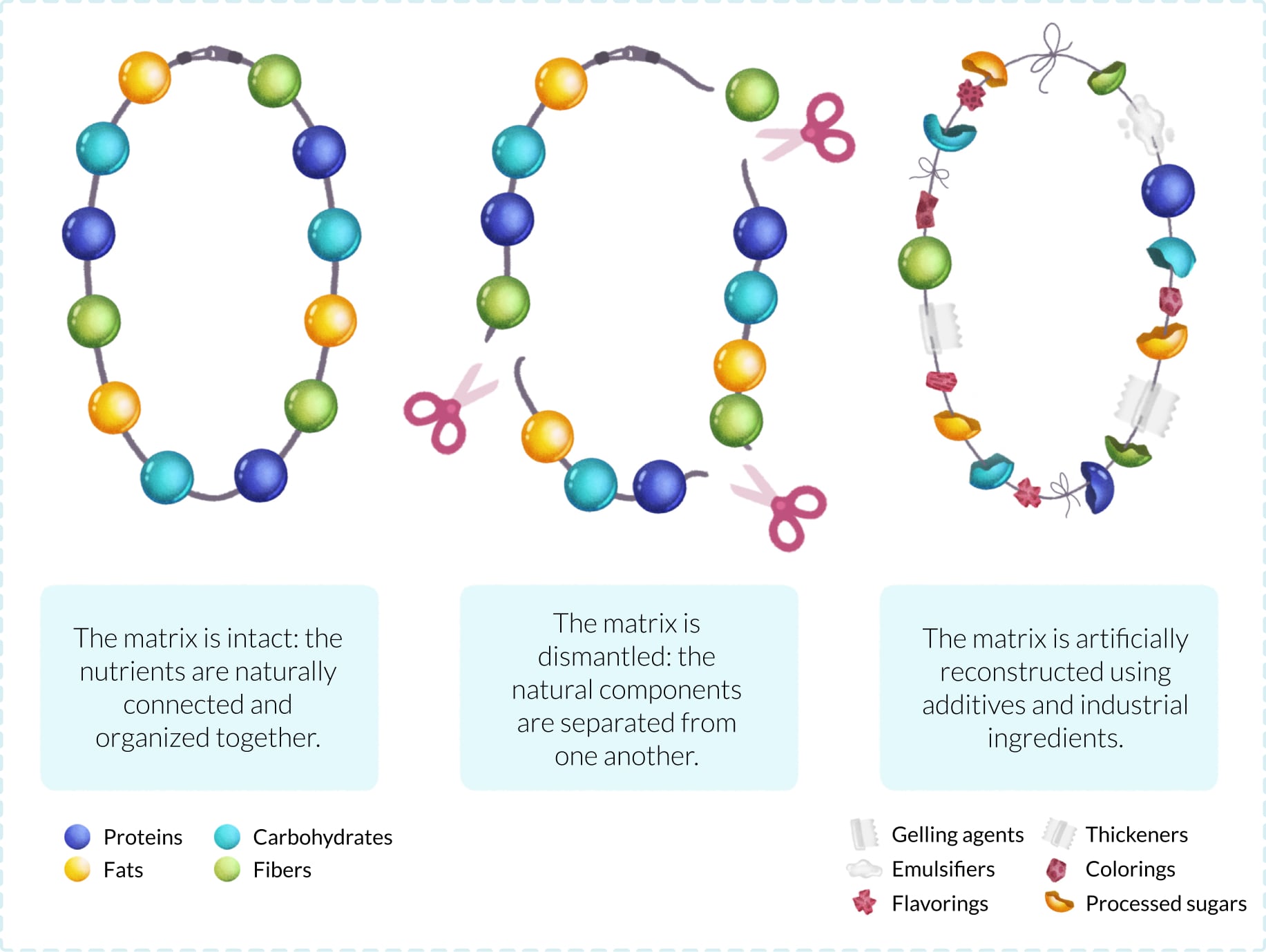
Imagine a pearl necklace. The pearls represent the natural components of a food: sugars, fats, proteins, fiber, vitamins, etc. The thread represents what holds them together: their natural structure. This is the metaphor used by researcher Anthony Fardet to describe the food matrix8. In an apple, a handful of almonds, or an egg, this structure remains intact: everything is naturally connected and organized.
During the production of ultra-processed foods, this thread is broken. Industrial processes dismantle foods, isolate their components, and then attempt to recreate the structure artificially using additives such as gums, modified starches, or emulsifiers. The result may resemble food, and even mimic its taste and color through the addition of flavorings and dyes, but its natural structure is gone9.
Yet this structure is essential. As Anthony Fardet puts it: “the matrix governs, and nutrients obey.” Take the example of a strawberry: it contains vitamin C, which interacts with its fibers, natural sugars, and the hundreds of other compounds present in the fruit. It is this synergy that produces the beneficial effects. When vitamin C is extracted and incorporated into an industrial product, this synergy disappears. The nutrient may still appear on the label, but it has lost much of its beneficial effect. The effect may even reverse: when isolated and consumed at high doses, vitamin C can become pro-oxidant, meaning that instead of protecting cells, it may contribute to damaging them10.
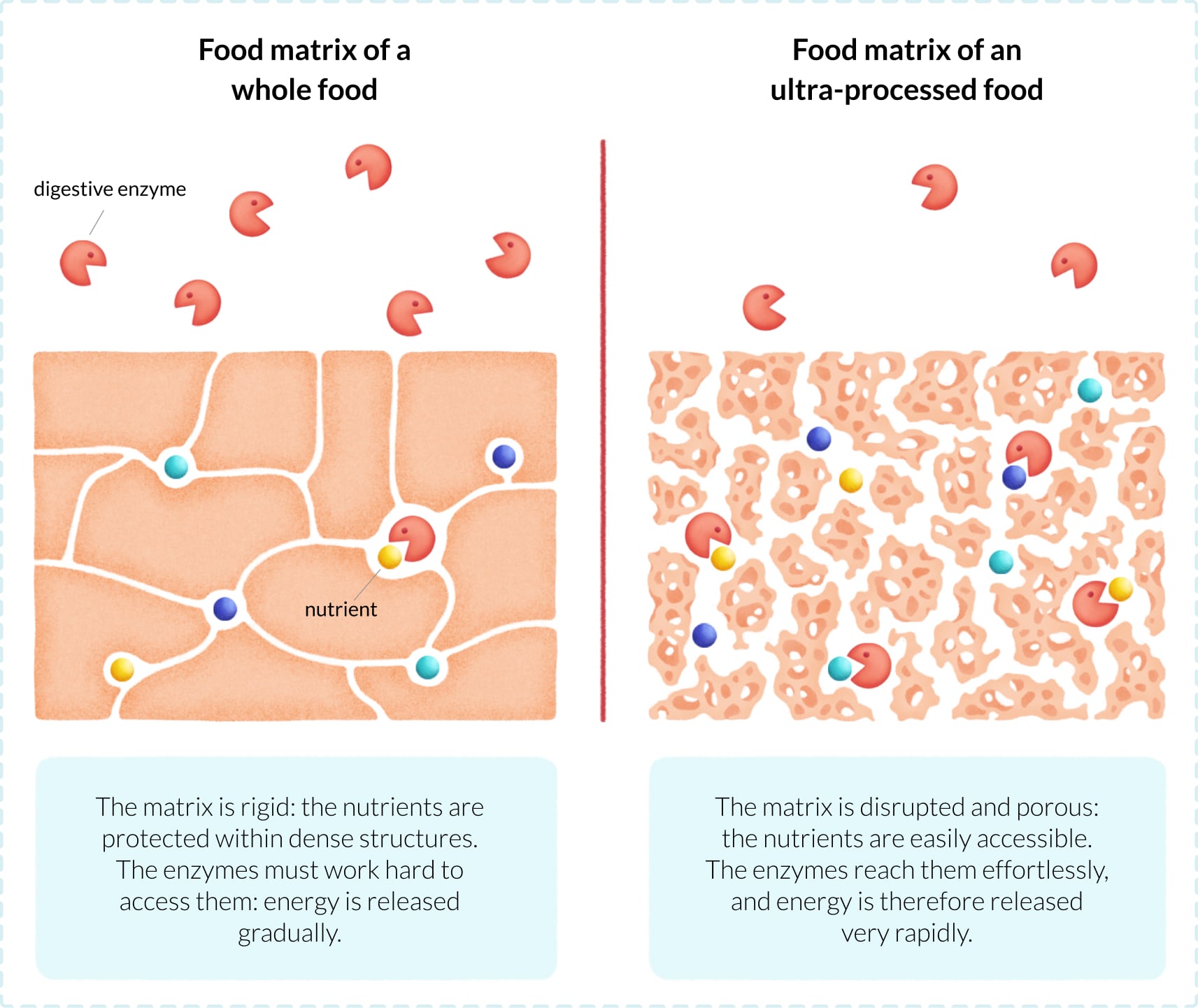
To understand why the food matrix is so important, we need to look at our digestive enzymes. They can be imagined as little Pac-Men, the video game characters that gobble up everything in their path. Their role is to break down the food we eat in order to extract nutrients and release energy. But before they can access those nutrients, they first have to pass through the food’s structure. When the matrix is intact, the nutrients are well protected within dense, fibrous cell structures11.
However, our little Pac-Men (the enzymes) have a biological limitation: they are unable to digest the fibers present in the matrix. These fibers act like indestructible walls in a maze – the enzymes cannot pass through them and must work their way around them. As a result, they move slowly, search for a path, and work hard before reaching the nutrients. Energy is therefore released gradually throughout digestion12.
But when the matrix is destroyed, the nutrients are already exposed. Enzymes can access them much more quickly and with little effort, leading to a very high influx of energy into the body, particularly from sugars and fats. In the case of sugars, this results in a blood sugar spike, a sudden rise in blood glucose levels13. In other words, ultra-processing pre-digests food for us before we even begin eating.
The example of rice cakes illustrates this very well. When cooked rice is consumed, the structure of the grain remains largely intact, particularly in the case of brown rice: our enzymes must work to extract the carbohydrates. In contrast, in a rice cake, this structure has been completely destroyed through processing: the carbohydrates then become much more rapidly accessible, resulting in a faster and higher blood sugar spike14,15.
The destruction of the matrix also has another, less visible effect: it significantly reduces the need to chew. A complex matrix naturally requires mastication. But because their structure has been broken down, ultra-processed foods are often soft, liquid, or highly aerated. They require little effort to eat and can be consumed very quickly16.
Chewing, however, plays a key role in satiety. The more we chew, the more the brain understands that a meal is being consumed and begins sending satiety signals. This signal takes around twenty minutes to kick in17. With ultra-processed foods, which can be consumed in just a few minutes, a massive amount of calories is absorbed before any feeling of fullness is even perceived18.
This helps explain why eating three apples in a few minutes feels almost impossible, whereas drinking a large glass of apple juice poses no difficulty at all. The apple still retains its matrix: it requires chewing and promotes satiety. The juice, by contrast, has an almost nonexistent matrix: it goes down effortlessly19. These mechanisms could help explain why diets composed of ultra-processed foods lead to higher calorie intake20.
A 2018 study provides further insight: the human brain is unable to accurately estimate the caloric density of foods that combine high amounts of both fat and carbohydrates, a combination that is very common in ultra-processed foods, but rarely found in nature. When faced with an ultra-processed food, the brain simply cannot properly assess how much energy has been consumed, which completely disrupts satiety regulation21.
Additives with concerning effects
Ultra-processed foods typically contain numerous so-called “cosmetic” additives, used to enhance appearance, taste, and texture. These substances are far from trivial and fall into several categories with potentially concerning effects.
 Food colorings that manipulate our perception
We are naturally drawn to colorful foods, and manufacturers make use of this. Artificial dyes are widely used, especially in products aimed at children, to increase appeal and encourage consumption. Colors directly influence emotions, and bright colors can promote an emotional attachment to certain products from an early age, shaping long-term food preferences22.
Color even influences our perception of taste. In one study, different colorings were used in a cherry-flavored drink. When the drink was orange, nearly 20% of participants said it tasted like orange. When it was green, 26% of participants said it tasted like lime23.
In addition, several studies suggest an association between artificial dye consumption and increased hyperactivity or attention deficit disorders (ADHD) in children24-26.
 Flavor enhancers that disrupt satiety mechanisms
Flavor enhancers are used to intensify taste and increase palatability. The most well-known is monosodium glutamate (MSG), responsible for the umami taste, sometimes referred to as the “fifth taste.” Umami exists naturally, and it comes from glutamate, an amino acid found in foods such as parmesan or seaweed. Biologically, this taste sends a signal: it tells our body that proteins are about to reach the stomach.
The issue is that the artificial glutamate added to products such as chips or ready-made meals sends the same signal without the corresponding protein. The brain anticipates something that never arrives. As a result, the satiety signal is not properly activated, hormones are disrupted, and we continue eating without really understanding why27.
 Texture agents that weaken the microbiota
Thickeners, emulsifiers, gelling agents… These additives modify the texture of foods to make them softer, smoother, and more pleasant in the mouth. In doing so, they reduce the need for chewing and, as we have seen, disrupt satiety signals.
But their effects do not stop there. Studies suggest that these additives may disrupt the gut microbiota, an essential pillar of human health that remains widely underestimated, and make the intestine more permeable, allowing toxins and microorganisms that do not belong there to pass into the bloodstream28,29.
This imbalance can impair insulin regulation, increase cravings for sugary and fatty foods, and cause persistent fatigue. Even more concerning, an altered gut microbiota can trigger a silent but chronic inflammatory state, often without visible symptoms, which serves as the starting point for many diseases such as type 2 diabetes, obesity, certain cancers, and autoimmune diseases30-32.
 Sweeteners that disrupt glycemic regulation
Intense sweeteners such as aspartame, sucralose, and acesulfame-K emerged a few decades ago as a miracle solution for providing a sweet taste without the calories. However, a growing number of studies are now highlighting their concerning effects on health (see our investigation into aspartame).
These substances activate the sweet taste receptors on the tongue, just like sugar does. And this is where the problem lies: they deceive the body. By perceiving the sweet taste, the body prepares to receive sugar and releases insulin… even though no sugar actually arrives. Over time, this mechanism could promote insulin resistance, a common precursor to type 2 diabetes33,34. Some researchers suggest these substances may even contribute to the global obesity epidemic, a paradox given their positioning as weight-control tools35-37.
Studies have also reported an association between regular sweetener consumption and an increased risk of certain cancers. Regarding aspartame, research from 2022 suggests an elevated risk from consumption levels as low as half a can of soda per day38. n 2023, it was classified as “possibly carcinogenic” (Group 2B) by the International Agency for Research on Cancer (IARC)39.
The cocktail effect: when risks accumulate
Ultra-processed foods rarely contain a single additive. In reality, they are often made up of a true “cocktail” of substances. However, the safety of additives is mainly assessed individually, without taking into account possible interactions between them.
This is what researchers set out to investigate in a study published in 202540. They recreated several mixtures of additives similar to those found in everyday products, and then observed their effects on human cells. The result: some additives that show no toxic effects when studied alone become problematic when combined with others41.
This is the core issue: in real-life conditions, we are exposed to these combinations every day, sometimes at every meal. Yet the effects of these mixtures remain poorly understood.
The presence of contaminants
Ultra-processed foods may also expose us to undesirable substances known as contaminants. These can form during industrial processing or through contact with packaging.
Contaminants formed during industrial processes
Certain processes, particularly high-temperature cooking methods (smoking, frying, grilling, etc.), promote the formation of so-called “process contaminants”42. These processes give foods their characteristic taste or color, such as the toasted flavor of crispbreads or the appealing browning of nuggets. But they can also generate substances associated with harmful effects. Among them are:
- Acrylamide, a substance classified as “probably carcinogenic,” which can be found in fried or baked products (chips, biscuits, coffee, etc.)43,44;
- PAHs (polycyclic aromatic hydrocarbons), produced during intense cooking and smoking, some of which are carcinogenic45,46;
- Nitrosamines, a group of compounds, some of which are classified as “probably carcinogenic,” that can form in certain processed meats containing nitrites47,48;
- Glycidol (classified as “probably carcinogenic”) and 3-MCPD (classified as “possibly carcinogenic”), which can form during the high-temperature deodorization of vegetable oils widely used in ultra-processed foods49;
- 4-MEI, a substance classified as “possibly carcinogenic,” formed during the production of certain caramel dyes50.
These contaminants are not exclusive to industrial processes. Some, such as PAHs and acrylamide, can also form at home during high-temperature cooking, for example, when bread or meat is heavily charred, or when barbecuing. Others, however, are more specifically linked to industrial processes, such as vegetable oil refining (3-MCPD, glycidol), processed meat production (nitrosamines), or the manufacture of certain additives, such as caramel dyes (4-MEI).
Contaminants from packaging
Ultra-processed foods are often designed to have a long shelf life. They are therefore packaged in complex materials (plastics, inks, adhesives), which may themselves contain undesirable substances. Some of these substances can migrate from the packaging into the food: a phenomenon known as migration.
Several factors promote this phenomenon, including storage time, heating the product in its packaging, and the presence of fat in the product, all of which facilitate the transfer of certain compounds51,52.
Among the main contaminants involved are:
- Phthalates and bisphenols, used in certain plastics, several of which are suspected or proven endocrine disruptors (see our article on endocrine disruptors)53,54;
- Mineral oils (MOSH and MOAH), originating in particular from packaging inks and adhesives, some of which are recognized as genotoxic, carcinogenic, and harmful to fetal development55,56;
- Micro- and nanoplastics, tiny particles that can detach from packaging and migrate into food57.
Several studies suggest that individuals who consume more ultra-processed foods have higher levels of some of these contaminants in their bodies.

- ¹ Leitão, A.E., Roschel, H., Oliveira-Júnior, G., Genario, R., Franco, T., Monteiro, C.A., and Martinez-Steele, E., 2024. Association between ultra-processed food and flavonoid intakes in a nationally representative sample of the US population. British Journal of Nutrition, 131(6), pp. 1074–1083. https://doi.org/10.1017/S0007114523002568
- ² Martini, D., Godos, J., Bonaccio, M., Vitaglione, P., and Grosso, G., 2021. Ultra-Processed Foods and Nutritional Dietary Profile: A Meta-Analysis of Nationally Representative Samples. Nutrients, 13(10), 3390. https://doi.org/10.3390/nu13103390
- ³ Fardet, A., 2018. Characterization of the Degree of Food Processing in Relation With Its Health Potential and Effects. Advances in Food and Nutrition Research, 85, pp. 79–129. https://doi.org/10.1016/bs.afnr.2018.02.002
- ⁴ Popkin, B.M., Miles, D.R., Taillie, L.S., and Dunford, E.K., 2024. A policy approach to identifying food and beverage products that are ultra-processed and high in added salt, sugar and saturated fat in the United States: a cross-sectional analysis of packaged foods. The Lancet Regional Health – Americas, 32, 100713. https://doi.org/10.1016/j.lana.2024.100713
- ⁵ Martínez Steele, E., Baraldi, L.G., Louzada, M.L., Moubarac, J.C., Mozaffarian, D., and Monteiro, C.A., 2016. Ultra-processed foods and added sugars in the US diet: evidence from a nationally representative cross-sectional study. BMJ Open, 6(3), e009892. https://doi.org/10.1136/bmjopen-2015-009892
- ⁶ Dicken, S.J. and Batterham, R.L., 2022. The Role of Diet Quality in Mediating the Association between Ultra-Processed Food Intake, Obesity and Health-Related Outcomes: A Review of Prospective Cohort Studies. Nutrients, 14(1), 23. https://doi.org/10.3390/nu14010023
- ⁷ Anastasiou, I.A., Kounatidis, D., Vallianou, N.G., Skourtis, A., Dimitriou, K., Tzivaki, I., Tsioulos, G., Rigatou, A., Karampela, I., and Dalamaga, M., 2025. Beneath the Surface: The Emerging Role of Ultra-Processed Foods in Obesity-Related Cancer. Current Oncology Reports, 27(4), pp. 390–414. https://doi.org/10.1007/s11912-025-01654-6
- ⁸ Fardet, Anthony, 2020. L’effet matrice des aliments. Webinar SIGA. https://www.youtube.com/watch?v=_41Ak_XIK0c
- ⁹ Fardet, A. and Rock, E., 2014. Toward a new philosophy of preventive nutrition: from a reductionist to a holistic paradigm to improve nutritional recommendations. Advances in Nutrition, 5(4), pp. 430–446. https://doi.org/10.3945/an.114.006122
- ¹⁰ Podmore, I.D., Griffiths, H.R., Herbert, K.E., Mistry, N., Mistry, P., and Lunec, J., 1998. Vitamin C exhibits pro-oxidant properties. Nature, 392(6676), p. 559. https://doi.org/10.1038/33308
- ¹¹ Fardet, A., 2010. New hypotheses for the health-protective mechanisms of whole-grain cereals: what is beyond fibre? Nutrition Research Reviews, 23(1), pp. 65–134. https://doi.org/10.1017/S0954422410000041
- ¹² Grundy, M.M., Edwards, C.H., Mackie, A.R., Gidley, M.J., Butterworth, P.J., and Ellis, P.R., 2016. Re-evaluation of the mechanisms of dietary fibre and implications for macronutrient bioaccessibility, digestion and postprandial metabolism. British Journal of Nutrition, 116(5), pp. 816–833. https://doi.org/10.1017/S0007114516002610
- ¹³ Haber, G.B., Heaton, K.W., Murphy, D., and Burroughs, L.F., 1977. Depletion and disruption of dietary fibre. Effects on satiety, plasma-glucose, and serum-insulin. The Lancet, 2(8040), pp. 679–682. https://doi.org/10.1016/S0140-6736(77)90494-9
- ¹⁴ Chakraborty, I., Pallen, S., Shetty, Y., Roy, N., and Mazumder, N., 2020. Advanced microscopy techniques for revealing molecular structure of starch granules. Biophysical Reviews, 12(1), pp. 105–122. https://doi.org/10.1007/s12551-020-00614-7
- ¹⁵ Lim, K.S. and Barigou, M., 2004. X-ray micro-computed tomography of cellular food products. Food Research International, 37, pp. 1001–1012.
- ¹⁶ BBC, 2024. Irresistible: Why We Can’t Stop Eating. Documentary with Chris van Tulleken. https://www.bbc.co.uk/programmes/m0025gqs
- ¹⁷ Smeets, A.J., Lejeune, M.P., and Westerterp-Plantenga, M.S., 2009. Effects of oral fat perception by modified sham feeding on energy expenditure, hormones and appetite profile in the postprandial state. British Journal of Nutrition, 101(9), pp. 1360–1368. https://doi.org/10.1017/S0007114508079592
- ¹⁸ Hamano, S., Sawada, M., Aihara, M., Sakurai, Y., Sekine, R., Usami, S., Kubota, N., and Yamauchi, T., 2024. Ultra-processed foods cause weight gain and increased energy intake associated with reduced chewing frequency: A randomized, open-label, crossover study. Diabetes, Obesity and Metabolism, 26(11), pp. 5431–5443. https://doi.org/10.1111/dom.15922
- ¹⁹ de Graaf, C., 2011. Why liquid energy results in overconsumption. Proceedings of the Nutrition Society, 70(2), pp. 162–170. https://doi.org/10.1017/S0029665111000012
- ²⁰ Hall, K.D., Ayuketah, A., Brychta, R., Cai, H., Cassimatis, T., Chen, K.Y., Chung, S.T., Costa, E., Courville, A., Darcey, V., Fletcher, L.A., Forde, C.G., Gharib, A.M., Guo, J., Howard, R., Joseph, P.V., McGehee, S., Ouwerkerk, R., Raisinger, K., Rozga, I., Stagliano, M., Walter, M., Walter, P.J., Yang, S., and Zhou, M., 2019. Ultra-Processed Diets Cause Excess Calorie Intake and Weight Gain: An Inpatient Randomized Controlled Trial of Ad Libitum Food Intake. Cell Metabolism, 30(1), pp. 67–77.e3. https://doi.org/10.1016/j.cmet.2019.05.008
- ²¹ DiFeliceantonio, A.G., Coppin, G., Rigoux, L., Edwin Thanarajah, S., Dagher, A., Tittgemeyer, M., and Small, D.M., 2018. Supra-Additive Effects of Combining Fat and Carbohydrate on Food Reward. Cell Metabolism, 28(1), pp. 33–44.e3. https://doi.org/10.1016/j.cmet.2018.05.018
- ²² Gilbert, A.N., Fridlund, A.J., and Lucchina, L.A., 2016. The color of emotion: A metric for implicit color associations. Food Quality and Preference, 52, pp. 203–210. https://doi.org/10.1016/j.foodqual.2016.04.007
- ²³ Spence, C., 2015. On the psychological impact of food colour. Flavour, 4, 21. https://doi.org/10.1186/s13411-015-0031-3
- ²⁴ Nigg, J.T., Lewis, K., Edinger, T., and Falk, M., 2012. Meta-analysis of attention-deficit/hyperactivity disorder or attention-deficit/hyperactivity disorder symptoms, restriction diet, and synthetic food color additives. Journal of the American Academy of Child & Adolescent Psychiatry, 51(1), pp. 86–97.e8. https://doi.org/10.1016/j.jaac.2011.10.015
- ²⁵ Miller, M.D., Steinmaus, C., Golub, M.S. et al., 2022. Potential impacts of synthetic food dyes on activity and attention in children: a review of the human and animal evidence. Environmental Health, 21, 45. https://doi.org/10.1186/s12940-022-00849-9
- ²⁶ McCann, D., Barrett, A., Cooper, A., Crumpler, D., Dalen, L., Grimshaw, K., Kitchin, E., Lok, K., Porteous, L., Prince, E., Sonuga-Barke, E., Warner, J.O., and Stevenson, J., 2007. Food additives and hyperactive behaviour in 3-year-old and 8/9-year-old children in the community: a randomised, double-blinded, placebo-controlled trial. The Lancet, 370(9598), pp. 1560–1567. https://doi.org/10.1016/S0140-6736(07)61306-3
- ²⁷ Shannon, M., Green, B., Willars, G., Wilson, J., Matthews, N., Lamb, J., Gillespie, A., and Connolly, L., 2017. The endocrine disrupting potential of monosodium glutamate (MSG) on secretion of the glucagon-like peptide-1 (GLP-1) gut hormone and GLP-1 receptor interaction. Toxicology Letters, 265, pp. 97–105. https://doi.org/10.1016/j.toxlet.2016.11.015
- ²⁸ Naimi, S., Viennois, E., Gewirtz, A.T., and Chassaing, B., 2021. Direct impact of commonly used dietary emulsifiers on human gut microbiota. Microbiome, 9(1), 66. https://doi.org/10.1186/s40168-020-00996-6
- ²⁹ Whelan, K., Bancil, A.S., Lindsay, J.O., and Chassaing, B., 2024. Ultra-processed foods and food additives in gut health and disease. Nature Reviews Gastroenterology & Hepatology, 21(6), pp. 406–427. https://doi.org/10.1038/s41575-024-00893-5
- ³⁰ Chassaing, B., Compher, C., Bonhomme, B., Liu, Q., Tian, Y., Walters, W., Nessel, L., Delaroque, C., Hao, F., Gershuni, V., Chau, L., Ni, J., Bewtra, M., Albenberg, L., Bretin, A., McKeever, L., Ley, R.E., Patterson, A.D., Wu, G.D., Gewirtz, A.T., and Lewis, J.D., 2022. Randomized Controlled-Feeding Study of Dietary Emulsifier Carboxymethylcellulose Reveals Detrimental Impacts on the Gut Microbiota and Metabolome. Gastroenterology, 162(3), pp. 743–756. https://doi.org/10.1053/j.gastro.2021.11.006
- ³¹ Daniel, N., Wu, G.D., Walters, W., Compher, C., Ni, J., Delaroque, C., Albenberg, L., Ley, R.E., Patterson, A.D., Lewis, J.D., Gewirtz, A.T., and Chassaing, B., 2024. Human Intestinal Microbiome Determines Individualized Inflammatory Response to Dietary Emulsifier Carboxymethylcellulose Consumption. Cellular and Molecular Gastroenterology and Hepatology, 17(2), pp. 315–318. https://doi.org/10.1016/j.jcmgh.2023.11.001
- ³² INSERM, 2023. Syndrome métabolique : un lien entre atteinte inflammatoire vasculaire et microbiote intestinal. https://www.inserm.fr/actualite/syndrome-metabolique-lien-entre-atteinte-inflammatoire-vasculaire-et-microbiote-intestinal/
- ³³ Suez, J., Cohen, Y., Valdés-Mas, R., Mor, U., Dori-Bachash, M., Federici, S., Zmora, N., Leshem, A., Heinemann, M., Linevsky, R., Zur, M., Ben-Zeev Brik, R., Bukimer, A., Eliyahu-Miller, S., Metz, A., Fischbein, R., Sharov, O., Malitsky, S., Itkin, M., Stettner, N., Harmelin, A., Shapiro, H., Stein-Thoeringer, C.K., Segal, E., and Elinav, E., 2022. Personalized microbiome-driven effects of non-nutritive sweeteners on human glucose tolerance. Cell, 185(18), pp. 3307–3328.e19. https://doi.org/10.1016/j.cell.2022.07.016
- ³⁴ Suez, J., Korem, T., Zeevi, D. et al., 2014. Artificial sweeteners induce glucose intolerance by altering the gut microbiota. Nature, 514, pp. 181–186. https://doi.org/10.1038/nature13793
- ³⁵ World Health Organization (WHO), 2022. Health effects of the use of non-sugar sweeteners: a systematic review and meta-analysis. https://www.who.int/publications/i/item/9789240046429
- ³⁶ Fagherazzi, G., Vilier, A., Saes Sartorelli, D., Lajous, M., Balkau, B., and Clavel-Chapelon, F., 2013. Consumption of artificially and sugar-sweetened beverages and incident type 2 diabetes in the Etude Epidemiologique auprès des femmes de la Mutuelle Générale de l’Education Nationale-European Prospective Investigation into Cancer and Nutrition cohort. American Journal of Clinical Nutrition, 97(3), pp. 517–523. https://doi.org/10.3945/ajcn.112.050997
- ³⁷ Toews, I., Lohner, S., Küllenberg de Gaudry, D., Sommer, H., and Meerpohl, J.J., 2019. Association between intake of non-sugar sweeteners and health outcomes: systematic review and meta-analyses of randomised and non-randomised controlled trials and observational studies. BMJ, 364:k4718. https://doi.org/10.1136/bmj.k4718
- ³⁸ Debras, C., Chazelas, E., Srour, B., Druesne-Pecollo, N., Esseddik, Y., Szabo de Edelenyi, F., Agaësse, C., De Sa, A., Lutchia, R., Gigandet, S., Huybrechts, I., Julia, C., Kesse-Guyot, E., Allès, B., Andreeva, V.A., Galan, P., Hercberg, S., Deschasaux-Tanguy, M., and Touvier, M., 2022. Artificial sweeteners and cancer risk: Results from the NutriNet-Santé population-based cohort study. PLOS Medicine, 19(3), e1003950. https://doi.org/10.1371/journal.pmed.1003950
- ³⁹ International Agency for Research on Cancer (IARC), 2023. Aspartame hazard and risk assessment results released. https://www.iarc.who.int/news-events/aspartame-hazard-and-risk-assessment-results-released/
- ⁴⁰ Recoules, C., Touvier, M., Pierre, F., and Audebert, M., 2025. Evaluation of the toxic effects of food additives, alone or in mixture, in four human cell models. Food and Chemical Toxicology, 196, 115198. https://doi.org/10.1016/j.fct.2024.115198
- ⁴¹ Chazelas, E., Druesne-Pecollo, N., Esseddik, Y. et al., 2021. Exposure to food additive mixtures in 106,000 French adults from the NutriNet-Santé cohort. Scientific Reports, 11, 19680. https://doi.org/10.1038/s41598-021-98496-6
- ⁴² ANSES, 2024. Avis relatif à la caractérisation et évaluation des impacts sur la santé de la consommation d’aliments dits ultra-transformés. https://www.anses.fr/fr/content/avis-relatif-la-caracterisation-et-evaluation-des-impacts-sur-la-sante-de-la-consommation
- ⁴³ Bellicha, A. et al., 2022. Dietary exposure to acrylamide and breast cancer risk: results from the NutriNet-Santé cohort. American Journal of Clinical Nutrition, 116, pp. 911–919.
- ⁴⁴ Zhivagui, M., Ng, A.W.T., Ardin, M., Churchwell, M.I., Pandey, M., Renard, C., Villar, S., Cahais, V., Robitaille, A., Bouaoun, L., Heguy, A., Guyton, K.Z., Stampfer, M.R., McKay, J., Hollstein, M., Olivier, M., Rozen, S.G., Beland, F., Korenjak, M., and Zavadil, J., 2019. Experimental and pan-cancer genome analyses reveal widespread contribution of acrylamide exposure to carcinogenesis in humans. Cold Spring Harbor Laboratory Press.
- ⁴⁵ German Federal Institute for Risk Assessment (BfR), 2024. Smoke flavourings in food: Updated FAQ on smoke flavourings and their health risks. https://mobil.bfr.bund.de/cm/349/smoke-flavourings-in-food.pdf
- ⁴⁶ European Commission, 2023. Information on the procedure for the renewal of existing authorisations for smoke flavourings. https://food.ec.europa.eu/food-safety/food-improvement-agents/flavourings/smoke-flavouring-renewals-existing_en
- ⁴⁷ ANSES, 2022. Évaluation des risques liés à la consommation de nitrates et nitrites. https://www.anses.fr/system/files/ERCA2020SA0106Ra.pdf
- ⁴⁸ EFSA CONTAM Panel, Schrenk, D., Bignami, M., Bodin, L., Chipman, J.K., del Mazo, J., Hogstrand, C., Hoogenboom, L., Leblanc, J.C., Nebbia, C.S., Nielsen, E., Ntzani, E., Petersen, A., Sand, S., Schwerdtle, T., Vleminckx, C., Wallace, H. et al., 2023. Scientific Opinion on the risk assessment of N-nitrosamines in food. EFSA Journal, 21(3), 7884. https://doi.org/10.2903/j.efsa.2023.7884
- ⁴⁹ EFSA ANS Panel, Younes, M., Aggett, P., Aguilar, F., Crebelli, R., Dusemund, B., Filipič, M., Frutos, M.J., Galtier, P., Gott, D., Gundert-Remy, U., Kuhnle, G.G., Leblanc, J.C., Lillegaard, I.T., Moldeus, P., Mortensen, A., Oskarsson, A., Stankovic, I., Waalkens-Berendsen, I., Woutersen, R.A., Wright, M. et al., 2017. Scientific Opinion on the re-evaluation of polyglycerol esters of fatty acids (E 475) as a food additive. EFSA Journal, 15(12), 5089. https://doi.org/10.2903/j.efsa.2017.5089
- ⁵⁰ EFSA ANS Panel, 2011. Scientific Opinion on the re-evaluation of caramel colours (E 150a, b, c, d) as food additives. EFSA Journal, 9(3), 2004. https://doi.org/10.2903/j.efsa.2011.2004
- ⁵¹ Yates, J., Kadiyala, S., Deeney, M., Carriedo, A., Gillespie, S., Heindel, J.J., Maffini, M.V., Martin, O., Monteiro, C.A., Scheringer, M., Touvier, M., and Muncke, J., 2024. A toxic relationship: ultra-processed foods & plastics. Global Health, 20(1), 74. https://doi.org/10.1186/s12992-024-01078-0
- ⁵² Srour, B., Kordahi, M.C., Bonazzi, E., Deschasaux-Tanguy, M., Touvier, M., and Chassaing, B., 2022. Ultra-processed foods and human health: from epidemiological evidence to mechanistic insights. The Lancet Gastroenterology & Hepatology, 7(12), pp. 1128–1140. https://doi.org/10.1016/S2468-1253(22)00169-8
- ⁵³ Buckley, J.P., Kim, H., Wong, E., and Rebholz, C.M., 2019. Ultra-processed food consumption and exposure to phthalates and bisphenols in the US National Health and Nutrition Examination Survey, 2013–2014. Environment International, 131, 105057. https://doi.org/10.1016/j.envint.2019.105057
- ⁵⁴ Edaes, F.S. and de Souza, C.B., 2022. BPS and BPF are as Carcinogenic as BPA and are Not Viable Alternatives for its Replacement. Endocrine, Metabolic & Immune Disorders – Drug Targets, 22(9), pp. 927–934. https://doi.org/10.2174/1871530322666220316141032
- ⁵⁵ EFSA CONTAM Panel, Schrenk, D., Bignami, M., Bodin, L., del Mazo, J., Grasl-Kraupp, B., Hogstrand, C., Hoogenboom, L., Leblanc, J.C., Nebbia, C.S., Nielsen, E., Ntzani, E., Petersen, A., Sand, S., Schwerdtle, T., Vleminckx, C., Wallace, H. et al., 2023. Update of the risk assessment of mineral oil hydrocarbons in food. EFSA Journal, 21(9), 8215. https://doi.org/10.2903/j.efsa.2023.8215
- ⁵⁶ Poon, E., Li, C., Schweitzer, D., and Akefe, I., 2026. Neurobiological insights into the effects of ultra-processed food on lipid metabolism and associated mental health conditions: a scoping review. Frontiers in Nutrition, 12, 1754492. https://doi.org/10.3389/fnut.2025.1754492
- ⁵⁷ EFSA, Barthélémy, E., Cariou, R., Castle, L., Crebelli, R., Di Consiglio, E., Hemy Dumas, T., Franz, R., Grog, K., Lambré, C., Lampi, E., Milana, M.R., Munoz Guajardo, I., Pronk, M., Rivière, G., da Silva, M., Tietz, T., Tsochatzis, E., and Van Hoeck, E., 2025. Literature review on micro- and nanoplastic release from food contact materials during their use. EFSA Supporting Publication, 22(10), EN-9733. https://doi.org/10.2903/sp.efsa.2025.EN-9733
