



What are we really eating when we consume a bag of chips, a cereal bar, or a ready-made meal? For a long time, scientists answered this question by counting nutrients: sugar, salt, and fat content. But since the 2000s, another approach has emerged, which questions not what a food contains, but what it has undergone before it reaches our plate.
So, what are ultra-processed foods and how are they made? And how can we explain why it is so difficult to stop eating them?
What is an ultra-processed food?
The term “ultra-processed food” was introduced for the first time in 2009 by the Brazilian researcher Carlos Monteiro. This marked a turning point. Until then, foods were mainly evaluated based on their nutritional composition: sugar content, salt, fat, protein1.
But at the turn of the 2000s, a phenomenon caught researchers’ attention. In Brazil, as in many countries, obesity and chronic diseases are increasing rapidly, including among disadvantaged populations that had until then been mainly affected by undernutrition. By analyzing national dietary surveys, Carlos Monteiro’s team observes a profound shift: raw foods and meals prepared from simple ingredients are declining, while ready-to-consume industrial products are taking up an increasing share of everyday diets.
The evolution of eating habits does not come down to a simple increase in sugar, salt, or fat intake. It reflects a more structural transformation: traditional foods and recipes are progressively replaced by standardized industrial products.
However, traditional nutritional analysis tools only make it possible to measure quantities (calories, sugar, salt, etc.) but are not capable of distinguishing a homemade dish from an industrial one. They do not make it possible to describe this change in the nature of food. This is why Carlos Monteiro and his team propose a new approach: classifying foods according to their degree of processing. In 2016, this reflection leads to the NOVA classification, which divides foods into four distinct groups depending on their degree of processing and the objective of the processing2.
Nova 1 : Unprocessed or minimally processed foods
- This group includes fruits and vegetables, cereals, meats, fish, eggs, or milk. These foods may be washed, cut, dried (dried fruits), pasteurized (pasteurized milk), or frozen (frozen fruits or vegetables). But their structure remains largely unchanged, and nothing else is added.
- Objective of processing: preserve or make a food consumable without fundamentally altering it.
Nova 2 : Culinary ingredients
- This group includes ingredients used to cook and season foods from group 1. These include, for example, oil, butter, vinegar, sugar, or salt. They are obtained from natural resources or raw foods through different processes, such as extracting salt from seawater or pressing seeds to produce oil. They are generally not consumed on their own, but in small quantities to prepare dishes.
- Objective of processing: produce ingredients for cooking.
Nova 3 : Processed foods
- This group corresponds to foods from group 1 to which one or more ingredients from group 2 are added. These products can be prepared at home, in an artisanal setting, or industrially. Examples include bread, cheese, canned vegetables, fruit in syrup, or a homemade cake. They are composed of a limited number of ingredients. In principle, they can be prepared at home with ingredients commonly found in one’s cupboards.
- Objective of processing: preserve a food or improve its taste with a few simple ingredients.
Nova 4 : Ultra-processed foods
- This group includes industrial formulations that incorporate highly processed ingredients used almost exclusively by the food industry (glucose syrup, maltodextrin, protein isolates, etc.), as well as additives intended to modify texture, color, or taste. These products are designed to be convenient, appealing, and to have a long shelf life.
- Objective of processing: create an industrial product ready to consume, convenient, stable, and attractive.
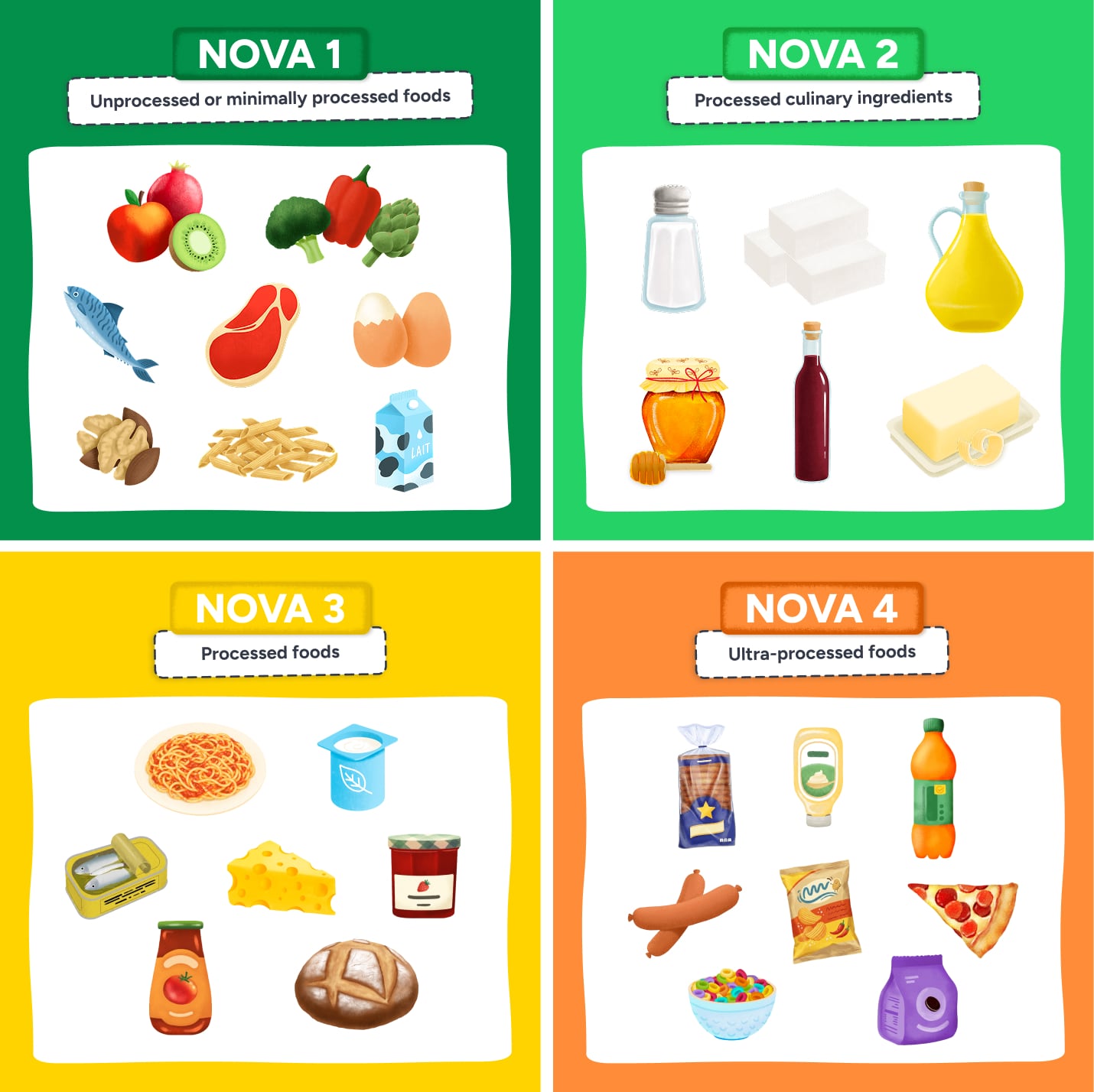
The NOVA classification is therefore based on a central principle: classifying foods according to the way they are processed and the objective of this processing. But this approach raises a practical difficulty. In most cases, the industrial processes used to manufacture a product are not accessible to the consumer: this information is not indicated on the product3.
In 2019, the Food and Agriculture Organization of the United Nations (FAO) therefore proposes a more operational approach to identifying ultra-processed foods4. Rather than relying on manufacturing processes – often invisible to the consumer – the FAO suggests observing an accessible indicator: the ingredient list, which is mandatory on all packaged products. In fact, certain ingredients and additives are characteristic of ultra-processed foods according to the FAO:
- Industrial ingredients: these are ingredients that are not found in a typical kitchen. They are intentionally added to products to modify their structure and/or the cost of production. Examples include hydrogenated oils, hydrolyzed proteins, mechanically separated meats, modified starches, sugar syrups, etc.
- “Cosmetic” food additives: ultra-processed foods generally contain several additives that serve to improve appearance, intensify taste, or provide a pleasant texture. They are called “cosmetic” additives because they act on perceptions – visual and sensory – like makeup that gives the illusion of a real food. Among the most common are artificial colorants, sweeteners such as aspartame or sucralose, texture agents such as mono- and diglycerides or certain gums, flavor enhancers such as monosodium glutamate, as well as flavorings.
Thus, according to the approach proposed by the FAO, the presence in the ingredient list of at least one industrial ingredient or cosmetic additive constitutes an indication that a product belongs to the category of ultra-processed foods.
This approach does not replace the NOVA classification, but it makes it easier to apply. By relying on the ingredient list – information accessible on packaging and legally mandatory – the FAO proposes a concrete way to identify ultra-processed foods in practice.
Deconstructing then reconstructing: how the food industry manufactures these products
Unlike a homemade dish, where whole ingredients are combined, ultra-processed foods result from a multi-step industrial process that first breaks down the food’s natural structure before artificially reassembling it.
Step 1: Deconstruction
Everything begins with low-cost raw materials, often derived from large monocultures that are heavily subsidized (corn, wheat, soy, peas, etc.) or from by-products of other sectors (lower-quality cuts of meat, whey from the dairy industry, etc.)5.
These raw materials are not used as they are. They are processed to extract their different components. The food industry “takes them apart” by separating proteins, sugars, fibers, or fats. This step makes it possible to obtain standardized ingredients: powders, oils, or syrups, often colorless and sometimes almost tasteless.
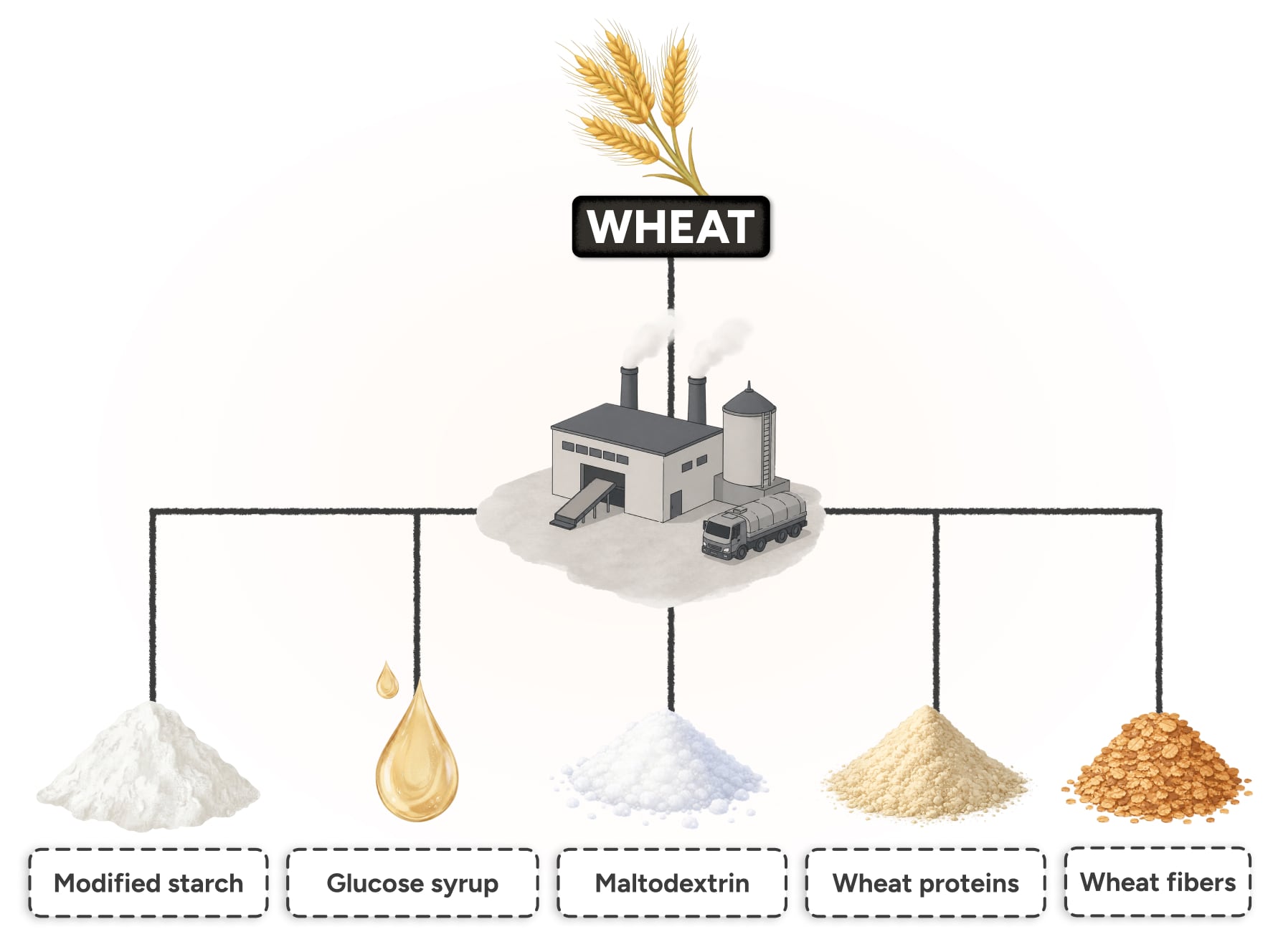
During this process, the natural structure of the food is profoundly altered. What researchers call the “matrix” – the complex organization that links nutrients together and notably influences how they are digested – disappears. The food is no longer a coherent whole, but rather a series of isolated components ready to be reassembled6-8.
Step 2: Reconstruction
Once the components are separated, they must be given form again. These powders, oils, and syrups no longer have the appearance or texture of a food: they must therefore be reassembled to become a consumable product.
Concretely, all these elements are mixed and reworked to form a uniform preparation. The objective is to obtain a stable product: a sauce that does not separate, a cream that always remains smooth, a biscuit identical from one batch to another.
It is at this stage that additives come into play. Texturizing agents are added to provide softness or crispness. Emulsifiers are used to create a creamy texture. Colorants add an attractive shade. Flavorings are used to recreate the taste of a fruit, meat, or another ingredient that may not actually be present in the product9.
The preparation can then be shaped using industrial processes such as extrusion cooking. This technique consists of subjecting the material to high pressure and high temperature, then passing it through a mold that gives it its final shape. Under the combined effect of heat and pressure, the texture is deeply modified: the material can become airy and crispy. This is how many breakfast cereals or certain puffed snack products are made.
At the end of this stage, it is no longer simply a processed food, but an industrially constructed product.
How to differentiate a processed food from an ultra-processed food?
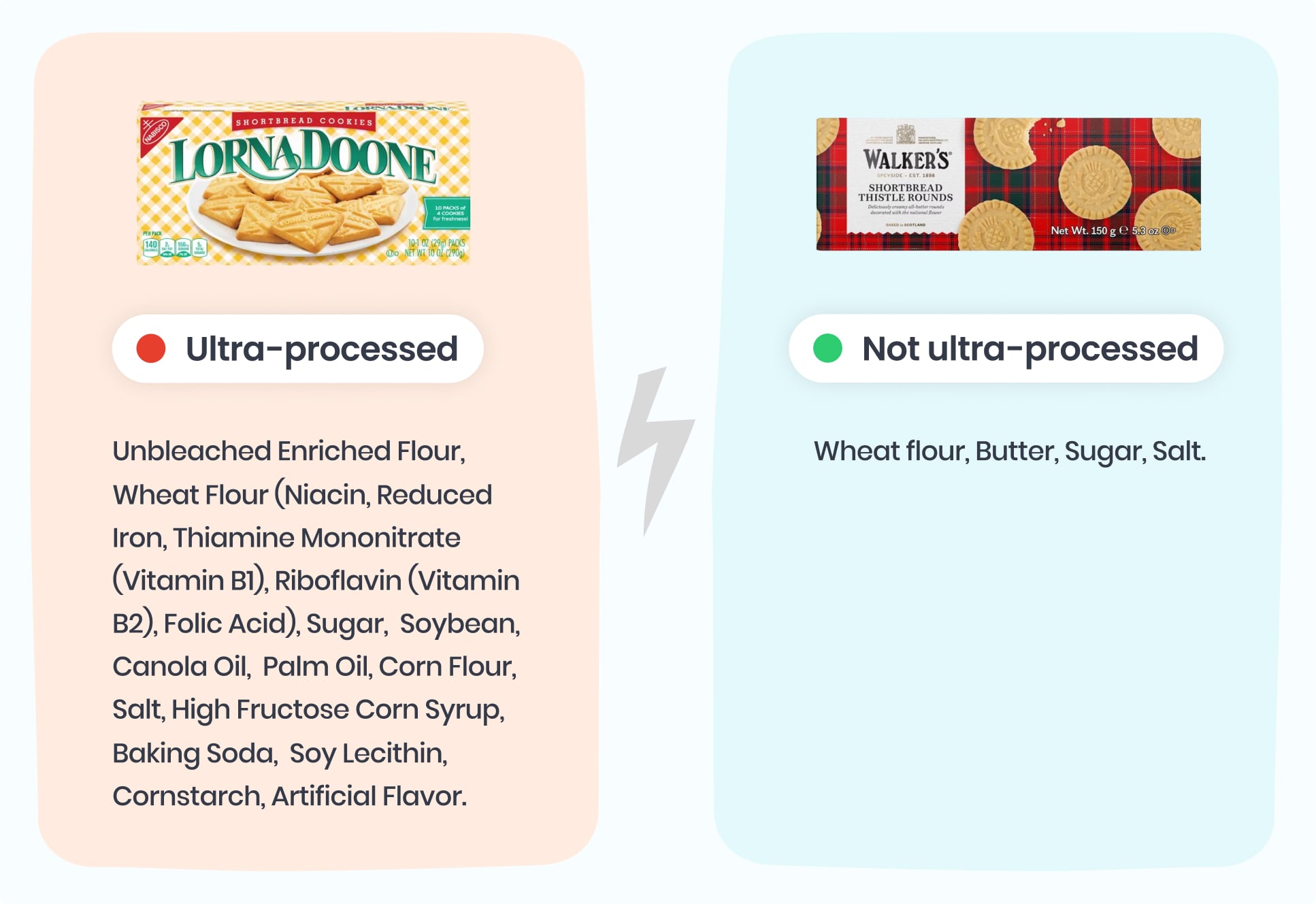
Transforming a food is an ancient practice and often necessary to facilitate preservation, improve digestibility, or simply make foods more palatable. For example, milk can be fermented to make yogurt, overripe fruit can be cooked to turn it into compote, bread can be made from flour, or a simmered dish made of meat and vegetables can be prepared and kept for several days. Processed foods (NOVA 3) fit within this logic. They can, in principle, be prepared in a home kitchen with common ingredients11.
The shift toward ultra-processing occurs when the product is no longer simply “prepared,” but “constructed.” It is no longer a matter of assembling familiar ingredients, but of combining highly modified ingredients and additives to artificially recreate a texture, taste, or appearance, often very far from the original food. The objective is no longer only to preserve or improve an existing food, but to create a standardized, attractive, and highly profitable product12.
Let us take the example of a cake. A homemade cake generally contains flour, eggs, butter, and sugar. Its ingredient list is short and understandable. It costs between 3 and 5 euros to produce and keeps for less than five days in the refrigerator. By contrast, an industrial cake may contain glucose syrup, refined oils, modified starches, flavorings, or emulsifiers: its ingredient list is much longer and contains substances not found in a typical kitchen. It costs around 30 cents to produce and can be stored for several months on a supermarket shelf13.
Products designed to be irresistible
The design of ultra-processed foods does not aim only to produce practical and low-cost products. It also pursues a central objective for the food industry: maximizing the pleasure experienced during consumption. To achieve this, companies rely on teams specialized in sensory optimization14.
One of the key notions in this field is the “bliss point”. This concept was developed in the 1970s by the American psychologist Howard Moskowitz, trained at Harvard. A researcher specializing in the study of taste, he published several scientific works at the time on the relationship between sugar concentration and perceived pleasure, showing that pleasure increases with the quantity of sugar and then decreases when the concentration becomes too high. These results are also valid for the quantity of salt or fat: there exists a precise level at which taste is judged “just right”15.
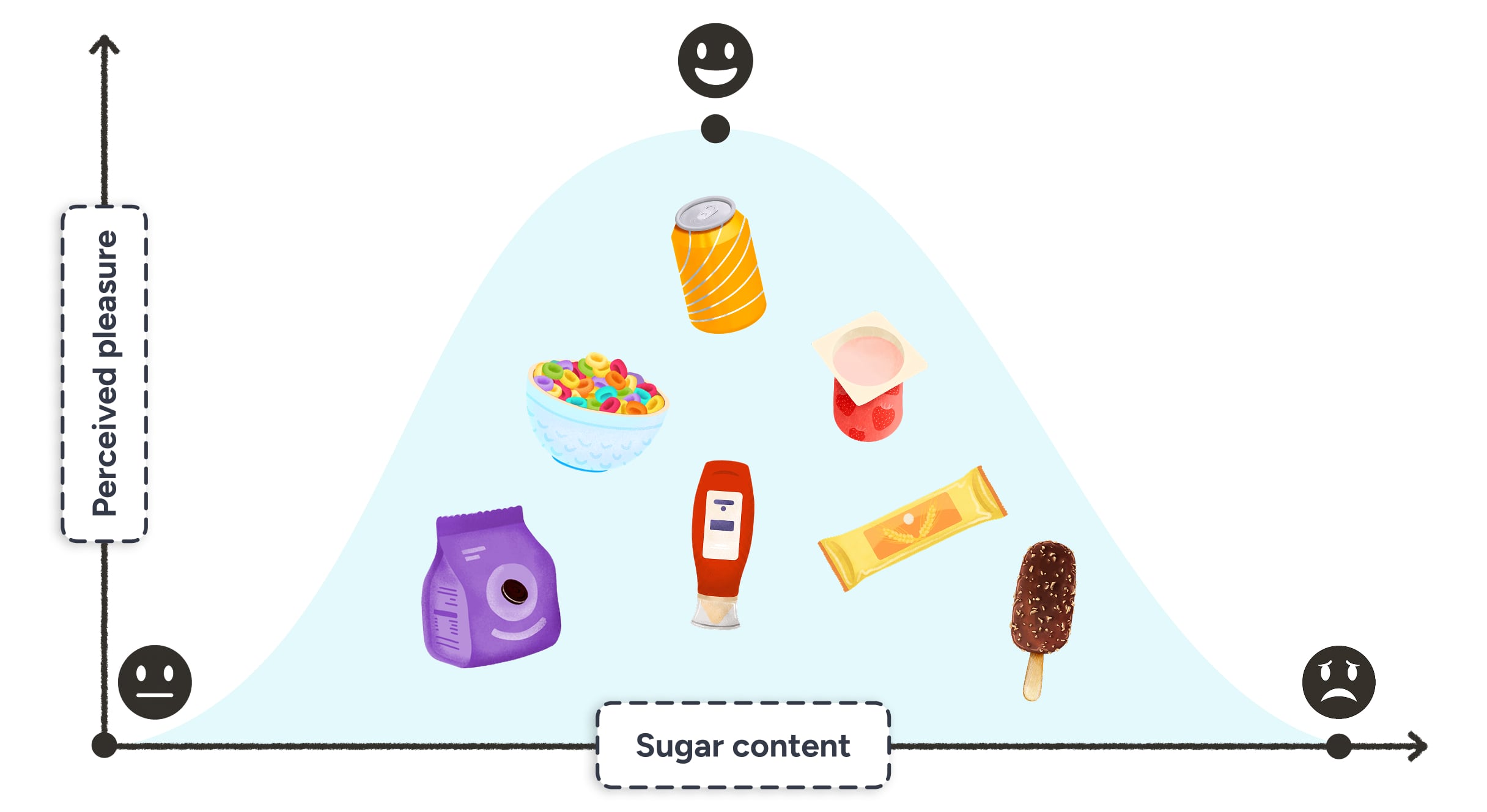
In the 1980s, Moskowitz became a consultant and applied these methods to the food industry. To help brands optimize their recipes, Moskowitz developed a method based on large-scale sensory tests. Hundreds of people tasted different versions of the same product, whose proportions of sugar, salt, or fat varied slightly. By analyzing their preferences, he identified the precise combination of these elements that maximizes taste pleasure. Neither too much nor too little: it is the perfect balance that makes a product irresistible. When a product reaches this threshold, it becomes particularly difficult to limit its consumption.
The method quickly achieved considerable success in the food industry. During the 1980s and 1990s, many major brands including Pepsi, Unilever, Dr Pepper, and Tropicana turned to these sensory optimization techniques to refine their products. A frequently cited example is Campbell’s, which asked Howard Moskowitz in 1986 to work on its Prego tomato sauce, which was then losing momentum. Consumer testing made it possible to identify the levels of sugar, salt, and fat that provided the greatest satisfaction. The recipe was then adjusted to reach this optimal level of pleasure – the bliss point – and the product went on to achieve significant commercial success16-17.
From the 1990s onward, these techniques became even more sophisticated. Methods from neuroscience were used to directly analyze the brain’s reactions to food. Rather than limiting themselves to what people say they like, they seek to measure brain signals associated with pleasure and reward. Some neuroscientists use brain imaging to observe brain activity during the tasting of different foods18.
This research shows that certain foods strongly activate brain circuits linked to reward. This is particularly the case for products rich in sugar and fat, which stimulate the release of dopamine, a neurotransmitter associated with the sensation of pleasure. This knowledge is progressively integrated into the design of food products. Manufacturers seek to reproduce the sensory characteristics that trigger the strongest pleasure responses19.
Researchers then begin referring to “hyper-palatable” foods: products designed to provoke a particularly intense response from the reward system. These foods are designed to offer a multisensory experience mobilizing all five senses. Thus, their taste, texture, smell, or appearance are carefully engineered in order to make the consumption experience particularly rewarding20.
The foods that activate these circuits the most often combine high amounts of sugar and fat, a combination rarely found in natural foods. For example, fruits are rich in carbohydrates but low in fat, while salmon or nuts are rich in fat but low in carbohydrates. This combination of sugar and fat can amplify the reward response and encourage repeated consumption21,22.
Some researchers suggest that these hyper-palatable foods may mimic certain mechanisms of addiction: by activating the same brain reward circuits as certain drugs, they could promote compulsive consumption behaviors23,24. Two factors would explain this similarity: the high concentration of ingredients that are highly rewarding for the brain, and their particularly rapid absorption by the body. To study this phenomenon, scientists have developed a scale called the Yale Food Addiction Scale, aimed at identifying addictive behaviors related to food. An analysis combining more than 280 studies based on this scale estimates that around 14% of adults and 12% of children show signs of food addiction linked to the consumption of ultra-processed foods25,26.

- ¹ Monteiro, C.A., 2009. Nutrition and health. The issue is not food, nor nutrients, so much as processing. Public Health Nutrition, 12(5), pp. 729–731. https://doi.org/10.1017/S1368980009005291
- ² Monteiro, C.A. et al., 2016. NOVA. The star shines bright. World Nutrition, 7(1–3). https://www.worldnutritionjournal.org/index.php/wn/article/view/5
- ³ Martinez-Steele, E., Khandpur, N., Batis, C., Bes-Rastrollo, M., Bonaccio, M., Cediel, G., Huybrechts, I., Juul, F., Levy, R.B., da Costa Louzada, M.L., Machado, P.P., Moubarac, J.C., Nansel, T., Rauber, F., Srour, B., Touvier, M., and Monteiro, C.A., 2023. Best practices for applying the Nova food classification system. Nature Food, 4(6), pp. 445–448. https://doi.org/10.1038/s43016-023-00779-w
- ⁴ Food and Agriculture Organization of the United Nations (FAO), 2019. Ultra-processed foods, diet quality, and health using the NOVA classification system. https://openknowledge.fao.org/server/api/core/bitstreams/5277b379-0acb-4d97-a6a3-602774104629/content
- ⁵ BeMiller, J.M., 2009. One Hundred Years of Commercial Food Carbohydrates in the United States. Whistler Center for Carbohydrate Research, Purdue University. https://college.agrilife.org/talcottlab/wp-content/uploads/sites/108/2019/01/100-Years-of-Carbs-in-the-US.pdf
- ⁶ Miller, G.D., Ragalie-Carr, J., and Torres-Gonzalez, M., 2023. Perspective: Seeing the Forest Through the Trees: The Importance of Food Matrix in Diet Quality and Human Health. Advances in Nutrition, 14(3), pp. 363–365. https://doi.org/10.1016/j.advnut.2023.03.005
- ⁷ Fardet, Anthony, 2020. L'effet matrice des aliments. Webinar SIGA. https://www.youtube.com/watch?v=_41Ak_XIK0c
- ⁸ Weaver, C.M. and Givens, D.I., 2025. Overview: the food matrix and its role in the diet. Critical Reviews in Food Science and Nutrition, 65(30), pp. 6880–6897. https://doi.org/10.1080/10408398.2025.2453074
- ⁹ Fardet, A., 2018. Characterization of the Degree of Food Processing in Relation With Its Health Potential and Effects. Advances in Food and Nutrition Research, 85, pp. 79–129. https://doi.org/10.1016/bs.afnr.2018.02.002
- ¹⁰ Furness, J.B. and Bravo, D.M., 2015. Humans as cucinivores: comparisons with other species. Journal of Comparative Physiology B, 185(8), pp. 825–834. https://doi.org/10.1007/s00360-015-0919-3
- ¹¹ Monteiro, C.A., Cannon, G., Moubarac, J.C., Levy, R.B., Louzada, M.L.C., and Jaime, P.C., 2018. The UN Decade of Nutrition, the NOVA food classification and the trouble with ultra-processing. Public Health Nutrition, 21(1), pp. 5–17. https://doi.org/10.1017/S1368980017000234
- ¹² Monteiro, C.A., Lawrence, M., Millett, C., Nestle, M., Popkin, B.M., Scrinis, G. et al., 2021. The need to reshape global food processing: a call to the United Nations Food Systems Summit. BMJ Global Health, 6:e006885. https://doi.org/10.1136/bmjgh-2021-006885
- ¹³ Maybury, Brandt, n.d. Tastehead – Food Product Development. https://www.tastehead.com/food-product-development
- ¹⁴ Gofman, Alex, Moskowitz, Howard R. et al., 2012. Rule Developing Experimentation: A Systematic Approach to Understand & Engineer the Consumer Mind.
- ¹⁵ Moskowitz, Howard R. and Gofman, Alex, 2007. Selling Blue Elephants: How to Make Great Products That People Want Before They Even Know They Want Them. https://ptgmedia.pearsoncmg.com/images/9780136136682/samplepages/0136136680.pdf
- ¹⁶ ARTE, 2025. Tous accros : le piège des aliments ultratransformés. Documentary. https://www.youtube.com/watch?v=kODhfdlUjLs
- ¹⁷ Moskowitz, H.R., 2022. The perfect is simply not good enough – Fifty years of innovating in the world of traditional foods. Food Control.
- ¹⁸ O'Doherty, J., Rolls, E.T., Francis, S., Bowtell, R., and McGlone, F., 2001. Representation of pleasant and aversive taste in the human brain. Journal of Neurophysiology, 85(3), pp. 1315–1321. https://doi.org/10.1152/jn.2001.85.3.1315
- ¹⁹ van Tulleken, C., 2025. Ultra-processed foods and public health: Evidence of harm and of conflicts of interest in the food industry to evade regulation. Future Healthcare Journal, 12(2), 100263. https://doi.org/10.1016/j.fhj.2025.100263
- ²⁰ Bellitti, J.S. and Fazzino, T.L., 2023. Discounting of Hyper-Palatable Food and Money: Associations with Food Addiction Symptoms. Nutrients, 15, 4008. https://doi.org/10.3390/nu15184008
- ²¹ DiFeliceantonio, A.G., Coppin, G., Rigoux, L., Edwin Thanarajah, S., Dagher, A., Tittgemeyer, M., and Small, D.M., 2018. Supra-Additive Effects of Combining Fat and Carbohydrate on Food Reward. Cell Metabolism, 28(1), pp. 33–44.e3. https://doi.org/10.1016/j.cmet.2018.05.018
- ²² Avena, N.M., Rada, P., and Hoebel, B.G., 2008. Evidence for sugar addiction: behavioral and neurochemical effects of intermittent, excessive sugar intake. Neuroscience & Biobehavioral Reviews, 32(1), pp. 20–39. https://doi.org/10.1016/j.neubiorev.2007.04.019
- ²³ Loch, L.K., Kirch, M., Singer, D.C., Solway, E., Roberts, J.S., Kullgren, J.T. et al., 2026. Ultra-processed food addiction in a nationally representative sample of older adults in the USA. Addiction, 121(3), pp. 510–521. https://doi.org/10.1111/add.70186
- ²⁴ Schulte, E.M., Yokum, S., Jahn, A., and Gearhardt, A.N., 2019. Food cue reactivity in food addiction: A functional magnetic resonance imaging study. Physiology & Behavior, 208, 112574. https://doi.org/10.1016/j.physbeh.2019.112574
- ²⁵ Gearhardt, A.N., Bueno, N.B., DiFeliceantonio, A.G., Roberto, C.A., Jiménez-Murcia, S., Fernandez-Aranda, F. et al., 2023. Social, clinical, and policy implications of ultra-processed food addiction. BMJ, 383:e075354. https://doi.org/10.1136/bmj-2023-075354
- ²⁶ Praxedes, D.R.S., Silva-Júnior, A.E., Macena, M.L., Oliveira, A.D., Cardoso, K.S., Nunes, L.O., Monteiro, M.B., Melo, I.S.V., Gearhardt, A.N., and Bueno, N.B., 2022. Prevalence of food addiction determined by the Yale Food Addiction Scale and associated factors: A systematic review with meta-analysis. European Eating Disorders Review, 30(2), pp. 85–95. https://doi.org/10.1002/erv.2878
